


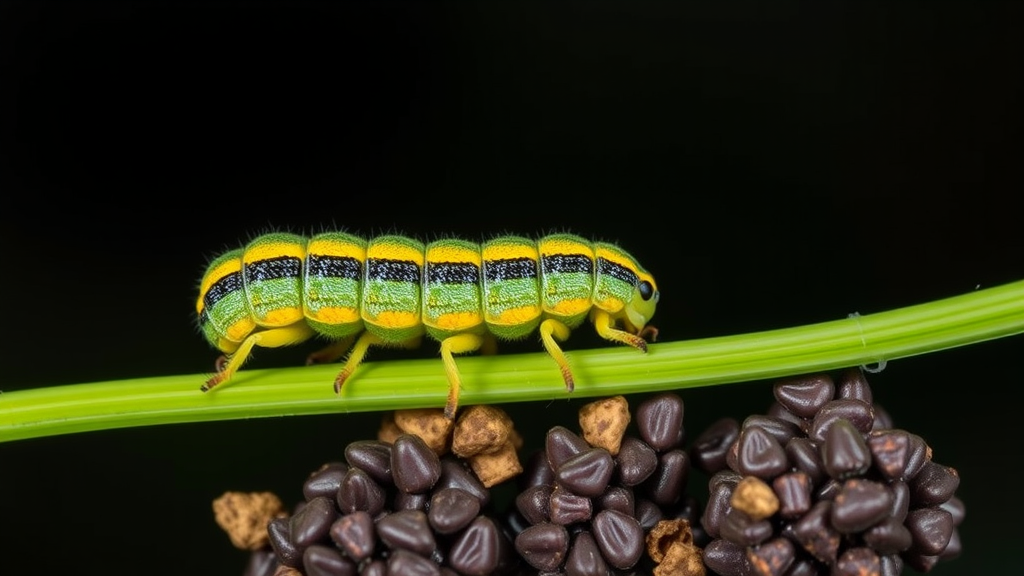
The fall armyworm, Spodoptera frugiperda, has earned its reputation as one of the most destructive invasive pests in modern agriculture. Since its spread beyond the Americas, the caterpillar has ravaged maize and other cereal crops across Africa and Asia, and growers have struggled to contain it with chemical insecticides, many of which the pest has already learned to shrug off. Against this backdrop, a team of Indian researchers has now reported a deceptively simple but potentially consequential finding: when combining two biological control agents against the armyworm, the order in which they are applied can determine whether the partnership works or fails.
The study, published in the journal Acta Parasitologica, was conducted by Akshay Majare, Nandkishore Lavhe, V. K. Biradar and Tini Pillai of the College of Agriculture in Nagpur, together with colleagues at the ICAR–Central Institute for Cotton Research and the ICAR–Central Potato Research Institute. The researchers set out to answer two questions that matter enormously for anyone designing integrated pest management programmes. First, how lethal are two species of entomopathogenic nematodes, Steinernema siamkayai and Heterorhabditis indica, against third-instar fall armyworm larvae? Second, are these nematodes compatible with two commercially important entomopathogenic fungi, Metarhizium anisopliae and Beauveria bassiana, and does the answer depend on whether the organisms are applied together or one after the other?
Entomopathogenic nematodes are microscopic roundworms that hunt insect larvae in the soil. Their infective juveniles, the free-living stage used in biocontrol, carry symbiotic bacteria in their guts. When a nematode enters an insect through natural openings such as the mouth, spiracles or anus, it releases these bacteria into the haemocoel, the insect’s open circulatory cavity. The bacteria multiply rapidly, killing the host within days through septicaemia and providing the nematodes with a nutrient-rich environment in which to reproduce. Entomopathogenic fungi attack by a different route: spores germinate on the insect’s cuticle, penetrate the body wall, and proliferate internally, eventually killing the host and sporulating on its corpse. Because the two agents exploit different infection pathways and different ecological niches, scientists have long suspected that combining them could deliver a one-two punch that neither achieves alone.
To test this, the team first measured the inherent virulence of each nematode species under controlled laboratory conditions. Third-instar fall armyworm larvae were exposed to a range of infective juvenile concentrations, from five to one hundred nematodes per larva, and mortality was recorded over ninety-six hours. The results were strikingly asymmetric. Steinernema siamkayai proved consistently and substantially more virulent than Heterorhabditis indica. At doses of thirty to forty infective juveniles per larva, S. siamkayai achieved complete mortality of the test larvae within ninety-six hours, whereas H. indica required the full one hundred juveniles per larva to reach the same endpoint. Probit analysis, a standard statistical technique for quantifying dose-response relationships in toxicology, confirmed the gap: the lethal concentration needed to kill half the larvae, the LC50, was just 5.47 infective juveniles per larva for S. siamkayai, compared with 15.14 for H. indica. The LC90 values told an even starker story, at 14.23 versus 83.52 infective juveniles per larva respectively. In practical terms, the Steinernema species needed roughly one-sixth the dose of its Heterorhabditis counterpart to achieve near-total kill.
With virulence baselines established, the researchers turned to the compatibility question. They paired each nematode with each fungus in three application regimes: simultaneous inoculation, nematode applied first followed by fungus, and fungus applied first followed by nematode. Larval mortality was recorded, and the interactions were classified using co-toxicity factor analysis, a method borrowed from pesticide combination studies that quantifies whether two agents act additively, synergistically or antagonistically when combined. The outcome hinged almost entirely on the nematode species involved. Simultaneous application of any nematode-fungus pair produced additive interactions across the board, meaning the combined mortality matched what would be expected from the sum of the individual effects, with no interference between the agents. The standout combination was S. siamkayai together with Metarhizium anisopliae, which killed 98.55 percent of larvae at ninety-six hours, the highest figure recorded in the laboratory phase of the study.
The picture changed, however, when the agents were applied sequentially. When Heterorhabditis indica was introduced after the fungi had already been applied, the interaction turned antagonistic: the combined mortality fell short of expectations, suggesting that the fungus, by establishing itself in or on the host first, somehow compromised the nematode’s ability to infect or complete its development. The authors did not identify the precise mechanism in this study, but the phenomenon is consistent with competition for the host resource. Both agents ultimately depend on the same larval cadaver for reproduction, and a fungus that has colonised a host first may leave insufficient resources, or an unsuitable internal environment, for the nematode’s symbiotic bacteria to flourish. Notably, Steinernema siamkayai was immune to this sequencing effect, maintaining additive compatibility with both fungi regardless of whether it was applied before or after them. This robustness marks it out as the more dependable partner in a combined biocontrol programme.
To check that the laboratory findings survived contact with more realistic conditions, the team validated the most promising combinations in pot experiments, with mortality and co-toxicity factors assessed at one hundred and twenty hours after treatment. Alone, S. siamkayai caused the highest larval mortality at 80.3 percent, followed by H. indica at 70.5 percent. Among the combined treatments, S. siamkayai plus M. anisopliae again led the field, achieving 71.5 percent mortality, and every nematode-fungus combination tested in pots registered additive interactions by co-toxicity analysis. The somewhat lower figures under pot conditions compared with the laboratory are unsurprising, since soil structure, moisture and other environmental variables inevitably dilute infection efficiency, but the qualitative conclusion held: simultaneous application preserves compatibility, and S. siamkayai is the more forgiving and more lethal of the two nematodes.
The significance of these results extends beyond a single pest. Fall armyworm management currently leans heavily on synthetic insecticides and Bt-transgenic crops, both of which face mounting resistance problems. Field populations of the pest have already shown multiple and cross-resistance to Bt toxins and organophosphates in some regions, and the caterpillar’s polyphagous habits, documented across dozens of host plant species in the Americas, make crop rotation alone an inadequate defence. Microbial biocontrol agents offer a complementary tool that is difficult for pests to circumvent, because the selection pressures they impose differ fundamentally from those of chemical toxins. Moreover, entomopathogenic nematodes and fungi are self-replicating, leave no toxic residues, and are compatible with many other components of integrated pest management, including certain insecticides, as earlier studies on their chemical compatibility have shown.
What this study adds is a practical rule of thumb for deploying such agents together. Compatibility between biocontrol agents is often assumed rather than tested, and the assumption can be costly. Prior research has documented both synergy and antagonism in nematode-fungus combinations against other pests, including black vine weevil, wireworms and scarab grubs, and the mechanisms underlying these interactions, from volatile organic compounds emitted by fungi that influence nematode foraging to direct competition for the host cadaver, remain an active area of investigation. By demonstrating that application sequence is a decisive variable for H. indica but not for S. siamkayai, the Indian team has given practitioners a concrete, testable guideline: if in doubt, apply simultaneously, and if a sequential schedule is unavoidable, choose the nematode species that tolerates it.
The authors identify S. siamkayai, particularly in combination with Metarhizium anisopliae, as a promising microbial strategy for the integrated management of fall armyworm. Field-scale trials will be needed to confirm that the additive interactions observed in the laboratory and in pots translate into meaningful yield protection in farmers’ fields, where UV radiation, desiccation and soil heterogeneity all challenge the survival of both agents. But the core message is already actionable. In the escalating contest between growers and one of the world’s most adaptable crop pests, the details of biological control matter, and something as mundane as the order of two spray applications may be the difference between a partnership that works and one that quietly undermines itself.
Subject of Research: Compatibility and virulence of entomopathogenic nematodes and fungi against the fall armyworm Spodoptera frugiperda
Article Title: Application Sequence Determines the Compatibility and Virulence of Entomopathogenic Nematodes and Entomopathogenic Fungi Against Spodoptera frugiperda
Article References: Majare, A., Lavhe, N., Biradar, V. K., Pillai, T., Deshmukh, V., Banu, G., Fand, B. B., Shah, V., Mhatre, P. H., & Thube, S. (2026). Application Sequence Determines the Compatibility and Virulence of Entomopathogenic Nematodes and Entomopathogenic Fungi Against Spodoptera frugiperda. Acta Parasitologica, 71(5), Article 220. https://doi.org/10.1007/s11686-026-01406-x
Image Credits: AI Generated
DOI: 10.1007/s11686-026-01406-x
Keywords: fall armyworm, Spodoptera frugiperda, entomopathogenic nematodes, entomopathogenic fungi, Steinernema siamkayai, Heterorhabditis indica, Metarhizium anisopliae, Beauveria bassiana, biological control, application sequence, co-toxicity factor, integrated pest management
Cite Scienmag News
Alan Morgan. (September 20, 2026). Order of Attack: How Nematode and Fungal Timing Decides Fall Armyworm’s Fate. Scienmag. https://scienmag.com/order-of-attack-how-nematode-and-fungal-timing-decides-fall-armyworms-fate/
Alan Morgan. "Order of Attack: How Nematode and Fungal Timing Decides Fall Armyworm’s Fate." Scienmag, 20 September 2026, https://scienmag.com/order-of-attack-how-nematode-and-fungal-timing-decides-fall-armyworms-fate/. Accessed 5 October 2026.
Alan Morgan. "Order of Attack: How Nematode and Fungal Timing Decides Fall Armyworm’s Fate." Scienmag. September 20, 2026. https://scienmag.com/order-of-attack-how-nematode-and-fungal-timing-decides-fall-armyworms-fate/


