


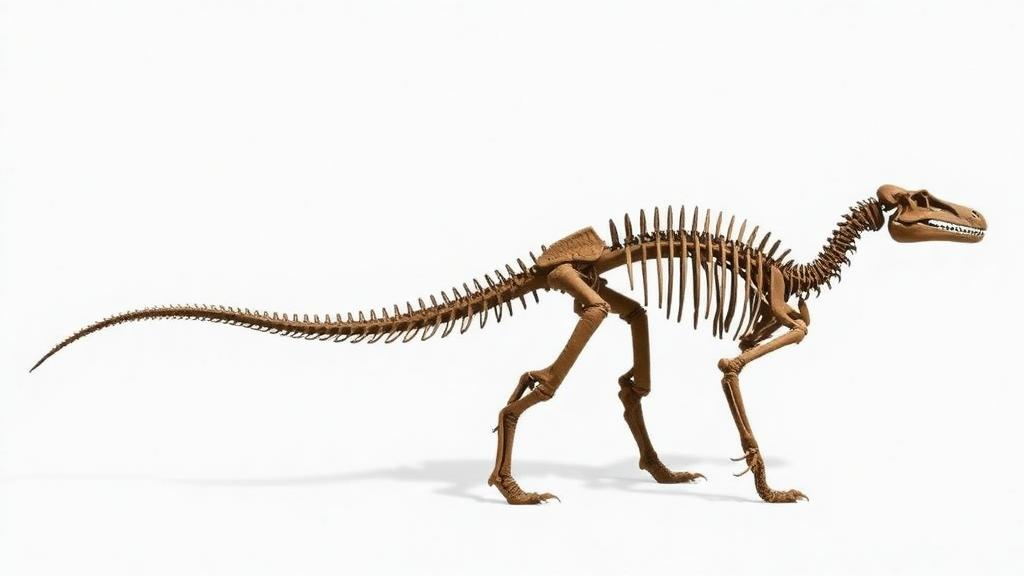
Palaeontologists working in eastern Spain have identified the first confirmed evidence of Diplodocus, one of the most iconic dinosaurs ever discovered, outside North America. The find, announced by researchers from the Fundación Conjunto Paleontológico de Teruel-Dinópolis and published in the peer-reviewed Journal of Vertebrate Paleontology, fundamentally challenges long-held assumptions about the geographic distribution of giant sauropod dinosaurs during the Late Jurassic period. For nearly a century and a half, every confirmed Diplodocus specimen had come exclusively from the Morrison Formation, a vast band of Late Jurassic sedimentary rock that stretches across the western United States. The Spanish fossils now rewrite that story, placing this celebrated long-necked giant firmly on the European side of what was then a narrowing proto-Atlantic Ocean.
The fossil material was unearthed at the La Tejería site in El Castellar, in the province of Teruel, an region that has become one of Europe’s most productive windows into Mesozoic life. Over the course of careful excavation, the team recovered fourteen exceptionally preserved caudal vertebrae, the bones of the dinosaur’s tail, along with several chevron bones, the small paired elements that hang beneath the tail vertebrae and help protect blood vessels and support musculature. Although skull material and limb bones were not part of the recovered assemblage, the quality and diagnostic character of the tail bones proved sufficient for the researchers to make a confident identification at the genus level, something rarely achievable with fragmentary sauropod remains.
Sergio Sánchez Fenollosa, a PhD student in biodiversity and evolutionary biology at Fundación Dinópolis and lead author of the study, described the slow accumulation of evidence that led the team to their conclusion. From the earliest stages of the osteological study, he explained, the researchers noticed strong similarities between the Spanish bones and several diplodocine sauropods. As the anatomical work progressed, they began to identify a combination of features characteristic of Diplodocus species, and subsequent evolutionary analyses repeatedly pointed in the same direction. With each new result, he said, the picture became clearer: the team was looking at a Diplodocus. He added that the outcome of the dig represents some of the strongest palaeontological evidence yet found for episodes of dispersal and faunal exchange between North America and Europe across the proto-Atlantic Ocean during the Late Jurassic, and that the discovery allows a better understanding of Iberian Mesozoic ecosystems and the diversity of sauropod dinosaurs that inhabited the European Jurassic.
The identification rested on a suite of distinctive anatomical features preserved in the vertebrae and chevrons. The tail bones display large pneumatic cavities, air-filled spaces that lightened the skeleton in these colossal animals, a hallmark of many sauropod lineages but expressed in a particularly characteristic form in Diplodocus. The underside of the tail vertebrae bears deep longitudinal grooves, and the chevron bones are distinctly forked, with unique medial fossae, depressions on their inner surfaces, that match the condition seen in North American Diplodocus material. The vertebral centra, the main cylindrical bodies of the vertebrae, are elongated and lack the lateral ridges found in many related diplodocids. Taken together, this combination of traits distinguished the Spanish specimen from other European diplodocids and aligned it with the Diplodocus lineage.
To test the anatomical assessment rigorously, the research team combined traditional comparative anatomy with advanced phylogenetic analyses, employing both maximum parsimony and Bayesian inference methods. These computational approaches evaluate how anatomical characters are distributed across known taxa to reconstruct evolutionary relationships. In both analytical frameworks, the Spanish specimen was confidently placed within the genus Diplodocus, and more specifically as a close relative of Diplodocus hallorum, one of the largest and longest species within the genus. The convergence of anatomical and statistical evidence is what gives the identification its strength, since isolated tail vertebrae can be notoriously difficult to assign to a precise genus among the many similar diplodocid sauropods known from the Late Jurassic.
The Spanish Diplodocus dates to approximately 150 million years ago, near the end of the Jurassic Period, a time that corresponds closely with the age of the Morrison Formation faunas in North America. Its presence in Europe provides compelling evidence that dinosaurs could migrate between the two landmasses during the Late Jurassic. The most likely mechanism, according to the researchers, involved temporary land bridges that emerged as the proto-North Atlantic Ocean underwent regressive phases, periods in which sea levels fell and exposed connections between now-separated continental areas. Such episodic corridors would have allowed herds of giant herbivores, and presumably the predators and smaller animals that followed them, to move between North America and Europe, explaining how a genus once thought to be endemic to the American West could appear on the Iberian Peninsula.
Co-author Dr Alberto Cobos, managing director of Fundación Dinópolis, emphasized the sheer scale of the animal. The Diplodocus from El Castellar was approximately 25 meters long, comparable in size to its North American relatives, making it another of the giant sauropods of the Spanish Jurassic. He noted that it joins other enormous sauropod dinosaurs from Teruel with very different characteristics from those of diplodocids, such as Turiasaurus and Losillasaurus, among others. The fossils of all these dinosaurs, including those of the new Diplodocus specimen, he said, make Teruel a reference place for understanding this great diversity. The coexistence of a diplodocid giant alongside turiasaurian sauropods of entirely different build suggests that Late Jurassic Iberian ecosystems supported multiple niches for gigantic herbivores, perhaps with the different lineages specializing in different vegetation or feeding heights.
The broader fossil record of the region reinforces that picture of ecological richness. The area where the specimen was found has yielded numerous dinosaur fossils representing sauropods, theropods, stegosaurs, and ornithopods, indicating that these ancient coastal environments supported complex and diverse ecosystems. During the Late Jurassic, eastern Iberia lay along the margins of the expanding Atlantic, with shallow seas, coastal plains, and floodplains that periodically preserved the remains of the animals that roamed them. The addition of Diplodocus to this faunal list strengthens the resemblance between Iberian and North American Late Jurassic assemblages, supporting the idea of a broadly shared dinosaur fauna across the two regions rather than isolated provincial communities.
Diplodocus itself occupies a special place in the history of palaeontology and popular culture. First discovered in the United States in 1878, the genus is famous for its enormous length of up to 25 meters, its long whip-like tail, and its relatively small head perched at the end of a gracefully curved neck. Throughout the early twentieth century, casts of Diplodocus skeletons were displayed in leading natural history museums around the world, making the animal a symbol of global palaeontology and a beloved icon of prehistoric life. Its frequent appearances in exhibitions, books, and audiovisual productions about dinosaurs have made it one of the best-known of all the so-called terrible lizards among the general public, which is precisely why the confirmation of its presence in Europe carries such resonance both scientifically and culturally.
The fossils themselves are now on display for future research and public education in the dinosaur hall of the Museo Aragonés de Paleontología at Dinópolis in Teruel, a city in eastern Spain situated roughly between Madrid and Valencia. There, visitors can see the tangible evidence of an animal that lived 150 million years ago on a planet whose geography differed profoundly from today’s, when the Atlantic was still young and narrow and continents remained within reach of wandering giants. For palaeontologists, the specimen opens new questions about how many other supposedly North American dinosaur lineages may await discovery in European rocks, and about the frequency and duration of the dispersal events that connected the faunas of two continents. For the moment, the tail bones from La Tejería stand as the first physical proof that Diplodocus, the archetypal giant of the American Jurassic, also called Europe home.
Subject of Research: First discovery of the sauropod dinosaur genus Diplodocus outside North America, from Late Jurassic deposits in Teruel, Spain
Article Title: First ever find of a Diplodocus outside of North America
Article References: First ever find of a Diplodocus outside of North America. (n.d.). Original publication
Image Credits: AI Generated
DOI: Not provided
Keywords: Diplodocus, sauropod, Late Jurassic, Teruel, Spain, paleontology, Morrison Formation, faunal dispersal, proto-Atlantic, vertebrate paleontology, dinosaurs, Iberia
Cite Scienmag News
Violet Maxwell. (October 5, 2026). First Diplodocus Ever Found Outside North America Unearthed in Spain. Scienmag. https://scienmag.com/first-diplodocus-ever-found-outside-north-america-unearthed-in-spain/
Violet Maxwell. "First Diplodocus Ever Found Outside North America Unearthed in Spain." Scienmag, 5 October 2026, https://scienmag.com/first-diplodocus-ever-found-outside-north-america-unearthed-in-spain/. Accessed 5 October 2026.
Violet Maxwell. "First Diplodocus Ever Found Outside North America Unearthed in Spain." Scienmag. October 5, 2026. https://scienmag.com/first-diplodocus-ever-found-outside-north-america-unearthed-in-spain/


