


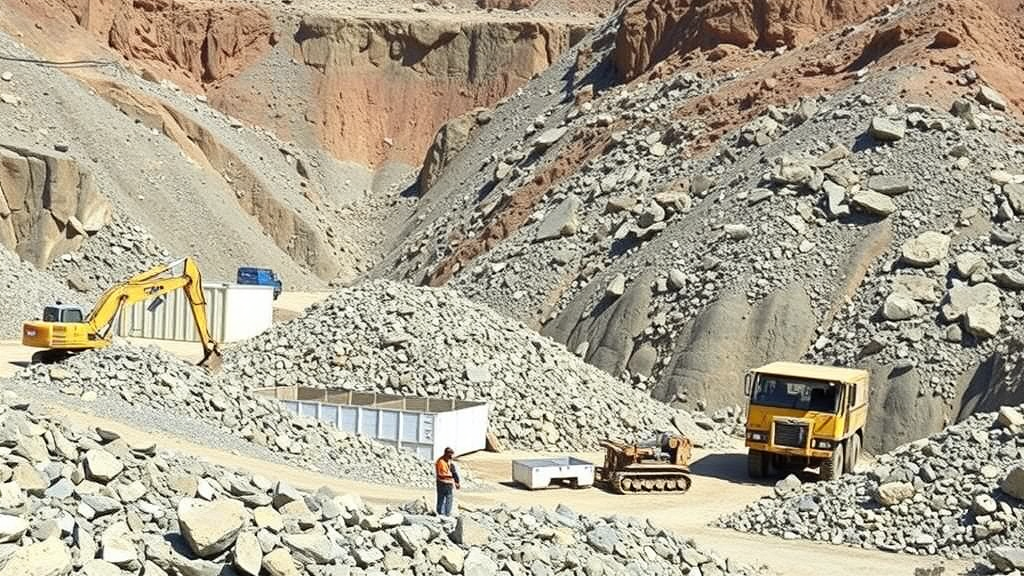
Beneath the dusty benches of the granite quarries that dot the Mandya district of Karnataka, southern India, a quiet stream of invisible radiation is constantly at work. Every rock, every handful of soil, every gravel pile contains trace amounts of naturally occurring radionuclides — primordial isotopes such as radium-226, thorium-232 and potassium-40 that have existed since the Earth formed. Because quarry-derived materials end up in buildings, roads and homes, understanding exactly how much radioactivity these stones carry has a direct bearing on public health. A new study of 21 quarry sites in Mandya district has now delivered one of the most detailed assessments to date of natural radioactivity in the region’s soil, and its verdict is reassuring: the gamma dose rates and derived hazard indices all fall comfortably within internationally accepted safety limits.
The research, published in the journal Environmental Geochemistry and Health, was conducted by a team from PES College of Engineering in Mandya, ATME College of Engineering in Mysuru and Visvesvaraya Technological University in Belagavi. The researchers collected soil samples from twenty-one quarry sites scattered across the district, a region whose geology is dominated by granitic terrain. Granite is chemically notorious among radiation scientists: it tends to be enriched in the minerals that carry uranium-series and thorium-series isotopes as well as potassium-40, so soils weathered from granitic bedrock typically register activity concentrations well above the global averages for ordinary soils. This geological signature is precisely what the team’s measurements captured.
Quantifying trace radioactivity requires a sensitive analytical instrument, and the study relied on high-purity germanium (HPGe) gamma-ray spectrometry, the workhorse technique of environmental radiometry. HPGe detectors, when cryogenically cooled, resolve the characteristic gamma-ray energies emitted by each decay chain with exquisite precision, allowing researchers to identify individual radionuclides within a mixed sample. By measuring the intensity of gamma lines characteristic of radium-226, thorium-232 and potassium-40, the team computed the activity concentrations of each isotope in becquerels per kilogram — a measure of how many atomic disintegrations occur per second in each kilogram of soil. The mean values they reported were 39.5 Bq/kg for radium-226, 81.5 Bq/kg for thorium-232 and 656 Bq/kg for potassium-40, confirming the influence of the granitic geology, particularly the elevated thorium and potassium content.
These individual numbers become far more informative when combined into composite indices that radiation protection agencies have designed to summarise risk. The researchers calculated the radium equivalent activity, Ra_eq, which weights the three radionuclides according to their respective gamma contributions; it averaged 206.5 Bq/kg, below the widely used ceiling of 370 Bq/kg associated with a dose of 1 mSv per year. They also computed the gamma radiation representative index (Iγr), the external hazard index (Hex) and the internal hazard index (Hin), which came out at averages of 1.52, 0.56 and 0.66 respectively. The two hazard indices both sit below unity, the conventional threshold indicating that the materials would pose no unacceptable radiological risk if used in construction, either outdoors where exposure is external or indoors where radon inhalation and gamma irradiation combine.
The ratios between the three radionuclides tell their own geological story. The team reported average activity concentration ratios of 2.05 for thorium-232 to radium-226, 16.65 for potassium-40 to radium-226 and 8.15 for potassium-40 to thorium-232. A thorium-to-radium ratio above two is characteristic of soils derived from rocks in which thorium-bearing minerals such as monazite accumulate preferentially, a hallmark of many Indian granitic terrains. Such ratios serve as fingerprints that connect surface soil measurements to the deeper petrology of the region, and they help distinguish natural geological enrichment from any anthropogenic contamination, which was not indicated at these sites.
Laboratory spectrometry alone does not capture the full radiological picture, because real-world exposure happens in situ, under open skies and variable conditions. To complement the sample analysis, the team deployed a calibrated ER-709 portable dosimeter at the quarry locations to measure ambient gamma radiation directly. The instrument recorded an average absorbed gamma dose rate of 89.06 nanogray per hour. Converting this absorbed dose into a quantity that health physicists can compare against international exposure standards yields an annual effective dose of approximately 0.11 millisieverts per year — a figure far below the roughly 2.4 millisieverts per year that every human being receives on average from all natural sources, including cosmic rays, food and inhaled radon.
From the dose measurements the researchers extrapolated two widely used risk metrics. The excess lifetime cancer risk, a statistical estimate of the additional lifetime cancer probability attributable to the measured exposure, averaged 0.38 × 10⁻³, meaning an additional cancer risk of roughly one in twenty-six hundred — within the range that international bodies such as the World Health Organization and the International Commission on Radiological Protection consider acceptable for natural background exposure. The team also estimated an annual gonadal dose equivalent of 671.22 microsieverts per year, a quantity relevant to hereditary effects because gonadal tissues are among the most radiation-sensitive in the body. Again, this value remained within the range documented for ordinary terrestrial environments worldwide and did not approach levels of concern.
The findings carry practical significance beyond academic interest. India’s construction industry consumes enormous quantities of crushed granite aggregate, dimension stone and quarry dust, and regulators must decide whether quarry-derived materials can be used safely in dwellings, schools and infrastructure. The study’s hazard indices below unity provide direct evidence that, for the sites examined in Mandya district, these materials do not exceed radiological constraints for building use. Equally important, the work establishes a baseline: because natural radioactivity varies with geology, long-term monitoring programmes need reference data to detect future changes, whether caused by new excavation, land-use shifts or industrial inputs. The authors emphasise that the dataset provides exactly such a foundation for future soil radioactivity monitoring and radiological assessments in the region.
The Mandya results also sit within a growing body of Indian and international literature on naturally occurring radioactive materials. Comparable surveys of granite quarries in the Bangalore rural district of Karnataka, of soils in neighbouring districts and of quarry sites in states such as Tamil Nadu, Punjab and Kerala have documented similar patterns of granitic enrichment, with regional variations driven by local mineralogy. Globally, studies from Egypt, Turkey, Brazil, Bangladesh, Nigeria and China have applied the same battery of indices — Ra_eq, Hex, Hin, Iγr and excess lifetime cancer risk — to quarry soils, building stones and beach sands, creating a common framework for comparing radiological safety across continents. Against that backdrop, Mandya’s quarry soils emerge as geologically distinctive but radiologically unremarkable.
For the workers and residents of Mandya district, the practical message of the study is one of reassurance grounded in careful measurement rather than assumption. Natural radioactivity is inescapable — it emanates from the bedrock beneath our feet, the minerals in our building materials and even the potassium in our own cells — and the relevant question is always whether local levels exceed the thresholds that decades of radiobiological research have established. In this corner of southern India, where ancient granites meet one of the world’s busiest quarrying economies, the answer is a measured no. The radiation written into the stone is real, quantifiable and now well documented, but it remains a modest contributor to the background radiation that all life on Earth has always lived with.
Subject of Research: Assessment of natural radioactivity from radium-226, thorium-232 and potassium-40 in quarry soils of Mandya district, Karnataka, India
Article Title: Assessment of 226Ra, 232Th and 40K in soil with gamma dose rates from quarries of the Mandya district, Karnataka, India
Article References: Nagaraju, R. M., Siddaiah, S. T., Dudda, C., Halligudra, G., & Jayaram, A. K. (2026). Assessment of 226Ra, 232Th and 40K in soil with gamma dose rates from quarries of the Mandya district, Karnataka, India. Environmental Geochemistry and Health, 48(15), Article 598. https://doi.org/10.1007/s10653-026-03470-8
Image Credits: AI Generated
DOI: 10.1007/s10653-026-03470-8
Keywords: natural radioactivity, radium-226, thorium-232, potassium-40, gamma-ray spectrometry, HPGe detector, quarry soils, granite, radiation dose, radiological hazard assessment, Karnataka, environmental radioactivity
Cite Scienmag News
Sloane Callahan. (September 20, 2026). Granite Quarries in Southern India Show Radiation Well Within Safety Limits. Scienmag. https://scienmag.com/granite-quarries-in-southern-india-show-radiation-well-within-safety-limits/
Sloane Callahan. "Granite Quarries in Southern India Show Radiation Well Within Safety Limits." Scienmag, 20 September 2026, https://scienmag.com/granite-quarries-in-southern-india-show-radiation-well-within-safety-limits/. Accessed 4 October 2026.
Sloane Callahan. "Granite Quarries in Southern India Show Radiation Well Within Safety Limits." Scienmag. September 20, 2026. https://scienmag.com/granite-quarries-in-southern-india-show-radiation-well-within-safety-limits/


