


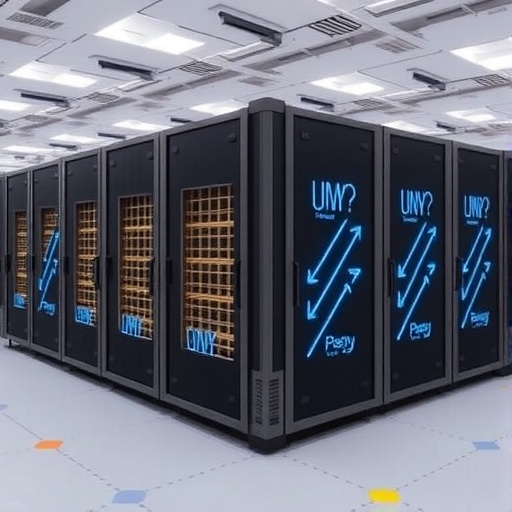
Japan has switched on its first full-stack neutral-atom quantum computer, opening a new chapter in the country’s race to build practical quantum machines. Named “Shunkai,” the system was developed by a research team led by Kenji Ohmori at the Institute for Molecular Science, part of Japan’s National Institutes of Natural Sciences. Unlike a laboratory device designed to demonstrate a single quantum operation, Shunkai brings together the hardware, control electronics, software, measurement systems and user interfaces required to run complete quantum programs. Its launch marks a significant step toward making neutral-atom processors available for research beyond the group that built them.
Quantum computers promise to solve certain problems that would overwhelm conventional machines, but today’s systems remain limited by noise, restricted connectivity and the difficulty of scaling up the number of usable quantum bits. The basic unit of quantum information, the qubit, can occupy a superposition of zero and one until it is measured. Qubits can also become entangled, creating correlations that have no classical equivalent and that underpin many quantum algorithms. In practice, however, quantum states are fragile. Imperfect control pulses, unwanted interactions with the environment and errors in measurement can quickly destroy the information a computation is meant to preserve. Building a useful machine therefore requires not only more qubits, but also exceptionally precise control and sophisticated methods for detecting and correcting errors.
Neutral-atom quantum computing has emerged as one of the most closely watched approaches to these challenges. In Shunkai, individual atoms serve as qubits and are held in place by optical tweezers: tightly focused laser beams that create microscopic traps near their focal points. Because the atoms are electrically neutral, they do not need to be embedded in a solid-state circuit or cooled to extremely low temperatures to remain trapped. The system can therefore operate at room temperature in its surrounding laboratory environment, avoiding the large refrigerators required by many superconducting quantum computers. The atoms themselves are cooled and controlled using specialized laser systems, but the computing platform does not depend on a dilution refrigerator surrounding the processor.
The architecture also offers a flexible way to create interactions between qubits. A neutral atom can encode information in two long-lived internal states, while laser or microwave pulses drive transitions between those states. To produce entanglement, selected atoms can be promoted to highly excited Rydberg states. In this state, an atom’s effective size and interaction strength increase dramatically, allowing nearby atoms to influence one another. This interaction can be used to implement quantum gates, the basic operations from which quantum algorithms are constructed. Since the atoms are held in movable optical traps, the processor can rearrange them during a calculation, bringing chosen qubits together and separating them afterward. That ability to dynamically alter the geometry of the array could provide a powerful alternative to the fixed wiring used in many other quantum architectures.
Shunkai’s “full-stack” design is central to its significance. At the lowest level, the optical system captures and moves the atoms while microwave and laser fields perform quantum operations. Cameras collect the fluorescence emitted by individual atoms after measurement, allowing the system to determine whether each qubit has ended in one state or another. Above this physical layer are the timing controls, calibration routines, data-processing tools and software that translate a user’s quantum circuit into the precise sequence of signals required by the processor. By integrating these layers, the project aims to address a problem that often receives less attention than the qubit count: the gap between a promising experimental device and a machine that outside researchers can actually program, test and compare.
The Ohmori team developed Shunkai through an industry-academic collaboration involving Hitachi, which contributed to the software stack, and Infleqtion, which contributed to the quantum processing unit stack. The system is expected to begin with approximately 50 qubits and later expand to about 500. Those numbers should not be compared directly with the headline qubit counts of every competing platform, because the usefulness of a quantum computer depends on factors including coherence time, gate fidelity, connectivity, measurement accuracy and the ability to correct errors. A smaller processor with reliable operations can be more valuable for research than a much larger device whose qubits are too noisy to support meaningful calculations. Shunkai will be partially opened to external users, allowing theorists, software developers and companies to explore algorithms, investigate error-correction strategies and evaluate potential applications.
The name Shunkai refers to Harumi Shibukawa, an Edo-period astronomer whose given name can also be pronounced “Shunkai.” Shibukawa established Japan’s first original calendar system through precise astronomical calculations. The project connects that historical achievement with the modern control of quantum states on the Bloch sphere, a geometric representation used by physicists to describe the state of a qubit. The analogy is more than symbolic: both the traditional calendar and a quantum processor depend on extracting reliable predictions from highly precise measurements and carefully controlled mathematical models. By choosing the name, the researchers are linking Japan’s early scientific independence with its effort to develop a homegrown quantum-computing capability.
The immediate scientific challenge is to determine how far the machine can be pushed before noise overwhelms the computation. Quantum error correction addresses this problem by distributing one logical qubit across many physical qubits and using carefully designed measurements to identify error syndromes without directly destroying the encoded quantum information. The process does not eliminate errors in individual atoms; instead, it detects patterns that reveal when a bit-flip, phase-flip or related fault has occurred, allowing the logical state to be repaired. Neutral-atom arrays are attractive for this task because atoms can be rearranged, redundant structures can be configured for different algorithms and additional qubits can potentially be added without redesigning a rigid chip. Demonstrating reliable error detection and, ultimately, error correction will be a decisive test of whether the platform can progress from experimental calculations to fault-tolerant computation.
The project’s longer-term plan is tied to the second stage of the Ohmori Moonshot Project, focused on a neutral-atom fault-tolerant quantum computer. By March 2031, the team aims to develop a system containing 10,000 physical qubits, with quantum error-detection and correction capabilities and access for external users. Reaching that goal will require advances across the entire machine, including laser stability, atom loading, motion control, gate fidelity, real-time feedback, imaging and software orchestration. The researchers also envision integrating Shunkai with the shared supercomputer facility at the Institute for Molecular Science to create a quantum-classical or quantum-GPU hybrid center. Such a facility would allow conventional processors to handle tasks that remain inefficient for quantum hardware while quantum processors are reserved for carefully selected subproblems.
For Japan, the activation of Shunkai represents more than the arrival of another experimental quantum processor. It establishes a national platform on which researchers can test algorithms, develop control software and study the engineering requirements of large-scale neutral-atom systems. For the global quantum community, its most important contribution may be practical: a processor that connects atomic physics with the software and user infrastructure needed for real experimentation. Neutral atoms will still have to prove that they can deliver sufficiently low error rates, stable operation and economically scalable hardware. Yet by putting a complete system into operation and preparing it for outside users, the Ohmori team is turning a rapidly advancing laboratory technology into a platform that can be challenged, improved and potentially transformed into a new route toward fault-tolerant quantum computing.
News Publication Date: August 24
References: Institute for Molecular Science, National Institutes of Natural Sciences; Cabinet Office/JST Moonshot Research and Development Program; MEXT Quantum Leap Flagship Program.
Cite Scienmag News
Katie Riggs. (August 24, 2026). Japan’s First Full-Stack Neutral-Atom Quantum Computer, Shunkai, Begins Operations. Scienmag. https://scienmag.com/japans-first-full-stack-neutral-atom-quantum-computer-shunkai-begins-operations/
Katie Riggs. "Japan’s First Full-Stack Neutral-Atom Quantum Computer, Shunkai, Begins Operations." Scienmag, 24 August 2026, https://scienmag.com/japans-first-full-stack-neutral-atom-quantum-computer-shunkai-begins-operations/. Accessed 4 September 2026.
Katie Riggs. "Japan’s First Full-Stack Neutral-Atom Quantum Computer, Shunkai, Begins Operations." Scienmag. August 24, 2026. https://scienmag.com/japans-first-full-stack-neutral-atom-quantum-computer-shunkai-begins-operations/


