


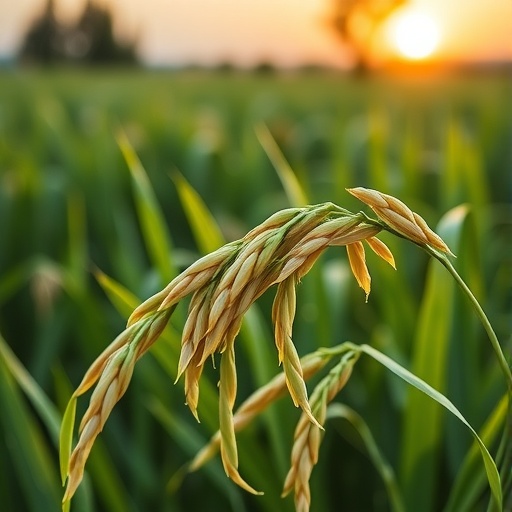
Rice farmers may soon have a new tool for improving both harvests and the quality of the grain on the plate. A field study conducted in China reports that foliar applications of zinc oxide nanoparticles helped direct-seeded rice produce more grain, accumulate more zinc in polished rice and develop characteristics associated with better cooking and eating quality. The findings, published in Model Organisms Research, suggest that nanoscale zinc may influence rice development in ways that conventional zinc fertilisers do not. The researchers describe the treatment as a possible non-genetically modified strategy for addressing several challenges at once: increasing productivity, improving nutritional value and reducing undesirable grain traits such as excessive chalkiness.
The work focuses on direct-seeded rice, a production system gaining popularity because it can reduce the labour and water demands of transplanting seedlings. Instead of raising young plants in a nursery and moving them into flooded fields, farmers sow seeds directly into the soil. The approach can be more efficient, but it also changes the plant’s early growth environment and may affect nutrient acquisition, panicle formation, grain filling and starch deposition. These changes can create a difficult trade-off: practices that save resources do not always deliver the same yield or grain quality as conventional cultivation. To investigate whether zinc nutrition could help close that gap, the researchers compared foliar zinc oxide nanoparticles with zinc sulphate, a widely used conventional zinc fertiliser, across two field trials.
The nanoparticle treatment produced measurable improvements in several agronomic and nutritional indicators. According to the study, zinc concentration in polished rice increased by 25.6% compared with untreated plants. The number of spikelets per panicle rose by 12.4%, while 1000-grain weight increased by 4.8%. Spikelets are the small flowering structures that can develop into grains, so a higher number per panicle can increase the crop’s yield potential when grain formation and filling are successful. The increase in 1000-grain weight indicates that the treatment also supported the accumulation of dry matter in individual grains. Together, these changes point to an effect extending beyond simple zinc enrichment: the treated plants appeared to form more reproductive units and fill their grains more effectively.
The researchers also observed changes that could influence how rice cooks and tastes. Treated grains contained less amylose and showed reduced chalkiness compared with untreated rice. Amylose is one of the two main components of rice starch, alongside amylopectin, and its proportion affects water absorption, firmness, stickiness and texture after cooking. Chalkiness refers to opaque, floury regions inside a grain, which can develop when starch granules are packed less densely during grain filling. Highly chalky rice is often more fragile during milling and may have less desirable cooking qualities. By lowering amylose content and chalkiness, the zinc oxide nanoparticle treatment appeared to shift the physical properties of the grain toward characteristics that many consumers associate with improved palatability.
The results became more intriguing when the team examined the physiological and molecular responses inside developing grains. Rather than acting only as a source of zinc, the nanoparticles were associated with changes in antioxidant activity, plant hormone balance and starch metabolism. The study reports higher levels of zeatin and gibberellin A3, two hormones involved in growth and development. Zeatin belongs to the cytokinin family, which can promote cell division and delay aspects of tissue ageing, while gibberellins regulate processes including stem growth, reproductive development and grain formation. The researchers also detected increased activity of antioxidant enzymes and lower oxidative damage, suggesting that the treatment helped plants manage reactive oxygen species generated during development and under field stress.
At the gene-expression level, the treatment was linked to what the researchers describe as transcriptional rewiring of pathways controlling starch and hormones. Two genes, OsAmy1C and OsRAmy1A, were activated. These genes encode amylase enzymes, which participate in the breakdown and remodelling of starch. Starch metabolism during grain development is tightly controlled: carbohydrates produced in leaves must be transported to the developing grain, converted into storage compounds and organised within the endosperm. Small changes in the timing or intensity of these processes can alter grain weight, starch structure and cooking behaviour. At the same time, the nanoparticle treatment suppressed OsCKX2, a gene involved in cytokinin breakdown. Reduced activity of this gene could help maintain higher cytokinin levels, providing a possible molecular link between the treatment, hormone balance and grain development.
The comparison with zinc sulphate is central to the study’s interpretation. Both treatments supply zinc, an essential micronutrient required for enzyme function, membrane stability, gene regulation and plant growth. However, zinc oxide nanoparticles may differ from dissolved zinc salts in their movement across leaf surfaces, interaction with plant tissues and release of zinc ions. Their small size gives them a high surface-area-to-volume ratio, potentially affecting how they adhere to leaves, enter tissues or influence local chemical conditions. The findings suggest that the nanoparticle formulation triggered responses that were not reproduced by conventional zinc treatment. The researchers therefore argue that the material may function not merely as a fertiliser, but as a regulator of developmental processes. That conclusion remains mechanistic rather than definitive, because the precise route by which the particles or released zinc altered hormone and gene activity still requires further investigation.
The prospect of using engineered nanoparticles in food production is likely to attract attention because it combines a promising agricultural application with important safety questions. Zinc is nutritionally valuable, and increasing its concentration in polished rice could contribute to biofortification, particularly in populations where diets rely heavily on rice and provide limited zinc from other sources. Yet nanoparticle behaviour in agricultural systems is complex. Particles may interact with soil minerals, irrigation water, beneficial microorganisms and surrounding plants, while repeated application could influence their accumulation or transport through ecosystems. The amount applied, particle size, coating, timing and environmental conditions may all affect plant uptake and persistence. The researchers emphasise that long-term field performance and environmental safety must be assessed before the approach can be considered ready for broad agricultural use.
For now, the study offers a molecularly informed explanation for how foliar zinc oxide nanoparticles might help direct-seeded rice escape the usual yield-quality compromise. By combining field measurements with physiological and transcriptomic analyses, the researchers connect larger panicles and heavier grains with hormone signalling, antioxidant protection and starch remodelling during grain development. The results do not establish that nanoparticle fertilisation will work equally well across rice varieties, climates or farming systems, nor do they resolve questions about food safety and ecological exposure. They do, however, identify a potentially powerful route for precision crop management—one that could increase grain zinc, improve harvest performance and reshape eating quality without altering the rice genome. Further multi-season trials will determine whether this laboratory-supported promise can withstand the complexity of real-world farming.
Web References: https://doi.org/10.1016/j.mores.2026.100007
References: Shiquan Bian and colleagues, Model Organisms Research, DOI: 10.1016/j.mores.2026.100007
Cite Scienmag News
Alan Morgan. (August 24, 2026). Nanoparticles help rice increase yields without sacrificing grain quality. Scienmag. https://scienmag.com/nanoparticles-help-rice-increase-yields-without-sacrificing-grain-quality/
Alan Morgan. "Nanoparticles help rice increase yields without sacrificing grain quality." Scienmag, 24 August 2026, https://scienmag.com/nanoparticles-help-rice-increase-yields-without-sacrificing-grain-quality/. Accessed 3 September 2026.
Alan Morgan. "Nanoparticles help rice increase yields without sacrificing grain quality." Scienmag. August 24, 2026. https://scienmag.com/nanoparticles-help-rice-increase-yields-without-sacrificing-grain-quality/


