


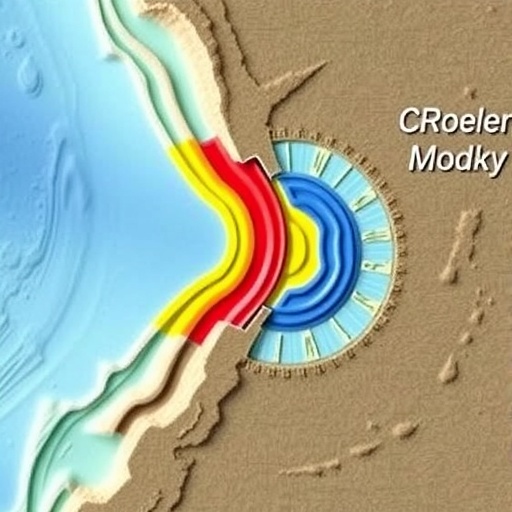
Earthquakes along oceanic transform faults have long been treated as relatively straightforward events: two sections of seafloor slide horizontally past one another, releasing accumulated tectonic stress when friction can no longer hold the boundary locked. A new study, however, suggests that these fault systems are far more mechanically diverse than their simple geometry implies. By examining how earthquake focal mechanisms vary along oceanic transform faults, F. Tan, W. Fan, P. M. Shearer and colleagues have revealed clues to the physical controls that divide these immense underwater structures into distinct segments. Their findings offer a sharper view of how earthquakes begin, propagate and stop in one of Earth’s most inaccessible environments.
Oceanic transform faults form where spreading centers are offset across the seafloor. At mid-ocean ridges, molten material rises and solidifies to create new crust, but the ridge is rarely a perfectly continuous line. Instead, it is broken into sections that are connected by transform faults. Along the active portions of these faults, newly formed oceanic crust moves laterally in opposite directions. The resulting earthquakes are commonly described as strike-slip events, meaning that the dominant motion occurs horizontally. Yet real fault zones are not smooth, uniform cracks. They contain bends, step-overs, ridges, fracture zones and changes in rock composition that can alter the distribution of stress and influence the direction and style of rupture.
The researchers focused on focal mechanisms, a seismological tool that describes the orientation of an earthquake’s fault plane and the direction in which the two sides moved. A focal mechanism is derived from the first motions and waveforms recorded by seismometers. Because seismic waves radiate differently depending on the geometry and slip direction of a rupture, scientists can use these signals to reconstruct the earthquake’s “beach ball” pattern, a graphical representation of compression and extension around the source. For an idealized transform fault, focal mechanisms would be expected to show a consistent strike-slip signature aligned with the fault. Variations from that pattern can reveal where local stresses, geometry or material properties are modifying the fault’s behavior.
In the new analysis, these variations become more than statistical noise. They provide a map of the mechanical environment along the fault. Earthquakes occurring on different segments may experience different levels of normal stress, shear stress and frictional resistance. Fault bends can rotate the direction of maximum compression, while intersections with inactive fracture zones may change how stress is transferred through the crust. Nearby volcanic structures and the contrast between hot, newly formed crust and older, cooler lithosphere can also affect the strength and elasticity of the surrounding rocks. Together, these factors may cause earthquakes only a short distance apart to display noticeably different focal mechanisms.
That result matters because segmentation is one of the central organizing principles of earthquake science. A fault segment can behave as a semi-independent unit, accumulating stress and rupturing on its own, or it can become linked to neighboring segments during a larger event. The boundaries between segments may therefore act as barriers that stop rupture, or as gateways that allow it to continue. On oceanic transform faults, where earthquakes occur beneath kilometers of water and instruments are relatively sparse, identifying such boundaries is especially difficult. Focal mechanism changes offer an indirect but powerful way to detect them, even when the physical structure of the fault cannot be observed directly.
The study’s broader contribution is its emphasis on mechanical controls rather than geometry alone. A fault may appear continuous on a map while behaving as a collection of mechanically distinct sections. Conversely, two sections separated by a subtle structural feature may still interact if stresses are efficiently transmitted between them. The direction of earthquake slip, the orientation of the fault plane and the balance between strike-slip, normal and reverse motion can expose these hidden differences. Such information helps distinguish whether segmentation is controlled primarily by the fault’s shape, by variations in the surrounding crust, by the regional stress field or by a combination of all three.
This perspective also challenges the idea that oceanic transform earthquakes are uniformly predictable from plate-motion vectors. Plate motions establish the long-term direction of relative movement, but they do not determine every detail of an individual rupture. Local stress can be rotated around bends, concentrated near discontinuities or redistributed after earlier earthquakes. Frictional properties may vary with temperature, mineral composition and the presence of fluids in the crust. Even the age of the oceanic lithosphere can matter: older crust is generally cooler and mechanically different from the young crust near a spreading ridge. Focal mechanisms capture the integrated effect of these factors at the moment an earthquake occurs.
The findings may improve interpretations of earthquake catalogs in regions where direct geological observations are limited. Traditional catalogs often classify events according to their location and magnitude, but earthquakes with similar magnitudes can have very different rupture styles and consequences for surrounding faults. A systematic change in focal mechanisms along a transform system could indicate a transition in fault architecture or stress regime. Repeated observations over time may also show whether a segment’s behavior changes after a large earthquake, as stress is transferred to adjacent sections. Such patterns could help researchers build more realistic models of earthquake clustering, rupture termination and seismic hazard, even though oceanic transform faults are generally far from populated coastlines.
The work also points toward a more dynamic picture of the seafloor. Oceanic transform faults are not merely passive boundaries accommodating plate motion; they are evolving mechanical systems shaped by earthquakes, magmatism, cooling, fluid circulation and the creation of new crust. Every rupture changes the stress state, sometimes subtly and sometimes dramatically. By reading the orientation and style of thousands of small earthquakes, scientists can assemble a detailed portrait of how stress is organized beneath the ocean. Tan, Fan, Shearer and their co-authors show that the diversity of focal mechanisms is itself a signal—one that reveals how fault segments interact and why apparently similar sections of the global plate boundary can produce very different seismic behavior. The study turns the hidden complexity of underwater earthquakes into a new source of information about the forces continuously reshaping Earth’s crust.
Cite Scienmag News
Violet Maxwell. (August 15, 2026). Earthquake Mechanisms Reveal Mechanical Controls Shaping Segmentation Along Oceanic Transform Faults. Scienmag. https://scienmag.com/earthquake-mechanisms-reveal-mechanical-controls-shaping-segmentation-along-oceanic-transform-faults/
Violet Maxwell. "Earthquake Mechanisms Reveal Mechanical Controls Shaping Segmentation Along Oceanic Transform Faults." Scienmag, 15 August 2026, https://scienmag.com/earthquake-mechanisms-reveal-mechanical-controls-shaping-segmentation-along-oceanic-transform-faults/. Accessed 4 September 2026.
Violet Maxwell. "Earthquake Mechanisms Reveal Mechanical Controls Shaping Segmentation Along Oceanic Transform Faults." Scienmag. August 15, 2026. https://scienmag.com/earthquake-mechanisms-reveal-mechanical-controls-shaping-segmentation-along-oceanic-transform-faults/


