


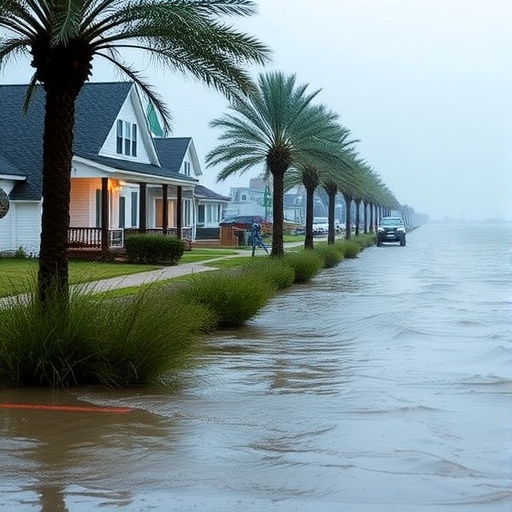
Coastal cities are used to floods arriving “suddenly,” but new research suggests many inundations follow a clockwork pattern. A study published in Nature Communications reports that flooding along the shore can be forecast with unusual precision by linking water level surges to predictable tidal timing, local meteorology, and the way waves are transformed as they approach land.
The team examined coastal observations and model outputs to identify recurring conditions that precede inundation. Rather than treating flooding as a rare, irregular event, they focused on how small changes in forcing—such as the timing of tides relative to offshore wave energy—can repeatedly push water onto vulnerable ground. Their analysis shows that in certain regions, the same combination of drivers tends to reappear across days and seasons.
Crucially, the work highlights that “predictable hours” are possible even when storms or strong seas are involved. This hinges on synchrony: when high waves and storm-enhanced water levels align with the most flood-prone phase of the tide, the coastal boundary behaves like a funnel. The shoreline then experiences rapid water-level build-up that is difficult to notice until it’s too late—unless the timing is known in advance.
The researchers also emphasize that local factors control how ocean signals translate into flooding. Features such as beach slope, nearshore bathymetry, and the presence of hard structures can amplify or dampen surge impacts. By incorporating these effects, the study improves the link between large-scale ocean forcing and small-scale inundation dynamics.
In practical terms, the approach could help coastal managers move from broad warnings to time-specific alerts. Instead of issuing generic “flood risk” notices, agencies could communicate when flooding is most likely to occur on a given day, enabling targeted responses such as temporary protections, traffic restrictions, and faster emergency coordination.
Beyond immediate utility, the findings strengthen the scientific case for timing-based coastal risk models. As climate change increases sea levels and alters storm patterns, predictive frameworks that capture how multiple drivers interact may become more valuable than those relying on single indicators.
Ultimately, the message is both sobering and hopeful: while the sea’s rising threat is unavoidable, some of its most damaging moments may be anticipated. If coastal systems are indeed governed by repeatable timing rules, then preparedness can become less reactive—and more precise.
Cite Scienmag News
Violet Maxwell. (July 28, 2026). Predictable Coastal Flooding Hits Shorelines at Regular Hours. Scienmag. https://scienmag.com/predictable-coastal-flooding-hits-shorelines-at-regular-hours/
Violet Maxwell. "Predictable Coastal Flooding Hits Shorelines at Regular Hours." Scienmag, 28 July 2026, https://scienmag.com/predictable-coastal-flooding-hits-shorelines-at-regular-hours/. Accessed 4 September 2026.
Violet Maxwell. "Predictable Coastal Flooding Hits Shorelines at Regular Hours." Scienmag. July 28, 2026. https://scienmag.com/predictable-coastal-flooding-hits-shorelines-at-regular-hours/


