


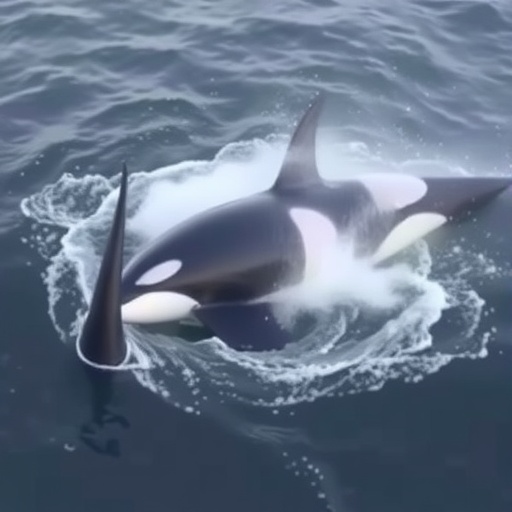
Orcas in the Gulf of California have been documented using a previously undescribed “hold-to-ram” strategy to process prey. Researchers report that the tactic involves stabilizing a dead sharp-tail sunfish by its large tail fin, then releasing it moments before another orca strikes at high speed. The impact disintegrates the tissue into thousands of fragments, changing how the carcass can be consumed.
The findings come from two independent hunting events separated by just over a year. In the first event (observed in July 2024), a group of orcas—including a juvenile—worked around a sunfish that had already been killed. A female held the carcass steady while a male accelerated toward it, and the release occurred immediately before collision.
A second, similar incident was filmed in September 2025 by Héctor Franz. The repeated sequence strongly suggests coordination between individuals, with one orca acting as a “stabilizer” while another delivers the high-energy ramming. Importantly, the prey was not observed to be killed by the ramming itself, pointing instead to processing behavior.
Why fracture the carcass? The team proposes that breaking the sunfish into smaller pieces may help younger orcas feed more easily. Orcas are known to tear and share prey within groups, and distributing accessible fragments would fit established patterns of cooperative feeding.
There may also be a microscopic payoff. Sharp-tail sunfish possess a distinct gelatinous capsule layer and skin microbiome. When tissue shatters, microbial communities associated with the prey can disperse into surrounding seawater, potentially altering nutrient conditions and increasing contact between orca and prey-associated microbes.
In the observations, the juvenile consumed smaller fragments after the ramming, while adult orcas focused on larger remaining portions. This division of feeding behavior aligns with the idea that high-impact processing creates size options within the same carcass.
The ramming technique has not been previously described in orcas, making it a noteworthy addition to known predation toolkits. The authors also consider alternative explanations, including social or playful behavior—because orcas are famous for manipulating objects and “playing” with food.
Still, the events reveal that orcas may use sophisticated, high-energy methods not only to capture prey, but to manage what happens afterward—sometimes turning a single meal into a cloud of bite-sized pieces.
Cite Scienmag News
Violet Maxwell. (July 27, 2026). Orcas filmed exploding a giant fish after ramming it with force, possibly playing. Scienmag. https://scienmag.com/orcas-filmed-exploding-a-giant-fish-after-ramming-it-with-force-possibly-playing/
Violet Maxwell. "Orcas filmed exploding a giant fish after ramming it with force, possibly playing." Scienmag, 27 July 2026, https://scienmag.com/orcas-filmed-exploding-a-giant-fish-after-ramming-it-with-force-possibly-playing/. Accessed 4 September 2026.
Violet Maxwell. "Orcas filmed exploding a giant fish after ramming it with force, possibly playing." Scienmag. July 27, 2026. https://scienmag.com/orcas-filmed-exploding-a-giant-fish-after-ramming-it-with-force-possibly-playing/


