

Friday, July 17, 2026
Science
No Result
View All Result
  • Login
  • HOME
  • SCIENCE NEWS
  • CONTACT US
  • HOME
  • SCIENCE NEWS
  • CONTACT US
No Result
View All Result
Scienmag
No Result
View All Result
Home Science News Medicine

Study Links Heavy TV Watching to Smaller Brain Structures

July 17, 2026
in Medicine
Reading Time: 2 mins read
0
Study Links Heavy TV Watching to Smaller Brain Structures

Study Links Heavy TV Watching to Smaller Brain Structures

65
SHARES
587
VIEWS
Share on FacebookShare on Twitter
ADVERTISEMENT

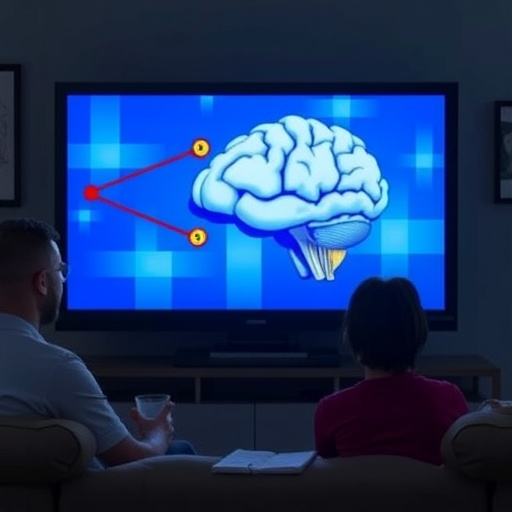
Television has long been blamed for sedentary habits and “brain rot.” Now a new brain-imaging study suggests the story may be more nuanced—and potentially more concerning—than the old punchline.

Researchers report that people who watched TV very often during midlife later showed measurable differences on MRI scans. These differences appeared in brain regions tied to memory and early Alzheimer’s-related changes, along with alterations in white-matter tissue associated with vascular aging and cognitive decline.

The team focused on more than how long participants sat. They asked whether the specific activity performed while seated—particularly leisure screen time—might have distinct biological signatures compared with other sedentary behaviors.

Using data from about 1,700 adults enrolled in the ARIC (Atherosclerosis Risk in Communities) Study in the late 1980s, investigators linked self-reported TV viewing frequency to later brain structure. Average participant age at enrollment was 53, and participants underwent MRI more than two decades afterward.

Compared with those who reported rarely or never watching TV, “very often” TV viewers showed widespread structural differences. Brain areas relevant to early Alzheimer’s pathology tended to have smaller volumes, while white-matter hyperintensity volumes—an imaging marker linked to small-vessel disease—were higher.

Smaller occipital and frontal lobes were also observed. The occipital region is strongly tied to visual processing, while frontal areas support executive functions—both central to cognition.

Importantly, the associations persisted even after statistical adjustment for physical activity, diabetes status, body mass index, smoking, and alcohol use. This suggests TV-linked patterns were not simply the result of overall inactivity.

However, the study design has limitations. TV exposure relied on self-report rather than continuous monitoring, and participants did not have an MRI baseline to track change in the same individuals over time. Still, the pattern of results supports the idea that “sitting” is not a single uniform risk factor.

Intriguingly, occupational sitting showed a different relationship: higher sitting time at work was associated with more favorable imaging metrics. That contrast hints that cognitive engagement—or other features of day-to-day activities—may modulate brain outcomes, even when total sitting time is similar.

Subject of Research: People
Article Title: Associations of distinct sedentary behaviors with cortical, subcortical, and white matter hyperintensity volumes: Evidence from the ARIC study
News Publication Date: 10-Jul-2026
Web References: https://alz-journals.onlinelibrary.wiley.com/doi/10.1002/alz.71582
References: 10.1002/alz.71582
Keywords: human health, dementia, Alzheimer disease, cognitive disorders

Tags: brain regions affected by sedentary leisure activitiesbrain volume reduction linked to TV consumptionearly Alzheimer’s disease markersimpact of prolonged TV watching on brain healthleisure screen time and neurodegenerationlong-term effects of screen time on cognitive functionMRI brain imaging in midlife adultsneuroimaging study on lifestyle factorssedentary behavior and cognitive declineTV viewing and brain structure changesvascular health and cognitive decline related to screen timewhite matter hyperintensities and vascular aging
Share26Tweet16
Previous Post

University of Toronto Professor Elected Fellow of the British Academy

Next Post

Y-Added FeCoNiSiB Amorphous Multi-Principal Alloys Demonstrate Enhanced Performance

Related Posts

SIRT6 and Its Modulators: New Roles in Kidney Disease Research
Medicine

SIRT6 and Its Modulators: New Roles in Kidney Disease Research

July 17, 2026
Journal of Nuclear Medicine Releases Ahead-of-Print Update for July 17, 2026
Medicine

Journal of Nuclear Medicine Releases Ahead-of-Print Update for July 17, 2026

July 17, 2026
Fans Train in CPR at 2026 MLB All-Star Game
Medicine

Fans Train in CPR at 2026 MLB All-Star Game

July 17, 2026
164 Schools Across 44 States Receive Grants to Improve Student Health
Medicine

164 Schools Across 44 States Receive Grants to Improve Student Health

July 17, 2026
Soft Robotic Suit Improves Sit-to-Stand and Walking Efficiency in Older Adults
Medicine

Soft Robotic Suit Improves Sit-to-Stand and Walking Efficiency in Older Adults

July 17, 2026
Study Shows Adolescent Brain Remodeling Improves Memory Formation
Medicine

Study Shows Adolescent Brain Remodeling Improves Memory Formation

July 17, 2026
Next Post
Y-Added FeCoNiSiB Amorphous Multi-Principal Alloys Demonstrate Enhanced Performance

Y-Added FeCoNiSiB Amorphous Multi-Principal Alloys Demonstrate Enhanced Performance

  • Mothers who receive childcare support from maternal grandparents show more

    Mothers who receive childcare support from maternal grandparents show more parental warmth, finds NTU Singapore study

    27656 shares
    Share 11059 Tweet 6912
  • University of Seville Breaks 120-Year-Old Mystery, Revises a Key Einstein Concept

    1061 shares
    Share 424 Tweet 265
  • Bee body mass, pathogens and local climate influence heat tolerance

    682 shares
    Share 273 Tweet 171
  • Researchers record first-ever images and data of a shark experiencing a boat strike

    546 shares
    Share 218 Tweet 137
  • Groundbreaking Clinical Trial Reveals Lubiprostone Enhances Kidney Function

    531 shares
    Share 212 Tweet 133
Science

Embark on a thrilling journey of discovery with Scienmag.com—your ultimate source for cutting-edge breakthroughs. Immerse yourself in a world where curiosity knows no limits and tomorrow’s possibilities become today’s reality!

RECENT NEWS

  • SIRT6 and Its Modulators: New Roles in Kidney Disease Research
  • Journal of Nuclear Medicine Releases Ahead-of-Print Update for July 17, 2026
  • Researchers Enhance Hydrogen Production with Single-Element Dual-Site Substitution
  • Fans Train in CPR at 2026 MLB All-Star Game

Categories

  • Agriculture
  • Anthropology
  • Archaeology
  • Athmospheric
  • Biology
  • Biotechnology
  • Blog
  • Bussines
  • Cancer
  • Chemistry
  • Climate
  • Earth Science
  • Editorial Policy
  • Marine
  • Mathematics
  • Medicine
  • Pediatry
  • Policy
  • Psychology & Psychiatry
  • Science Education
  • Social Science
  • Space
  • Technology and Engineering

Subscribe to Blog via Email

Enter your email address to subscribe to this blog and receive notifications of new posts by email.

Join 5,146 other subscribers

© 2025 Scienmag - Science Magazine

Welcome Back!

Login to your account below

Forgotten Password?

Retrieve your password

Please enter your username or email address to reset your password.

Log In
No Result
View All Result
  • HOME
  • SCIENCE NEWS
  • CONTACT US

© 2025 Scienmag - Science Magazine

Discover more from Science

Subscribe now to keep reading and get access to the full archive.

Continue reading
