


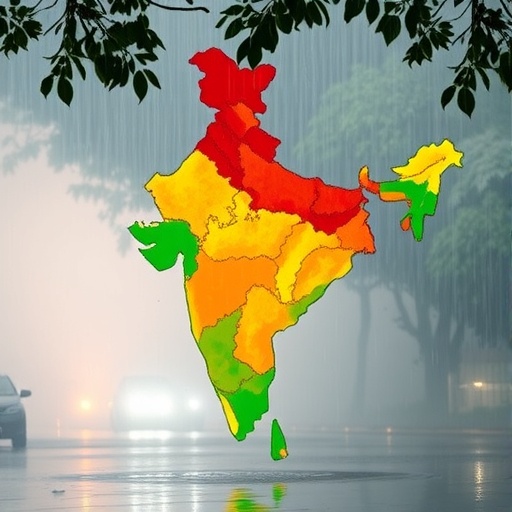
Coordinated air-quality policies could reshape rainfall across South Asia—possibly in ways that single-country cleanup plans may not anticipate, according to new research from the University of Reading.
Air pollution alters Earth’s energy balance. By absorbing and scattering incoming sunlight, pollution reduces how much solar energy reaches land and ocean surfaces. That dimming can weaken surface warming and disrupt the monsoon circulation that transports moisture inland.
In East Asia, the story looks familiar: when emissions decline, more sunlight reaches the surface, warming it by up to about one degree Celsius. The model results suggest this radiative shift can increase summer monsoon precipitation by roughly 0.20 millimeters per day across parts of the region.
But the same mechanism does not translate neatly to India. The study reports that aerosol reductions may reduce rainfall by about 0.2 to 0.6 millimeters per day over portions of west-central and eastern India, even as upwind regions see benefits.
The key lies in atmospheric teleconnections: wind patterns can couple distant changes in aerosols and heating, meaning that alterations in one region’s air mass can nudge circulation hundreds or thousands of kilometers away. For India, that coupling can steer moisture and convection toward different pathways than expected.
To test these dynamics, the researchers ran ten climate models within the RAMIP framework, using thousands of simulation runs coordinated across research teams. The goal was to compare scenarios where different regions reduce aerosol emissions.
Their findings indicate that cleanup everywhere produces a larger monsoon boost for India than cleanup restricted to South Asia alone. All-India rainfall rises by about 0.28 millimeters per day under worldwide cleanup, compared with about 0.19 millimeters per day when only South Asia acts.
Rain increases are strongest over areas including the northern Bay of Bengal, the Western Ghats, and the Indo-Gangetic Plains—regions that depend heavily on seasonal timing and storm development.
The authors note that the next challenge is not just how much rainfall changes, but when it arrives and how intense individual storms become—details that could matter directly for farmers and water managers.
Cite Scienmag News
Russell Cooper. (July 15, 2026). India’s monsoon rainfall varies with cleaner air in different regions. Scienmag. https://scienmag.com/indias-monsoon-rainfall-varies-with-cleaner-air-in-different-regions/
Russell Cooper. "India’s monsoon rainfall varies with cleaner air in different regions." Scienmag, 15 July 2026, https://scienmag.com/indias-monsoon-rainfall-varies-with-cleaner-air-in-different-regions/. Accessed 5 September 2026.
Russell Cooper. "India’s monsoon rainfall varies with cleaner air in different regions." Scienmag. July 15, 2026. https://scienmag.com/indias-monsoon-rainfall-varies-with-cleaner-air-in-different-regions/


