


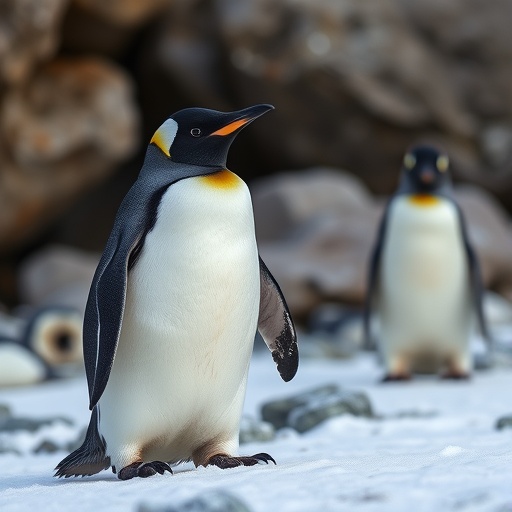
A new study suggests Ashmole’s halo—an outer boundary around large seabird colonies where prey availability drops—may form not only because food is eaten, but because it becomes harder to find. Researchers focused on Adélie penguins and Antarctic krill under sea ice, examining how repeated foraging from the same opening reshapes predator–prey dynamics at fine spatial scales.
Ashmole’s halo is widely attributed to prey depletion: more predators consume more prey near the colony. Yet the ocean’s complexity makes it difficult to track whether predators also change prey behavior or distribution in ways that reduce capture success without dramatically lowering prey numbers.
To test this, lead author Hina T. Watanabe and colleagues equipped breeding Adélie penguins at an East Antarctic colony with bio-logging devices. Landfast sea ice confined access to the ocean to a limited number of shared openings, forcing localized repeat foraging and creating a natural setting to study cumulative effects.
Using high-resolution data, the team reconstructed three-dimensional underwater dive paths and pinpointed feeding events beneath the ice with video validation. The study design ensured the birds needed to complete foraging trips and return to feed their young, producing repeated behavioral cycles that could influence the same prey field.
Across 30 foraging trips and more than 6,000 dives from 23 penguins, a consistent pattern emerged. During successive dives from the same sea-ice opening, penguins traveled progressively farther and descended deeper to encounter krill, while feeding rates remained essentially unchanged once prey were detected.
These results also appeared at the colony scale: birds foraging closer to the colony showed the same tendency toward deeper, farther searches. Despite these changes in search behavior, feeding rates upon encounter varied little, pointing toward reduced prey accessibility rather than simple prey depletion.
The authors interpret this as evidence for “functional prey depletion,” where prey remain present but become progressively less reachable. Repeated diving concentrated near breeding sites may displace krill behaviorally, effectively expanding the distance and depth required for successful encounters.
While the study provides strong empirical support for prey-accessibility changes, it has limitations. The researchers inferred krill responses from penguin behavior rather than directly measuring prey movement beneath the ice.
The next step, Watanabe says, is to combine animal-borne sensors with methods that can directly map prey distribution under sea ice. Ultimately, the goal is to understand how predator disturbance and prey responses generate ecological patterns from individual foraging to colony-scale resource landscapes.
Cite Scienmag News
Violet Maxwell. (July 14, 2026). Prey Access, Not Abundance, Drives Predator Behavior in Penguins. Scienmag. https://scienmag.com/prey-access-not-abundance-drives-predator-behavior-in-penguins/
Violet Maxwell. "Prey Access, Not Abundance, Drives Predator Behavior in Penguins." Scienmag, 14 July 2026, https://scienmag.com/prey-access-not-abundance-drives-predator-behavior-in-penguins/. Accessed 3 September 2026.
Violet Maxwell. "Prey Access, Not Abundance, Drives Predator Behavior in Penguins." Scienmag. July 14, 2026. https://scienmag.com/prey-access-not-abundance-drives-predator-behavior-in-penguins/


