

Wednesday, July 15, 2026
Science
No Result
View All Result
  • Login
  • HOME
  • SCIENCE NEWS
  • CONTACT US
  • HOME
  • SCIENCE NEWS
  • CONTACT US
No Result
View All Result
Scienmag
No Result
View All Result
Home Science News Marine

Prey Access, Not Abundance, Drives Predator Behavior in Penguins

July 14, 2026
in Marine
Reading Time: 2 mins read
0
Prey Access, Not Abundance, Drives Predator Behavior in Penguins

Prey Access, Not Abundance, Drives Predator Behavior in Penguins

65
SHARES
587
VIEWS
Share on FacebookShare on Twitter
ADVERTISEMENT

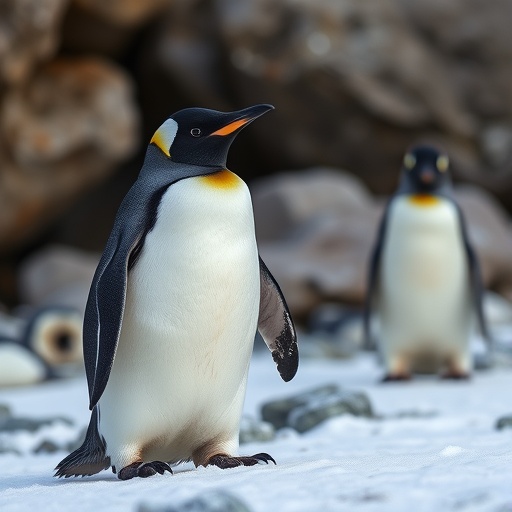
A new study suggests Ashmole’s halo—an outer boundary around large seabird colonies where prey availability drops—may form not only because food is eaten, but because it becomes harder to find. Researchers focused on Adélie penguins and Antarctic krill under sea ice, examining how repeated foraging from the same opening reshapes predator–prey dynamics at fine spatial scales.

Ashmole’s halo is widely attributed to prey depletion: more predators consume more prey near the colony. Yet the ocean’s complexity makes it difficult to track whether predators also change prey behavior or distribution in ways that reduce capture success without dramatically lowering prey numbers.

To test this, lead author Hina T. Watanabe and colleagues equipped breeding Adélie penguins at an East Antarctic colony with bio-logging devices. Landfast sea ice confined access to the ocean to a limited number of shared openings, forcing localized repeat foraging and creating a natural setting to study cumulative effects.

Using high-resolution data, the team reconstructed three-dimensional underwater dive paths and pinpointed feeding events beneath the ice with video validation. The study design ensured the birds needed to complete foraging trips and return to feed their young, producing repeated behavioral cycles that could influence the same prey field.

Across 30 foraging trips and more than 6,000 dives from 23 penguins, a consistent pattern emerged. During successive dives from the same sea-ice opening, penguins traveled progressively farther and descended deeper to encounter krill, while feeding rates remained essentially unchanged once prey were detected.

These results also appeared at the colony scale: birds foraging closer to the colony showed the same tendency toward deeper, farther searches. Despite these changes in search behavior, feeding rates upon encounter varied little, pointing toward reduced prey accessibility rather than simple prey depletion.

The authors interpret this as evidence for “functional prey depletion,” where prey remain present but become progressively less reachable. Repeated diving concentrated near breeding sites may displace krill behaviorally, effectively expanding the distance and depth required for successful encounters.

While the study provides strong empirical support for prey-accessibility changes, it has limitations. The researchers inferred krill responses from penguin behavior rather than directly measuring prey movement beneath the ice.

The next step, Watanabe says, is to combine animal-borne sensors with methods that can directly map prey distribution under sea ice. Ultimately, the goal is to understand how predator disturbance and prey responses generate ecological patterns from individual foraging to colony-scale resource landscapes.

Subject of Research: Animals
Article Title: Emergence of functional prey depletion halo through penguin–krill behavioural dynamics
News Publication Date: 15-Jul-2026
Web References: http://dx.doi.org/10.1098/rspb.2026.0490
References: Proceedings of the Royal Society B Biological Sciences (DOI: 10.1098/rspb.2026.0490)
Image Credits: Hina T. Watanabe, NIPR
Keywords: Ashmole’s halo, Adélie penguins, Antarctic krill, sea ice, prey accessibility, functional prey depletion, bio-logging, predator–prey dynamics

Tags: Adélie penguin foraging behaviorAntarctic krill as prey speciesAshmole’s halo formation mechanismsbio-logging in seabird researcheffect of repeated foraging on prey behaviorhigh-resolution underwater dive trackingimpact of predator access on prey distributionnatural experimental settings for predator studiespredator-prey dynamics in Antarctic ecosystemprey availability under sea icesea ice influence on marine food websseabird foraging cycle and reproductive needs
Share26Tweet16
Previous Post

Brain Morphometry Links Behavioral Inhibition Activation System to OCD Treatment Outcomes

Next Post

Scientists Reveal How Macrophages Age Differently Across the Body

Related Posts

Climate Change Forces Amphibians to Shift Diet, but Limits Adaptation
Marine

Climate Change Forces Amphibians to Shift Diet, but Limits Adaptation

July 14, 2026
W&M, NOAA Collaborate to Enhance Chesapeake Bay Shallow Water Mapping Data
Marine

W&M, NOAA Collaborate to Enhance Chesapeake Bay Shallow Water Mapping Data

July 14, 2026
Dolphins Spotted Returning to the Sea of Japan
Marine

Dolphins Spotted Returning to the Sea of Japan

July 14, 2026
Disturbance Impacts Giant Kelp Growth More Than Resource Levels
Marine

Disturbance Impacts Giant Kelp Growth More Than Resource Levels

July 13, 2026
Nanostructures Enhance Aquaculture Safety, New Review Finds
Marine

Nanostructures Enhance Aquaculture Safety, New Review Finds

July 13, 2026
RB5 Dye Breakdown May Increase Toxicity Despite Color Removal
Marine

RB5 Dye Breakdown May Increase Toxicity Despite Color Removal

July 13, 2026
Next Post
Scientists Reveal How Macrophages Age Differently Across the Body

Scientists Reveal How Macrophages Age Differently Across the Body

  • Mothers who receive childcare support from maternal grandparents show more

    Mothers who receive childcare support from maternal grandparents show more parental warmth, finds NTU Singapore study

    27656 shares
    Share 11059 Tweet 6912
  • University of Seville Breaks 120-Year-Old Mystery, Revises a Key Einstein Concept

    1061 shares
    Share 424 Tweet 265
  • Bee body mass, pathogens and local climate influence heat tolerance

    682 shares
    Share 273 Tweet 171
  • Researchers record first-ever images and data of a shark experiencing a boat strike

    546 shares
    Share 218 Tweet 137
  • Groundbreaking Clinical Trial Reveals Lubiprostone Enhances Kidney Function

    531 shares
    Share 212 Tweet 133
Science

Embark on a thrilling journey of discovery with Scienmag.com—your ultimate source for cutting-edge breakthroughs. Immerse yourself in a world where curiosity knows no limits and tomorrow’s possibilities become today’s reality!

RECENT NEWS

  • England study finds lockdown-born children harder to focus and manage emotions at four
  • Molecular Model Explains Buckled Dimers on Ge(100) Surface
  • KAIST Unveils Technology to Make Personalized AI Safer
  • Genetic findings from tumor-prone reptile reveal clues for cancer research

Categories

  • Agriculture
  • Anthropology
  • Archaeology
  • Athmospheric
  • Biology
  • Biotechnology
  • Blog
  • Bussines
  • Cancer
  • Chemistry
  • Climate
  • Earth Science
  • Editorial Policy
  • Marine
  • Mathematics
  • Medicine
  • Pediatry
  • Policy
  • Psychology & Psychiatry
  • Science Education
  • Social Science
  • Space
  • Technology and Engineering

Subscribe to Blog via Email

Enter your email address to subscribe to this blog and receive notifications of new posts by email.

Join 5,146 other subscribers

© 2025 Scienmag - Science Magazine

Welcome Back!

Login to your account below

Forgotten Password?

Retrieve your password

Please enter your username or email address to reset your password.

Log In
No Result
View All Result
  • HOME
  • SCIENCE NEWS
  • CONTACT US

© 2025 Scienmag - Science Magazine

Discover more from Science

Subscribe now to keep reading and get access to the full archive.

Continue reading
