

Friday, July 10, 2026
Science
No Result
View All Result
  • Login
  • HOME
  • SCIENCE NEWS
  • CONTACT US
  • HOME
  • SCIENCE NEWS
  • CONTACT US
No Result
View All Result
Scienmag
No Result
View All Result
Home Science News Agriculture

Mulberry Biochar Boosts Fish Gut Health and Aquaculture Water Quality

July 10, 2026
in Agriculture
Reading Time: 2 mins read
0
Mulberry Biochar Boosts Fish Gut Health and Aquaculture Water Quality

Mulberry Biochar Boosts Fish Gut Health and Aquaculture Water Quality

65
SHARES
587
VIEWS
Share on FacebookShare on Twitter
ADVERTISEMENT

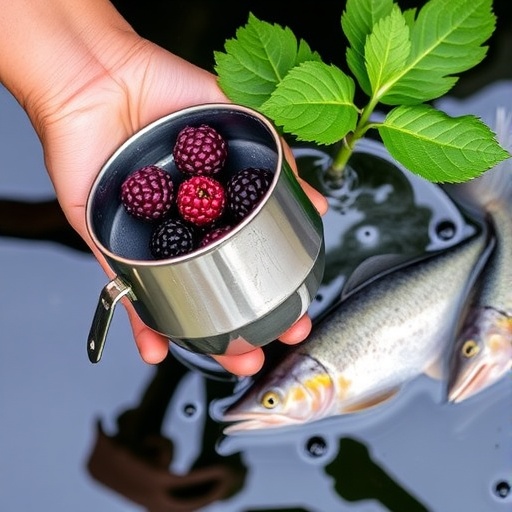
A groundbreaking study has unveiled a novel approach to enhancing aquaculture sustainability by incorporating biochar derived from mulberry branches into the diet of largemouth bass (Micropterus salmoides). This innovative strategy not only promotes intestinal health but also significantly improves water quality in intensive fish farming systems.

The research team produced biochar through the pyrolysis of discarded mulberry branches at 550 °C under oxygen-limited conditions, transforming agricultural waste into a functional feed additive. Mulberry trees commonly grow near aquaculture ponds in southern China, rendering their branches an abundant and cost-effective resource.

In a controlled 42-day trial, juvenile largemouth bass were fed diets supplemented with 0, 10, 20, or 40 grams of biochar per kilogram of feed. While growth metrics such as body weight and survival rates remained unaffected, fish receiving 20 and 40 grams per kilogram demonstrated enhanced intestinal digestive enzyme activities, specifically trypsin and amylase, indicating improved protein and carbohydrate digestion.

On a molecular level, lower to moderate biochar inclusion boosted the expression of genes crucial for maintaining intestinal integrity and antioxidant defense. Notably, the antioxidant enzyme gene sod and tight junction protein gene Occludin were upregulated, with the 10-gram biochar dose also elevating the anti-inflammatory cytokine IL-10. These changes suggest strengthened gut barrier function and reduced inflammatory responses.

Microbial community analyses revealed a significant rise in intestinal bacterial diversity following biochar supplementation. The microbiome composition shifted toward an increased abundance of Actinobacteriota, a phylum associated with nutrient metabolism and immune modulation. Concurrently, potentially pathogenic genera such as Plesiomonas and Mycoplasma decreased, highlighting biochar’s role in fostering a healthier gut environment.

Beyond fish physiology, water quality benefits were profound. Ammonia nitrogen concentrations decreased by over 60% in the 10-gram biochar group and nearly 50% in the 20-gram group compared to controls. Similarly, nitrite nitrogen levels plummeted substantially, with a striking 91.78% reduction observed at the 10-gram treatment. These outcomes mitigate the toxic accumulation of nitrogenous waste, a pervasive issue in intensive aquaculture.

However, the highest biochar concentration (40 grams/kg) elicited adverse effects, including diminished fish condition factors, elevated pro-inflammatory TNF-α gene expression, and increased microbiome variability. These findings indicate that excessive biochar may disrupt nutrient absorption or gut microbial balance, underscoring the need for precise dosing.

The study’s findings illuminate a dual-function approach: utilizing mulberry branch biochar to simultaneously enhance fish intestinal health and maintain cleaner aquaculture waters. This sustainable practice exemplifies a circular economy model by valorizing agricultural residues and reducing environmental impacts of fish farming.

Published in Biochar X, this pioneering research signals a promising avenue for advancing aquaculture sustainability by integrating waste-derived biochar as a functional feed component, with implications for global food security and ecosystem health.


Subject of Research: Experimental study on dietary mulberry branch biochar in largemouth bass aquaculture
Article Title: Dietary mulberry branch biochar improves intestinal health and water quality in largemouth bass (Micropterus salmoides) aquaculture
News Publication Date: 1 May 2026
Web References: https://doi.org/10.48130/bchax-0026-0010
References: Chen B, Hu J, Peng K, Huang W, Li J, et al. 2026. Dietary mulberry branch biochar improves intestinal health and water quality in largemouth bass (Micropterus salmoides) aquaculture. Biochar X 2: e014
Image Credits: Bing Chen, Junru Hu, Kai Peng, Wen Huang, Jinhong Li, Mulian Wei, Zhihua Zeng, Dongxu Xing, Bing Fu, Junming Cao, Hongxia Zhao, Xiang Li, & Hailong Wang
Keywords: Aquaculture, Biochar, Intestinal health, Water quality, Microbiome, Nitrogen reduction, Sustainable fish farming

Tags: antioxidant defense in aquaculture speciesAquaculture sustainabilitybiochar production from agricultural wastedietary supplements for fisheffects of biochar on fish growthenvironmental benefits of biochar applicationfish gut health improvementintestinal enzyme activity in fishmolecular mechanisms of gut healthmulberry branch biocharuse of plant-based feed additives in aquaculturewater quality enhancement in aquaculture
Share26Tweet16
Previous Post

Hassen Elected Fellow of American Society for Nondestructive Testing

Next Post

Journal of Nuclear Medicine Early Release Highlights July 10, 2026

Related Posts

Wearable Devices Developed to Monitor Plant Health in Real Time
Agriculture

Wearable Devices Developed to Monitor Plant Health in Real Time

July 9, 2026
Plant Roots Avoid Rot by Steering Clear of Infected Areas
Agriculture

Plant Roots Avoid Rot by Steering Clear of Infected Areas

July 9, 2026
Designing Successful Living Labs for Agriculture and Nutrition Research
Agriculture

Designing Successful Living Labs for Agriculture and Nutrition Research

July 9, 2026
Sawdust-Based Material Effectively Cleans Dye and Food Processing Wastewater
Agriculture

Sawdust-Based Material Effectively Cleans Dye and Food Processing Wastewater

July 8, 2026
Harnessing Neglected Livestock for Sustainable Food Systems in the Global South
Agriculture

Harnessing Neglected Livestock for Sustainable Food Systems in the Global South

July 8, 2026
EU scientists warn Europe faces imminent pollinator collapse risk
Agriculture

EU scientists warn Europe faces imminent pollinator collapse risk

July 8, 2026
Next Post
Journal of Nuclear Medicine Early Release Highlights July 10, 2026

Journal of Nuclear Medicine Early Release Highlights July 10, 2026

  • Mothers who receive childcare support from maternal grandparents show more

    Mothers who receive childcare support from maternal grandparents show more parental warmth, finds NTU Singapore study

    27656 shares
    Share 11059 Tweet 6912
  • University of Seville Breaks 120-Year-Old Mystery, Revises a Key Einstein Concept

    1061 shares
    Share 424 Tweet 265
  • Bee body mass, pathogens and local climate influence heat tolerance

    682 shares
    Share 273 Tweet 171
  • Researchers record first-ever images and data of a shark experiencing a boat strike

    546 shares
    Share 218 Tweet 137
  • Groundbreaking Clinical Trial Reveals Lubiprostone Enhances Kidney Function

    531 shares
    Share 212 Tweet 133
Science

Embark on a thrilling journey of discovery with Scienmag.com—your ultimate source for cutting-edge breakthroughs. Immerse yourself in a world where curiosity knows no limits and tomorrow’s possibilities become today’s reality!

RECENT NEWS

  • Han directs new $15M NIH center for organ-on-chip technology
  • Stress-Coping Traits Influence Fat Tissue Function and Metabolic Resilience
  • FMR1 Gene Therapy Rescues Fragile X Syndrome Traits in Mice
  • AGA Introduces Nigel, AI Assistant for Gastroenterology and Hepatology

Categories

  • Agriculture
  • Anthropology
  • Archaeology
  • Athmospheric
  • Biology
  • Biotechnology
  • Blog
  • Bussines
  • Cancer
  • Chemistry
  • Climate
  • Earth Science
  • Editorial Policy
  • Marine
  • Mathematics
  • Medicine
  • Pediatry
  • Policy
  • Psychology & Psychiatry
  • Science Education
  • Social Science
  • Space
  • Technology and Engineering

Subscribe to Blog via Email

Enter your email address to subscribe to this blog and receive notifications of new posts by email.

Join 5,146 other subscribers

© 2025 Scienmag - Science Magazine

Welcome Back!

Login to your account below

Forgotten Password?

Retrieve your password

Please enter your username or email address to reset your password.

Log In
No Result
View All Result
  • HOME
  • SCIENCE NEWS
  • CONTACT US

© 2025 Scienmag - Science Magazine

Discover more from Science

Subscribe now to keep reading and get access to the full archive.

Continue reading
