


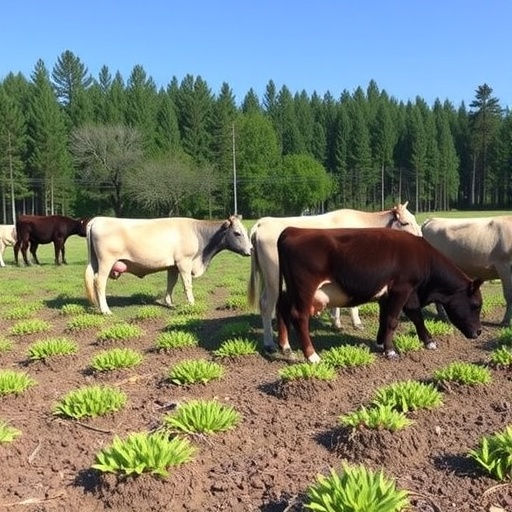
A groundbreaking systematic review published in Communications Earth & Environment is reshaping scientific understanding about the benefits of alternative grazing practices on soil organic carbon (SOC) levels. Led by Jennifer Sanderman and colleagues, the 2026 study rigorously reexamines the growing body of research promoting alternative grazing as a climate-friendly strategy for boosting soil carbon sequestration. Their findings reveal that reported gains in SOC hinge significantly on the methodological quality of the underlying studies, casting doubt on some of the more optimistic claims.
Alternative grazing practices, including rotational and holistic planned grazing, have been championed as sustainable land management techniques that could enhance soil health and mitigate climate change by increasing the amount of carbon stored in soils. Numerous field studies and meta-analyses have suggested that these approaches can lead to measurable SOC gains compared to conventional continuous grazing. However, the new systematic review highlights a critical need for caution when interpreting these results due to variability in study design and data robustness.
Sanderman et al. meticulously evaluated a wide array of peer-reviewed studies, applying stringent quality criteria related to controls, sampling duration, spatial replication, and statistical rigor. The authors demonstrate that many studies reporting substantial SOC improvements suffer from limitations such as short monitoring periods, lack of appropriate control plots, and insufficient replication. These methodological shortcomings can artificially inflate perceived carbon storage benefits of alternative grazing systems.
The review further elucidates how studies deemed high quality typically indicate much smaller or statistically insignificant SOC increases. This discrepancy suggests that previous enthusiasm for alternative grazing’s soil carbon storing capacity may rely on incomplete or biased evidence. The authors emphasize that robust experimental designs and long-term monitoring are essential to accurately quantify SOC dynamics under various grazing regimes.
Importantly, the study does not dismiss alternative grazing practices outright but rather underscores the complexities involved in measuring soil carbon changes. Soil carbon stocks fluctuate slowly and are influenced by numerous confounding factors, including climate variability, soil type, vegetation composition, and historical land use. The researchers advocate for nuanced interpretation and caution against overstating climate mitigation potential without supporting high-quality data.
These findings arrive at a critical juncture as policymakers and land managers seek scalable, nature-based solutions for carbon sequestration. The review’s cautionary message calls for increased investment in long-term, well-controlled field experiments to definitively determine the carbon sequestration benefits of grazing management strategies. Such clarity is vital to inform evidence-based recommendations that balance agricultural productivity, ecosystem health, and climate mitigation goals.
In summary, this comprehensive assessment by Sanderman and colleagues challenges prevailing assumptions and highlights the imperative for rigorous science in evaluating alternative grazing impacts. The study not only advances our understanding of soil carbon dynamics but also serves as a pivotal guidepost toward more credible and actionable climate-smart land management practices moving forward.
Sanderman, J., Partida, C., Xia, Y. et al. Systematic review reveals soil organic carbon benefits of alternative grazing depend on study quality.
Commun Earth Environ (2026). https://doi.org/10.1038/s43247-026-03790-8
Cite Scienmag News
Violet Maxwell. (July 10, 2026). Review Finds Soil Carbon Gains from Alternative Grazing Vary by Study Quality. Scienmag. https://scienmag.com/review-finds-soil-carbon-gains-from-alternative-grazing-vary-by-study-quality/
Violet Maxwell. "Review Finds Soil Carbon Gains from Alternative Grazing Vary by Study Quality." Scienmag, 10 July 2026, https://scienmag.com/review-finds-soil-carbon-gains-from-alternative-grazing-vary-by-study-quality/. Accessed 4 September 2026.
Violet Maxwell. "Review Finds Soil Carbon Gains from Alternative Grazing Vary by Study Quality." Scienmag. July 10, 2026. https://scienmag.com/review-finds-soil-carbon-gains-from-alternative-grazing-vary-by-study-quality/


