


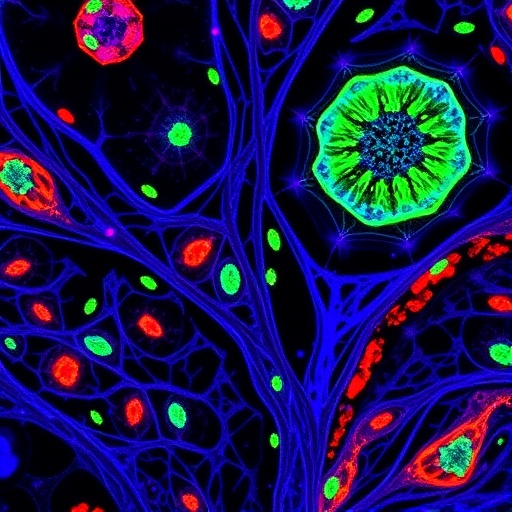
In a significant leap for spatial transcriptomics, researchers have unveiled DISSECT, an innovative cell segmentation model that fuses cytological imaging with spatial transcriptomic data to enhance single-cell resolution analyses. Spatial transcriptomics technologies, which map gene expression within the spatial context of tissues, have surged forward in molecular throughput and resolution. Despite these advances, accurately delineating individual cells remains a formidable challenge, especially given the variability in cell morphology, tissue preparation, and staining protocols across diverse samples and platforms.
Traditional segmentation algorithms, while effective in certain contexts, often struggle to generalize across datasets due to these inherent biological and technical variations. Addressing this limitation, the team developed DISSECT, a deep learning-based framework designed to integrate multiscale image features with rich transcriptomic profiles, allowing for more precise cell instance identification.
At the core of DISSECT is a pretrained deep generative model that captures and denoises complex cytological image features at varying scales. This denoising step ensures that subtle structural details are preserved while minimizing noise-induced artifacts. Next, an instance-aware detection module predicts cell boundaries by analyzing the refined image features in tandem with spatial gene expression patterns, which provide complementary molecular cues to demarcate cell limits more accurately than imaging alone.
A unique aspect of DISSECT is its use of gradient fields derived from both image gradients and transcriptomic gradients. By coupling these two sources of spatial information, the model iteratively refines preliminary segmentation masks, resulting in sharper and more biologically faithful cell boundaries. This dual-gradient approach harnesses the strengths of both modalities, overcoming limitations posed by relying solely on morphological or molecular data.
Benchmarking tests across multiple publicly available spatial transcriptomic datasets demonstrated that DISSECT significantly outperforms existing segmentation tools in terms of mean average precision, a standard metric reflecting accuracy in identifying individual cells. This robust performance underscores the model’s potential to serve as a new standard for spatial single-cell transcriptome reconstruction.
To showcase DISSECT’s practical applications, the researchers applied it to dissect the spatial transcriptomes of gastric adenocarcinoma samples collected before and after anti-PD-1 immunotherapy treatment. Processed using the Stereo-seq platform, these samples revealed insights into how the tumor microenvironment and immune cell architecture evolve in response to treatment—a testament to DISSECT’s utility in translational cancer research.
The integration of multiplexed imaging and spatial transcriptomic data heralds a new era in tissue biology, empowering researchers to unmask cellular heterogeneity and interaction networks with unprecedented clarity. As spatial omics technologies continue to proliferate, tools like DISSECT will be critical in harnessing their full potential, enabling discoveries that could reshape diagnostics and therapeutics across a spectrum of diseases.
By bridging the gap between cytological imagery and spatial gene expression data, DISSECT represents a transformative advance in computational biology, setting the stage for more accurate, high-throughput insights into cellular organization within complex tissues.
Cite Scienmag News
Brooke Gardner. (July 9, 2026). DISSECT combines cytology and spatial transcriptomics for precise cell segmentation. Scienmag. https://scienmag.com/dissect-combines-cytology-and-spatial-transcriptomics-for-precise-cell-segmentation/
Brooke Gardner. "DISSECT combines cytology and spatial transcriptomics for precise cell segmentation." Scienmag, 9 July 2026, https://scienmag.com/dissect-combines-cytology-and-spatial-transcriptomics-for-precise-cell-segmentation/. Accessed 3 September 2026.
Brooke Gardner. "DISSECT combines cytology and spatial transcriptomics for precise cell segmentation." Scienmag. July 9, 2026. https://scienmag.com/dissect-combines-cytology-and-spatial-transcriptomics-for-precise-cell-segmentation/


