

Thursday, July 9, 2026
Science
No Result
View All Result
  • Login
  • HOME
  • SCIENCE NEWS
  • CONTACT US
  • HOME
  • SCIENCE NEWS
  • CONTACT US
No Result
View All Result
Scienmag
No Result
View All Result
Home Science News Psychology & Psychiatry

Stochastic Models Reveal Rapid Smallpox Spread and High Indigenous Mortality Post-Colonial Contact

July 9, 2026
in Psychology & Psychiatry
Reading Time: 2 mins read
0
Stochastic Models Reveal Rapid Smallpox Spread and High Indigenous Mortality Post-Colonial Contact

Stochastic Models Reveal Rapid Smallpox Spread and High Indigenous Mortality Post-Colonial Contact

65
SHARES
587
VIEWS
Share on FacebookShare on Twitter
ADVERTISEMENT

New Epidemiological Models Shed Light on Smallpox’s Catastrophic Impact on Indigenous Australians

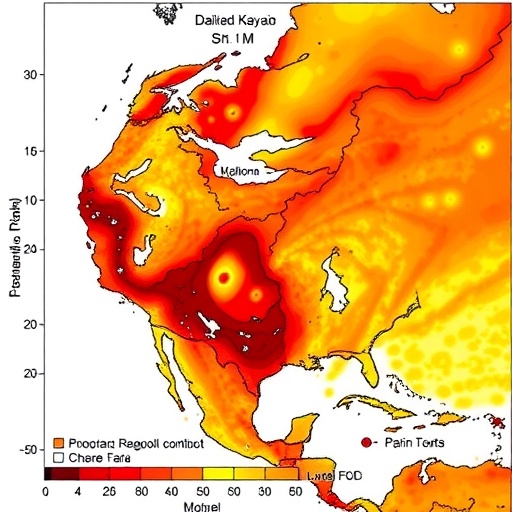
The introduction of smallpox to Aboriginal communities following early European colonization has long been recognized as a devastating event in Australian history. Yet uncertainty has persisted about how and where the disease first entered the continent: was it through pre-colonial trade with Makassan Indonesians along the northern coast, or did it arrive with the British First Fleet in southeastern Australia in 1788? A groundbreaking study published in Nature Human Behaviour presents stochastic, multipatch epidemiological models that unravel this historical mystery and quantify the demographic toll of the epidemic.

Researchers employed sophisticated mathematical models that simulate disease transmission dynamics across different geographic “patches” representing communities. These models incorporated spatial heterogeneity, realistic infection rates, and historical accounts to rigorously test competing hypotheses on smallpox’s initial entry and subsequent spread patterns. The results consistently indicate that initial introduction in southeastern Australia best explains observed outbreak dynamics.

Under scenarios assuming optimistic transmission conditions and even elevated contagion rates, the simulations demonstrate that the disease spreading northwards from a Makassan entry point in the early 1780s would have been implausibly slow and limited in reach. Conversely, a southeastern introduction corresponds with rapid, widespread outbreaks congruent with historical records from 1789. This finding challenges narratives positing a widespread Australia-wide epidemic during this period, suggesting instead a geographically concentrated crisis.

The model estimates mortality rates around 60%, aligning with global smallpox fatality data. Applying this rate to affected regions yields a catastrophic death toll of approximately 220,000 Indigenous Australians. This unprecedented loss not only decimated populations but precipitated profound social disruption, eroding traditional lifeways and weakening resistance to accelerating European colonization.

Importantly, the models argue against extensive disease dissemination beyond southeastern Australia in the initial epidemic wave. This nuance underscores the heterogeneity of colonial impacts across Indigenous Australia and cautions against generalized assumptions of uniform experience. The study further highlights how epidemiological modeling, paired with historical scrutiny, can correct long-standing biases that have shaped public understanding.

The researchers emphasize the ongoing implications of this history, noting the intergenerational trauma that still resonates within Aboriginal communities. Accurate reconstruction of these events is critical to truth-telling and reconciliation efforts, providing a foundation for national healing that acknowledges both epidemiological realities and cultural ramifications.

While the study relies on contemporary data and mathematical frameworks, the authors acknowledge uncertainties inherent in reconstructing past epidemics. Nonetheless, their rigorous, multidisciplinary approach offers a vital lens into one of Australia’s darkest chapters, fusing history with cutting-edge science.

This research marks an important advance in infectious disease historical epidemiology, demonstrating the power of stochastic models to illuminate complex transmission patterns and demographic consequences. As we deepen our understanding of colonial-era epidemics, such insights enhance our capacity to address their legacies and inform modern public health responses.

Subject of Research: Impact and spread of smallpox in Indigenous Australian populations post-colonial contact.

Article Title: Stochastic models indicate rapid smallpox spread and mass mortality of Indigenous Australians after colonial exposure.

Article References:
Nitschke, M.C., Williams, A.N., Ingrey, S.D. et al. Stochastic models indicate rapid smallpox spread and mass mortality of Indigenous Australians after colonial exposure. Nat Hum Behav (2026). https://doi.org/10.1038/s41562-026-02504-6

DOI: https://doi.org/10.1038/s41562-026-02504-6

Tags: assessing mortality rates in indigenous Australian communitiesdemographic effects of smallpox on Aboriginal populationsdisease transmission dynamics in geographically separated communitiesepidemiological modeling of infectious disease transmissionhistorical hypotheses of smallpox introductionhistorical smallpox outbreaks in Australiaimpact of European colonization on indigenous populationsmodeling early disease entry points in Australiamodeling infectious disease outbreaks with realistic infection ratessmallpox spread in indigenous Australian communitiesspatial heterogeneity in disease spreadstochastic multipatch epidemiological models
Share26Tweet16
Previous Post

STEM-PD Reveals First Human Trial Results for Parkinson’s Cell Therapy

Next Post

DISSECT combines cytology and spatial transcriptomics for precise cell segmentation

Related Posts

Biological Causes of Different Cortical Abnormalities in Psychiatric Disorders
Psychology & Psychiatry

Biological Causes of Different Cortical Abnormalities in Psychiatric Disorders

July 9, 2026
MANF in the lateral septum controls ER function during chronic stress
Psychology & Psychiatry

MANF in the lateral septum controls ER function during chronic stress

July 9, 2026
Genetic Impact on Brain Activity During Emotional Face Matching Revealed by fMRI
Psychology & Psychiatry

Genetic Impact on Brain Activity During Emotional Face Matching Revealed by fMRI

July 9, 2026
Body Weight Influences Stress Response Differently in Males and Females via MeA Tac2-Nk3R
Psychology & Psychiatry

Body Weight Influences Stress Response Differently in Males and Females via MeA Tac2-Nk3R

July 9, 2026
Studying Brain Mechanisms of Irritability Through Cross-Species Reward Frustration
Psychology & Psychiatry

Studying Brain Mechanisms of Irritability Through Cross-Species Reward Frustration

July 9, 2026
GLP-1 Receptor Agonists Aid Weight Management in Mental Illness
Psychology & Psychiatry

GLP-1 Receptor Agonists Aid Weight Management in Mental Illness

July 9, 2026
Next Post
DISSECT combines cytology and spatial transcriptomics for precise cell segmentation

DISSECT combines cytology and spatial transcriptomics for precise cell segmentation

  • Mothers who receive childcare support from maternal grandparents show more

    Mothers who receive childcare support from maternal grandparents show more parental warmth, finds NTU Singapore study

    27656 shares
    Share 11059 Tweet 6912
  • University of Seville Breaks 120-Year-Old Mystery, Revises a Key Einstein Concept

    1061 shares
    Share 424 Tweet 265
  • Bee body mass, pathogens and local climate influence heat tolerance

    682 shares
    Share 273 Tweet 171
  • Researchers record first-ever images and data of a shark experiencing a boat strike

    546 shares
    Share 218 Tweet 137
  • Groundbreaking Clinical Trial Reveals Lubiprostone Enhances Kidney Function

    531 shares
    Share 212 Tweet 133
Science

Embark on a thrilling journey of discovery with Scienmag.com—your ultimate source for cutting-edge breakthroughs. Immerse yourself in a world where curiosity knows no limits and tomorrow’s possibilities become today’s reality!

RECENT NEWS

  • Movement Sensors Track Nighttime Sleep and Motion in Parkinson’s Disease
  • Immune and Nutrition Impact Age-Related Survival in Nasopharyngeal Carcinoma
  • New Stem Cell Therapy Shows Promise for Parkinson’s at ISSCR 2026
  • Korea University Opens Korea’s First Center for Refractory GERD

Categories

  • Agriculture
  • Anthropology
  • Archaeology
  • Athmospheric
  • Biology
  • Biotechnology
  • Blog
  • Bussines
  • Cancer
  • Chemistry
  • Climate
  • Earth Science
  • Editorial Policy
  • Marine
  • Mathematics
  • Medicine
  • Pediatry
  • Policy
  • Psychology & Psychiatry
  • Science Education
  • Social Science
  • Space
  • Technology and Engineering

Subscribe to Blog via Email

Enter your email address to subscribe to this blog and receive notifications of new posts by email.

Join 5,146 other subscribers

© 2025 Scienmag - Science Magazine

Welcome Back!

Login to your account below

Forgotten Password?

Retrieve your password

Please enter your username or email address to reset your password.

Log In
No Result
View All Result
  • HOME
  • SCIENCE NEWS
  • CONTACT US

© 2025 Scienmag - Science Magazine

Discover more from Science

Subscribe now to keep reading and get access to the full archive.

Continue reading
