

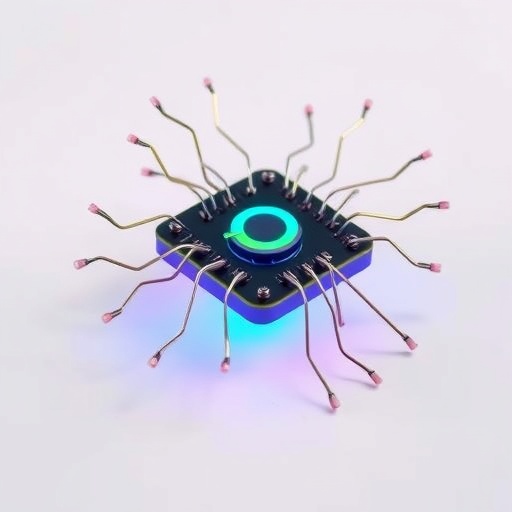
A sliver of engineered crystal no wider than a human hair is rewriting the rules of machine vision. Researchers at McGill University have built a light-sensitive nanostructure that does something remarkable: it not only detects light but processes it on the spot, mimicking the way a biological neuron integrates signals and fires a response. The device, described in the journal Nanoscale, fuses sensing and computation into a single physical element, bypassing the energy-hungry circuits and software that normally sit between a photodetector and a decision-making algorithm. In an era where artificial intelligence strains power grids and data centres, such a merger of physics and function could herald a new generation of ultra-efficient visual processors.
At its core, the device harnesses a phenomenon called persistent photoconductivity, engineered into a gallium-nitride nanowire through molecular beam epitaxy – a technique that deposits atoms layer by layer with sub-nanometre precision. By carefully tuning the composition and thickness of these layers, the team created an internal electric field landscape that traps photo-generated charge carriers. When light strikes the nanowire, it excites electrons that become caught in these potential wells, producing a slow, cumulative buildup of electrical current. This gradual accumulation mirrors the way a neuron integrates incoming synaptic inputs over time, holding a fading memory of past signals until a threshold is reached.
Once the stored charge crosses a critical point, the device undergoes a sudden, nonlinear jump in conductivity – akin to the all-or-nothing spike that defines neural firing. The researchers demonstrated that this threshold can be adjusted by varying the intensity and wavelength of the illumination, as well as the biasing voltage across the nanowire. Different colours of light produce distinct integration dynamics: blue photons, with their higher energy, drive a faster rise to threshold, while green light results in a more sluggish, leaky integration, much like the diversity of time constants observed in real neurons. Even the timing between successive light pulses can determine whether the artificial neuron fires, enabling it to discriminate temporal patterns embedded in a stream of optical inputs.
This behaviour is not programmed or simulated; it is an intrinsic property of the material stack. “In our paper, using unique materials and nanostructure, we made for the first time a device that can closely mimic the neuron dynamics we’d see in a biological context,” said Songrui Zhao, associate professor of electrical and computer engineering and the study’s lead author. Because the computation happens directly in the nanowire, the architecture eliminates the energy and latency penalties that normally arise when shuttling raw optical data from a sensor to a separate processing unit. The team measured spike-like output pulses with durations on the order of milliseconds, and they showed that the refractory period – the brief window after a spike during which the neuron is less excitable – can be controlled through device design, a feature critical for building networks that do not saturate.
The promise of the technology extends well beyond energy savings. Because each nanowire acts as a single artificial neuron that responds to light, assembling them into arrays could yield a hardware substrate for optical neural networks that process information in a fundamentally brain-like manner. Such networks could perform edge detection, motion tracking, and even simple image recognition directly at the focal plane of a camera, without ever converting the scene into a digital bitstream. This in-sensor computing paradigm is particularly attractive for applications where speed and privacy are paramount: a smart optical sensor that encrypts visual information the moment it is captured, for instance, would leave no raw image data vulnerable to interception.
From a materials science perspective, the work showcases how mature semiconductor platforms can be repurposed for neuromorphic computing by exploiting defect states that are usually considered detrimental. The gallium-nitride system, more commonly associated with high-power electronics and blue LEDs, here reveals a delicate interplay between deep-level traps and free carriers that gives rise to history-dependent conductance. The team used time-resolved photocurrent measurements under modulated laser excitation to tease apart the contributions of fast electronic processes from the slower, trap-mediated dynamics, confirming that the dominant mechanism is indeed charge storage at intentionally introduced defect levels. By varying the epitaxial growth conditions, they could tune the density and energy depth of these traps, effectively dialling in the desired neural time constants.
Future work will focus on expanding the spectral range into the infrared, where many autonomous vehicle and security cameras operate, and on demonstrating multi-neuron networks on a single chip. The researchers are also exploring how the intrinsic noise of the photocurrent – often a nuisance in conventional detectors – might be exploited to implement stochastic computing or probabilistic spiking, bringing the artificial neurons even closer to their biological counterparts. “A single artificial neuron is like a cell you can use as a building block, allowing us to construct networks from the bottom up,” Zhao noted. “It’s a bit of a crazy idea – to create something like a biological system using an inorganic material.”
The achievement resonates with a broader effort in neuromorphic engineering to collapse the boundary between sensing, memory, and processing. Instead of relying on the brute-force parallelism of graphics cards to run deep learning models, the McGill device points toward a future where the very materials that perceive the world also make decisions about what they see. If the approach can be scaled, it might one day lead to artificial retinas that pre-process visual signals before they ever reach the optic nerve – or a robotic eye that recognizes a face without ever sending an image to the cloud.
Subject of Research: Nanostructured photodetectors emulating single-neuron dynamics
Article Title: Nanowire photodetectors: path to single physical artificial neurons
News Publication Date: 14 May 2026
Web References: 10.1039/d6nr00513f
References: Chen, Y., Fathabadi, M., Vafadar, M. F., & Zhao, S. (2026). Nanowire photodetectors: path to single physical artificial neurons. Nanoscale.
Image Credits: Not provided
Keywords: neuromorphic photonics, artificial neuron, nanowire photodetector, gallium nitride, in-sensor computing, persistent photoconductivity, molecular beam epitaxy, nanophotonics, nanostructures, threshold spiking


