

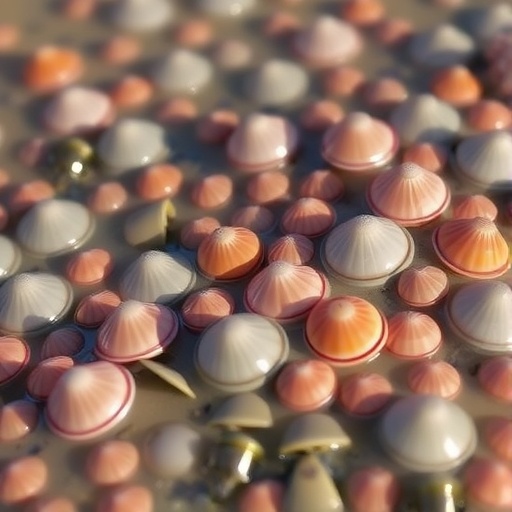
In a rare and scientifically invaluable moment, marine biologists have documented the precise window when a notorious global invader breaches one of the last remaining strongholds in the Northern Hemisphere. The Manila clam, Ruditapes philippinarum, a species that has reshaped coastal ecosystems and generated a multibillion-dollar global aquaculture industry, has officially established itself along the northeastern coast of the United States. The discovery, published in the journal Biological Invasions, closes the final major geographic gap for a shellfish that has been on a century-long march across the world’s temperate shorelines, from the American Pacific coast to the Mediterranean. The event marks the first confirmed reproductive populations between Cape Cod and Boston Harbor, representing a critical, fleeting snapshot of an invasion in its infancy.
The home range of the Manila clam arcs from the Sakhalin Islands of Russia through Japan and into the warm waters of southern China. However, starting in the early twentieth century, a combination of accidental transport and deliberate introduction for aquaculture seeded the clams into distant waters, where their adaptability allowed them to flourish. They now underpin a staggering $7 billion per year global industry, prized for their sweet, firm flesh in cuisines worldwide. Yet this commercial success masks a complex ecological identity. Where they become abundant, Manila clams can outcompete native bivalves for space and resources, alter benthic community structure through dense colonization, and even hybridize with local venerid species. Yet, as researchers point out, their arrival is not an unalloyed ecological disaster; they can simultaneously become a rich energetic subsidy for native predators like racoons, diving seabirds, and voracious crustaceans such as the invasive green crab, potentially relieving predatory pressure on struggling native shellfish.
The serendipitous unveiling of this invasion was not the work of a single expedition but a convergence of vigilant monitoring networks. In the summer of 2025, Aly Putnam, a postdoctoral researcher at the University of Massachusetts Amherst and lecturer at Smith College, was leading an intertidal biodiversity workshop on Spectacle Island in Boston Harbor. A text message arrived from collaborator El Fernekees Hartshorn, containing a photograph of a suspicious clam shell—a potential Manila clam. Simultaneously, Carolina Bastidas, a research scientist with MIT Sea Grant, was part of the same field team, and the duo began purposefully scanning the wrack line, finding an abundance of tell-tale shells. Unbeknownst to them, Owen Nichols and colleagues at the Center for Coastal Studies were receiving a parallel stream of reports from commercial shellfishermen operating around Provincetown, at the northern tip of Cape Cod, who had been encountering “weird clams” in their hauls since 2023.
The two parallel investigations were destined to merge through the intervention of James T. Carlton, an emeritus professor of marine sciences at Williams College and a towering figure in invasion biology. When Carlton learned of the accumulating shell records, he issued a critical directive that transformed the discovery from a collection of dead valves into a definitive biological record. “Find me living clams,” he urged the teams, insisting on evidence of reproduction and recruitment—specifically, juvenile spat and females with active gonads. His insistence on life-history proof is the gold standard for distinguishing a transient introduction from a self-sustaining, established invasion. The teams responded, spending hours digging in the intertidal zones of Squantum in Quincy and Calf Pasture Park in Boston. Using rigorous sieve-based quantitative sampling, they extracted dozens of live specimens, many smaller than a human thumbnail, confirming recent settlement and the critical transition from drifters to settlers. Concurrently, dissections of specimens from Cape Cod revealed female clams with histological evidence of recent spawning activity.
The combined dataset from Boston Harbor and outer Cape Cod paints a picture of a species no longer just arriving but actively engineering its foothold. The ability to catch an invasion at this “pinpoint establishment phase,” as Carlton described it, is exceptionally rare. Most invasive species are detected only after they have become widely distributed and ecologically entangled, obfuscating the early dynamics of their spread. Here, the collaboration between rapid assessment survey networks, academic researchers, and the situated knowledge of local clammers provided a multi-focal lens on the moment of colonization. This synergy allowed the team to document the clam’s initial substrate preferences, size-class distributions, and co-occurring species assemblages, establishing a baseline against which all future ecological shifts in the system can be measured.
While the arrival vector remains speculative, the implications are already materializing. The northwestern Atlantic is a heavily invaded marine ecoregion, and the Manila clam’s entry adds a functionally novel, fast-burrowing suspension feeder capable of reaching densities exceeding hundreds of individuals per square meter. Its physiological tolerance for a wide range of temperatures and salinities makes it a formidable competitor. From a trophic perspective, the species could redirect significant benthic energy flows. Manila clams often dominate the diets of native predators, effectively replacing endemic prey items and recalibrating predator-prey dynamics. For the commercial shellfishing sector, the clam introduces both a market opportunity and a potential threat to iconic local fisheries for softshell clams (Mya arenaria) and quahogs (Mercenaria mercenaria), with which it shares habitat and functional traits.
As the scientific community digests this latest biogeographic shift, the focus turns to forecasting its ripple effects. Putnam emphasized that the discovery is merely the starting signal for a long-term ecological experiment none of the researchers designed. Understanding whether the Manila clam will remain a minor faunal addition or transform into a dominant ecosystem engineer requires sustained monitoring of its recruitment success, larval dispersal corridors, and competitive interactions with native bivalves under varying climate scenarios. Bastidas noted that while the clams may reduce predatory grazing pressure on softshell clams by acting as an alternative prey buffer, the net ecological outcome remains a complex unknown. The race is now on to map the invisible leading edge of the invasion front before it sweeps into new embayments, potentially altering New England’s iconic coastline in ways that will take decades to fully unravel.
Subject of Research: Establishment and early-stage invasion dynamics of the Manila clam (Ruditapes philippinarum) in the Northwest Atlantic Ocean.
Article Title: Completing the journey in the global north: the Manila clam (Ruditapes philippinarum) (Bivalvia: Veneridae) arrives in the Northwest Atlantic Ocean.
News Publication Date: 01-Mar-2026
Web References: DOI: 10.1007/s10530-026-03861-z; Media Kit: https://drive.google.com/drive/folders/1cU5fnpc2M6nhe1MbeIWuqdPQaUqDcOH-?usp=sharing
References: Biological Invasions, 2026.
Image Credits: Aly Putnam
Keywords: Marine invasion biology, Manila clam, Ruditapes philippinarum, establishment phase, Northwest Atlantic, benthic ecology, invasive species, rapid assessment survey, shellfish aquaculture, predator-prey dynamics.


