


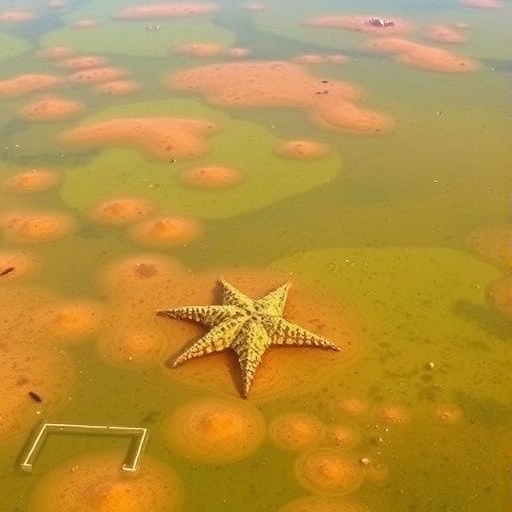
A single microscopic alga has been unmasked as the most toxic bloom-forming species ever studied, reaching a potency that scientists describe as an order of magnitude greater than any previously recorded. The finding, published today in Nature Ecology & Evolution, explains the staggering scale of death that has washed over South Australia’s coastline for more than 15 months, and it raises an urgent new concern: this cold-water killer could emerge in any temperate sea with similar conditions.
The organism at the centre of the crisis is Karenia cristata, a marine microalga that releases a cocktail of neurotoxic compounds dominated by brevetoxins. These lipid-soluble cyclic polyethers are infamous for binding to site 5 on voltage-gated sodium channels in nerve cells, forcing the channels to open at resting membrane potential and triggering uncontrolled neuronal firing. In vertebrates and invertebrates alike, the result is rapid neuromuscular paralysis, respiratory failure and, for countless animals caught in the bloom, death. The researchers, led by Professor Shauna Murray of the University of Technology Sydney, had first identified K. cristata as the source of brevetoxins during the event’s early months. Now, using three independent bioassay platforms and targeted chemical analyses on both laboratory-cultured strains and field water samples, they have quantified just how extraordinarily lethal this species really is.
“We’ve now established that Karenia cristata, which releases a range toxic compounds including brevetoxins, has stronger toxic effects than previously studied harmful algal bloom species,” Murray said. The team’s toxicological assays revealed that the cultured microalgae remained highly toxic even at cell concentrations so low they would barely be visible in a plankton net tow. That potency aligns precisely with environmental cell counts measured during the mass mortality pulses of 2025 and 2026, when beaches became littered with dead fish, rays, seals and seabirds. The researchers found that K. cristata is an order of magnitude more toxic than the next most toxic microalga ever examined—a statistical leap that redefines the upper boundary of marine biotoxin risk.
Until now, the warm-water brevetoxin producer Karenia brevis, infamous for recurring red tides that plague Florida’s Gulf Coast, had been considered the most devastating harmful algal bloom species in terms of environmental and economic damage. K. brevis blooms can kill millions of fish and cause respiratory irritation in humans via aerosolised toxins. Yet the new data show that its cold-water cousin K. cristata outpaces it dramatically in per-cell toxicity. “This unprecedented event has international consequences, because we now know of a cold water brevetoxin producing Karenia that could potentially bloom anywhere with similar coastal water conditions,” Murray warned. Temperate coastlines from southern Australia to New Zealand, Chile, and even the Atlantic shores of Europe may now need to be on alert for a threat that previously seemed confined to the subtropics.
The South Australian harmful algal bloom, a complex consortium of phytoplankton species of which K. cristata is the principle toxic player, ignited in early 2025 and has not fully dissipated even now, some 15 months later. The researchers used high-resolution molecular genetic techniques, including metabarcoding and quantitative PCR, to map the spatial and temporal distribution of the Karenia species through multiple phases of the bloom. These data confirmed that toxin concentrations in seawater rose and fell in lockstep with K. cristata cell abundance, while other co-occurring microalgae remained minor toxicological actors. The paper, titled “A catastrophic marine mortality event caused by a complex algal bloom including the brevetoxin producer Karenia cristata”, details how the environmental devastation encompassed mass die-offs of commercially important molluscs, crustaceans, and finfish, alongside charismatic megafauna such as dolphins and sea lions.
Murray stressed that a harmful algal bloom of this magnitude is a natural disaster on a par with a cyclone or a wildfire, and humanity cannot expect to fully control or reverse it. “Understanding the ecology, physiology and genetics of Karenia cristata will be the basis though to develop testing and possibly even future mitigation methods to help protect aquaculture and inform public health management,” she said. The team’s ongoing work aims to untangle the environmental triggers that sent the microalga into explosive growth, including the possible roles of upwelling, nutrient fluctuations and shifting ocean temperatures. Early genomic runs hint that the species may possess an unusually large gene arsenal for producing bioactive secondary metabolites beyond brevetoxins, a finding that could explain its unparalleled toxic punch and is now being pursued through full-genome sequencing.
The study was supported by the Fisheries Research and Development Corporation, the New Zealand Ministry of Business, Innovation and Employment’s Seafood Safety Research Platform, and the Endeavour research programme ‘From Reactive to Resilient: Effectively Managing Our Changing Microalgal Communities’. Scientists involved from the Cawthron Institute in New Zealand and the University of Adelaide brought complementary expertise in toxin chemistry and marine ecology, cementing a trans-Tasman collaboration that has now set a grim global benchmark.
For coastal communities, the revelation reshapes how risk is calculated. Existing monitoring programmes largely built around warm-water Karenia species will need recalibration to detect the low cell densities at which K. cristata can still cause ecosystem-scale destruction. And as climate change reshuffles the deck of ocean conditions, the appearance of such a highly toxic cold-adapted brevetoxin producer serves as a stark notice that marine biotoxin hazards are not static. They are emerging, evolving and, in this case, deadlier than science ever imagined.
Cite Scienmag News
Gavin Prescott. (July 6, 2026). South Australia’s algal bloom is the most toxic microalga recorded. Scienmag. https://scienmag.com/south-australias-algal-bloom-is-the-most-toxic-microalga-recorded/
Gavin Prescott. "South Australia’s algal bloom is the most toxic microalga recorded." Scienmag, 6 July 2026, https://scienmag.com/south-australias-algal-bloom-is-the-most-toxic-microalga-recorded/. Accessed 4 September 2026.
Gavin Prescott. "South Australia’s algal bloom is the most toxic microalga recorded." Scienmag. July 6, 2026. https://scienmag.com/south-australias-algal-bloom-is-the-most-toxic-microalga-recorded/


