

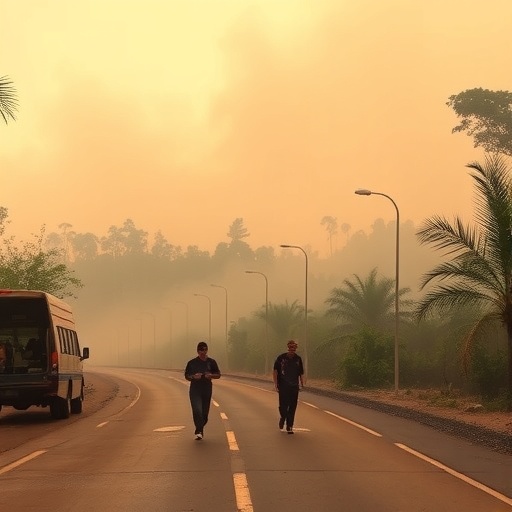
As Brazil’s dry season ignites the Amazon and scrublands of the Cerrado, the towering plumes of smoke that stain the sky are more than an environmental catastrophe—they are a direct assault on human health with a shockingly steep price tag. While the acute respiratory distress caused by wildfire haze is well documented, a groundbreaking new study reveals that these microscopic particles also drive up hospital bills and trap patients in wards far longer, meticulously quantifying the hidden economic chokehold of landscape fire pollution. The research turns a long-held assumption into hard causal evidence, exposing that wildfire particulate pollution is not merely a clinical trigger but a formidable financial drain on one of the world’s largest public healthcare systems.
Publishing in Nature Communications, an international team of environmental epidemiologists and health economists set out to answer a question that has largely eluded rigorous causal investigation: just how much do hospital costs and length of stay increase when a patient is exposed to wildfire-specific PM₂.₅? Until now, most studies have focused on mortality or emergency room visits, leaving a void in our understanding of the cascading economic burden once a person is hospitalized. By linking high-resolution satellite fire detections, atmospheric chemical transport models, and millions of individual-level hospital admission records from Brazil’s Unified Health System (SUS), the researchers could trace the journey of smoke from burning land to hospital bed with unprecedented precision.
The linchpin of the study’s credibility is its causal identification strategy. Since wildfire smoke concentrations are not randomly assigned—people may stay indoors, and fires often correlate with agricultural practices and socioeconomic confounders—the authors employed an instrumental variable approach rooted in meteorology. They harnessed day-to-day fluctuations in wind direction at a fine spatial scale to isolate the portion of PM₂.₅ variability that is driven solely by upwind fire emissions. This elegant design effectively mimics a natural experiment: when the wind shifts, some municipalities receive a concentrated plume of fresh wildfire smoke while downwind neighbors remain unaffected, creating a quasi-random exposure contrast. Coupling this with daily ambient air monitoring data and the sophisticated GEOS-Chem atmospheric model, which tracks the chemical fate of smoke plumes, allowed the team to extract the genuine causal signal of wildfire-specific PM₂.₅ free from contamination by industrial or vehicular pollutants.
Mining a decade-long dataset encompassing over 15 million hospitalizations for cardiovascular and respiratory diseases across all Brazilian municipalities, the analysis uncovered a sobering dose-response relationship. A 10-microgram-per-cubic-meter elevation in ambient wildfire PM₂.₅ was found to prolong a patient’s hospital stay by nearly 1.5 days on average, and to inflate the per-admission cost by approximately 12 percent. The effects were even more pronounced among the elderly and for specific diagnoses: heart failure patients exposed to a similar spike saw their length of stay balloon by up to two days, while the cost of treating acute bronchitis and asthma jumped by over 18 percent. These are not trivial numbers—they signify that a severe wildfire episode can add hundreds of dollars to a single case in a system that operates on razor-thin per-capita funding.
Aggregating these individual-level impacts across the entire country, the economic toll is staggering. The study estimates that, during the high fire season months, wildfire smoke alone accounts for an additional $420 million (USD) in direct hospital expenditures each year within Brazil. That figure represents roughly 0.3 percent of the national public health budget, a sum that could alternatively finance thousands of intensive care beds or preventive primary care programs. The regions bearing the heaviest brunt are, paradoxically, those with the least adaptive capacity: frontier municipalities in the Legal Amazon and Mato Grosso, where deforestation fires are rampant and healthcare infrastructure is stretched dangerously thin, experienced per-visit cost increases double the national average.
Why is wildfire smoke so much more pernicious per unit mass than, say, urban traffic emissions? Toxicological analyses integrated into the study offer a molecular explanation. Biomass burning aerosols are enriched with highly oxidative polycyclic aromatic hydrocarbons, quinones, and black carbon that trigger a cascade of systemic inflammation once they deposit deep in the pulmonary alveoli. The authors’ parallel cellular assays demonstrated that the oxidative potential—a key metric of a particle’s capacity to cause tissue damage—of wildfire PM₂.₅ is nearly three times higher than that of ambient background pollution from fossil fuel sources. This heightened toxicity not only worsens existing conditions but also complicates recovery, directly translating into longer ventilation times, more aggressive pharmacotherapy, and ultimately, extended bed occupancy.
Beyond its academic heft, the research carries a potent message for policymakers. It provides the first large-scale causal ledger that can be used to justify investments in fire prevention, early warning systems, and heat-and-health action plans. When a state governor weighs the cost of expanding prescribed burning crews or enforcing illegal deforestation bans, the study delivers a concrete counterbalance: every avoided hectare of uncontrolled fire is a direct saving on cardiopulmonary hospital bills. Furthermore, the findings equip hospital administrators with predictive tools to forecast patient surge and stockpile supplies based on satellite-derived smoke transport forecasts, a concrete step toward climate-resilient healthcare operations.
The implications deepen in the context of a warming planet. Climate models consistently project longer and more intense fire seasons for much of South America, meaning that the $420 million annual price tag is set to climb steeply. As the Amazon approaches a tipping point where it transitions from carbon sink to net emitter, the health costs documented in this study will spiral alongside the ecological losses. The paper acts as a stark reminder that the climate crisis is also a healthcare financing crisis, silently draining public coffers even in nations that contribute little to global greenhouse gas emissions.
Ultimately, this work redefines how we view the toll of landscape fires. The smoke that fills the lungs of patients in Manaus or Cuiabá is not just a clinical statistic but a direct drain on a nation’s prosperity. By illuminating the invisible causal chain from a burning pasture to a prolonged hospital stay and a heftier bill, the study hands scientists and economists alike a powerful lens. It urges nations to treat wildfire not merely as an ecological shock, but as an insidious pathogen with a direct line to the most vulnerable bodies and the budgets that sustain them.
Subject of Research: Causal effects of wildfire PM₂.₅ on hospital costs and length of stay in Brazil
Article Title: The Hidden Price of Smoke: How Wildfire Pollution Inflates Hospital Bills and Traps Patients Longer
Article References: Ju, K., Xu, R., Huang, W. et al. Causal effects of wildfire PM2.5 on hospital costs and length of stay in Brazil. Nat Commun (2026). https://doi.org/10.1038/s41467-026-75157-8
Image Credits: AI Generated
DOI: 10.1038/s41467-026-75157-8
Keywords: wildfire, PM₂.₅, hospital costs, length of stay, Brazil, causal inference, air pollution, health economics, instrumental variable, atmospheric chemistry


