


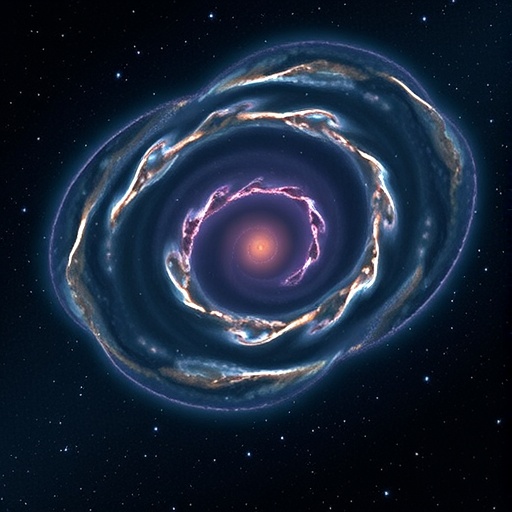
A groundbreaking investigation combining observations from the European Space Agency’s (ESA) XMM-Newton and NASA’s Chandra X-ray space telescopes has provided unprecedented insights into the structure of the Milky Way’s outer spiral arms. This research focuses on the detection and analysis of X-ray echoes from gamma-ray bursts (GRBs), revealing the positions of distant galactic arms to be up to ten percent farther than previously estimated. These findings mark a significant advancement in our understanding of the complex architecture of our home galaxy.
For decades, astronomers have grappled with the challenge of accurately mapping the Milky Way’s extensive spiral arms, particularly the outer reaches. Earth’s systemic perspective from within the galactic disc obstructs a comprehensive, unobstructed view, compounded by pervasive cosmic dust clouds that absorb and scatter visible light. Traditional methods of gauging distances in these regions, often reliant on rotational models, have been met with inherent uncertainties. However, the combination of precise star measurements from ESA’s Gaia mission with novel X-ray scattering techniques introduces a powerful dual approach to charting galactic features with greater fidelity.
ESA’s Gaia satellite, launched with the aim of compiling an exhaustive three-dimensional map of the Milky Way, has dramatically refined stellar distance measurements within the galaxy’s inner regions. Its astrometry data has resolved longstanding debates such as the total count of spiral arms in the Milky Way, conclusively verifying four main arms. Yet, Gaia’s optical-based observations lose accuracy in the obscured, distant outer arms, where interstellar dust diminishes the precision of parallax estimates. This necessitated the exploration of complementary observational platforms.
Enter XMM-Newton and Chandra, two formidable X-ray observatories that probe the high-energy universe. Their capability to detect and image X-ray emissions—unimpeded by dust extinction that plagues optical and infrared wavelengths—positions them uniquely to study diffuse matter in the galactic outskirts. In the recent study led by astrophysicist Beatrice Vaia at the Istituto Nazionale di Astrofisica (INAF), the team exploited X-ray light echoes generated by powerful GRBs far beyond our galaxy. These bursts emitted intense radiation, part of which was scattered by dust grains embedded in the Milky Way’s spiral arms, creating discernible ring-like structures detectable by XMM-Newton and Chandra.
The mechanics of this phenomenon are anchored in the physics of dust scattering. When a GRB’s prompt X-ray photons encounter dust grains along the line of sight, the resulting scattered photons reach observers on Earth after a slight delay, producing expanding concentric rings over time. By precisely measuring the angular expansion rates and temporal evolution of these rings, the researchers computed the exact distances to the responsible dust clouds — effectively mapping the Milky Way’s dust layers embedded in the spiral arms. This technique bypasses the assumptions inherent to rotation-based distance models, offering direct empirical measurements.
Among the notable revelations was confirmation of the distance to the well-studied Perseus arm. More striking, however, was the revision of the distances to two outer arms: the Scutum-Centaurus and the Outer Arm. Both were found to be situated roughly 10% further away than existing models suggested. This adjustment implies that our galaxy’s dimensions and the spatial relationships of its structural components require re-evaluation, with cascading implications for understanding galactic formation, stellar population distributions, and the dynamics of spiral density waves.
This study exemplifies how longstanding missions continue to deliver transformative science decades after their launch. XMM-Newton, operating since 1999, and Chandra have provided a continuous stream of novel astrophysical insights, ranging from the most luminous gamma-ray bursts ever observed to the high-energy processes that govern black hole accretion and planetary phenomena. Their synergy with Gaia’s precise optical survey data highlights the indispensable value of multiwavelength astronomy in decoding the complex layers of our galaxy.
Looking ahead, the astrophysical community anticipates further refinement of galactic mappings through forthcoming Gaia data releases, notably the fourth and fifth, slated for late 2026 and beyond 2030. These releases promise enhanced parallax and proper motion measurements extending to fainter and more distant stars. Concurrently, ESA’s next-generation X-ray observatory, NewAthena, is poised to revolutionize high-energy astronomy by detecting fainter X-ray signals and resolving the finer structures of galactic and extragalactic environments, enabling even more precise characterization of dust distributions and their relation to galactic morphology.
The integration of X-ray echo methodologies represents a paradigm shift in galactic cartography. By circumventing dust obscuration limitations, scientists cultivate a truer picture of the Milky Way’s size and shape, essential for contextualizing the galaxy in a cosmological framework. These advances will refine models of star formation rates, the distribution of molecular clouds, and the overall mass and gravitational potential profile, enriching our understanding of the forces sculpting our cosmic neighborhood.
Moreover, this research underscores the symbiotic relationship across space agencies and observational platforms. The sharing of data and coordinated campaigns between ESA and NASA telescopes amplify the scientific return on investment and foster collaborative innovation. By pooling resources and expertise, the astrophysics community accelerates progress in unveiling the intricate structures hidden within and beyond our galaxy.
In sum, the discovery that Milky Way’s outer arms — the Outer Scutum-Centaurus Arm and the Outer Arm — reside farther from the Solar System than previously believed not only reshapes galactic maps but opens new avenues for astrophysical inquiry. Such refined measurements are foundational stepping stones toward unraveling broader mysteries, including the galaxy’s formation history, spiral arm genesis, and the distribution of dark matter. As technology and observational strategies evolve, we stand on the threshold of a new era where the Milky Way’s architecture is charted with unprecedented clarity.
—
Keywords
Milky Way, Galactic structure, Spiral arms, X-ray astronomy, Gamma-ray bursts, Dust scattering, ESA Gaia, XMM-Newton, Chandra, Galactic mapping, Astrophysics, High-energy astrophysics
Cite Scienmag News
Grant Pearson. (July 1, 2026). XMM-Newton Sheds New Light on Distances to Outer Spiral Arms. Scienmag. https://scienmag.com/xmm-newton-sheds-new-light-on-distances-to-outer-spiral-arms/
Grant Pearson. "XMM-Newton Sheds New Light on Distances to Outer Spiral Arms." Scienmag, 1 July 2026, https://scienmag.com/xmm-newton-sheds-new-light-on-distances-to-outer-spiral-arms/. Accessed 1 September 2026.
Grant Pearson. "XMM-Newton Sheds New Light on Distances to Outer Spiral Arms." Scienmag. July 1, 2026. https://scienmag.com/xmm-newton-sheds-new-light-on-distances-to-outer-spiral-arms/


