


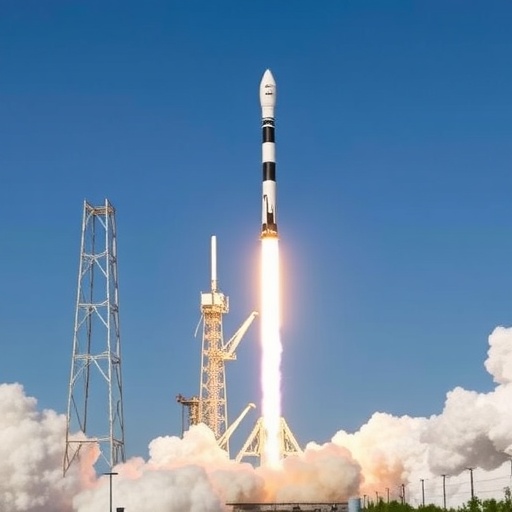
A team of over sixty students and faculty members at the University of Southern California (USC) has brought to life an ambitious nanosatellite project known as MAVERIC. This shoebox-sized spacecraft, classified as a 3U CubeSat, is scheduled for launch aboard a SpaceX Falcon 9 rideshare mission in July. Designed to pioneer the next generation of autonomous space technology, MAVERIC embodies a multifaceted approach towards enhancing the capabilities of small satellite missions and advancing on-orbit servicing technologies.
MAVERIC’s core mission is rooted in the integration of sophisticated imaging systems, low-cost magnetic field sensors, and artificial intelligence (AI) enabled navigation tools. Its imaging payload consists of a dual-camera setup capable of producing both two-dimensional and three-dimensional visual data. This capacity is essential for future spacecraft operations involving close-proximity servicing, where one satellite inspects, repairs, or refuels another. Such operations require high fidelity data streams and situational awareness, particularly as autonomous systems take on increasingly complex roles in space.
The development strategy centers on enabling spacecraft to operate more autonomously without relinquishing human oversight in critical decision-making processes. David Barnhart, a research professor of astronautical engineering at USC’s Viterbi School of Engineering and director of the Space Engineering Research Center, emphasizes the importance of human trust in autonomy. “Being able to watch what’s happening and step in when necessary during these delicate operations fosters confidence in automated systems,” Barnhart explains. This balanced approach between autonomy and human control underpins MAVERIC’s technical objectives.
USC’s Space Engineering Research Center, situated within Southern California’s rich aerospace corridor, orchestrates MAVERIC’s design, assembly, and testing. The interdisciplinary collaboration brings together expertise from the USC Viterbi School of Engineering, the USC Information Sciences Institute, and numerous industry partners. Over the past two years, students at every academic level have engaged hands-on with MAVERIC’s hardware and software development, translating theoretical coursework into tangible flight-ready technologies.
One of the satellite’s novel features is its employment of magnetic field sensing for navigation. Unlike conventional satellites that primarily rely on reaction wheels to maintain attitude control, MAVERIC uses Earth’s magnetic field for orientation adjustments. This approach promises a reduction in mechanical failure modes and system cost, while enabling increased autonomy. Flight data collected during the mission will be used together with AI-based reinforcement learning algorithms to refine onboard navigation systems, illustrating a closed-loop model of continuous in-orbit software improvement.
Additionally, MAVERIC serves as an experimental platform for Planetary Systems AI, which is testing its AI-driven decision-support software in space for the first time. Utilizing imagery captured by the satellite, the AI models are trained and evaluated on-orbit, reducing dependence on ground-based processing and bandwidth-intensive downlinking of raw data. The in-flight demonstration represents a crucial milestone for incorporating machine learning directly into satellite system operations, potentially revolutionizing space data handling.
Another key innovation aboard MAVERIC is a low-cost, high-precision magnetic field sensor array. By deploying these sensors in space, the mission seeks to contribute to improved measurements of Earth’s magnetosphere. The ability to deploy multiple CubeSats equipped with such sensors could dramatically enhance our understanding of space weather phenomena, which directly affect satellite operation and communication infrastructure on Earth.
The satellite’s multifaceted experimental payloads align with the emerging demands of the commercial and scientific space communities for smarter, safer, and more durable spacecraft. MAVERIC exemplifies how university-led initiatives can push the envelope in aerospace research, nurturing the next wave of engineers and scientists by providing them with direct mission experience. This experience spans designing satellite hardware, conducting operations via dedicated ground stations, and participating in data analysis of active space missions.
Through MAVERIC, USC also illustrates the important role of academic institutions as incubators of innovation that bridge the gap between theory and practical application. The collaborative framework with industry partners like Planetary Systems AI provides a real-world testing environment for emerging space technologies, accelerating their readiness level. This symbiotic relationship demonstrates a new model for technology maturation where academic research directly fuels operational spaceflight capabilities.
The interdisciplinary nature of MAVERIC’s development also facilitates knowledge transfer across fields such as aerospace engineering, AI, computer vision, and space systems operation. This breadth equips students with a comprehensive skill set, well-preparing them for careers in the rapidly evolving space sector. The mission’s challenges embody real-world complexities, including stringent environmental requirements, limited power and volume constraints, and the necessity for fault-resilient software architectures.
Looking forward, MAVERIC’s successful deployment and operation could pave the way for a new class of autonomous nanosatellites capable of self-directed servicing, environmental monitoring, and more. The innovations tested will contribute to protocols for safer close-proximity interactions between spacecraft, a critical enabler for sustainable space operations, and advanced space traffic management. Additionally, the utilization of AI onboard satellites promises a paradigm shift in how satellite missions handle data acquisition, processing, and decision-making remotely.
In summary, MAVERIC stands at the forefront of the nanosatellite revolution, integrating cutting-edge technologies that challenge traditional spacecraft paradigms. By effectively marrying state-of-the-art imaging, AI, and navigation systems within a compact satellite form factor, USC’s endeavor showcases the transformative potential for autonomous space systems. The mission underscores the importance of academic-driven research and public-private partnerships in advancing humanity’s reach into and understanding of space.
News Publication Date: Not specified in the content provided
Web References:
- USC Space Engineering Research Center: https://www.isi.edu/centers-serc/research/nanosatellites/maveric/
- SpaceX Falcon 9: https://www.spacex.com/vehicles/falcon-9
- Planetary Systems AI: https://planetarysystems.ai/
Keywords
MAVERIC, nanosatellite, CubeSat, autonomous spacecraft, on-orbit servicing, AI navigation, space imaging, magnetic field sensing, USC Space Engineering Research Center, Planetary Systems AI, reinforcement learning, space technology innovation
Cite Scienmag News
Grant Pearson. (June 30, 2026). USC Satellite Set to Launch into Orbit on SpaceX Mission. Scienmag. https://scienmag.com/usc-satellite-set-to-launch-into-orbit-on-spacex-mission/
Grant Pearson. "USC Satellite Set to Launch into Orbit on SpaceX Mission." Scienmag, 30 June 2026, https://scienmag.com/usc-satellite-set-to-launch-into-orbit-on-spacex-mission/. Accessed 4 September 2026.
Grant Pearson. "USC Satellite Set to Launch into Orbit on SpaceX Mission." Scienmag. June 30, 2026. https://scienmag.com/usc-satellite-set-to-launch-into-orbit-on-spacex-mission/


