


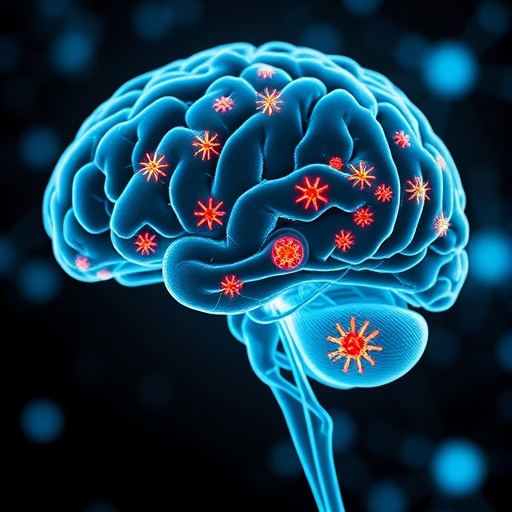
In the evolving landscape of traumatic brain injury (TBI) research, a transformative review published in Brain Medicine redefines how we understand and potentially treat this devastating condition. Traumatic brain injury, historically viewed as a localized assault on the brain — a singular event where trauma causes damage that largely remains confined — is now illuminated as a far more systemic and intricate biological disruption. This new perspective comes from Dr. Ye Xiong and colleagues, whose comprehensive synthesis ushers in a paradigm where TBI is likened to ripples from a stone dropped in water, where the initial blow triggers cascading effects reaching beyond the brain, influencing vital organs including the lungs, heart, and gut.
At the heart of this novel conceptualization lies the role of extracellular vesicles—tiny, membrane-bound parcels released by cells under stress. These minuscule messengers carry proteins, RNA, and other bioactive molecules capable of signaling tissue damage and orchestrating systemic responses. Dr. Xiong’s review posits that vesicles derived from mesenchymal stromal cells (MSCs), renowned for their regenerative versatility, can be harnessed therapeutically, delivering tailored molecular payloads capable of modulating inflammation, promoting repair, and restoring function—without the use of live cellular transplants.
Unlike experimental studies restricted to narrow questions, this review integrates findings across preclinical models, revealing a consistent theme: MSC-derived extracellular vesicles improve sensorimotor skills and cognition, reduce brain lesions, and stimulate neurogenesis in the hippocampus. Notably, these therapeutic benefits manifest even when treatment initiation is delayed by several days post-injury, highlighting a clinically relevant window for intervention. This timing matters profoundly in real-world scenarios, where immediate medical response following brain trauma is often challenging.
The review’s biological insights delve deeply into the dual phases of TBI. The primary mechanical insult causes immediate, irreversible damage. However, it is the secondary wave of biochemical cascades—characterized by excitotoxicity, oxidative stress, disruption of the blood-brain barrier, and vicious cycles of neuroinflammation—that presents actionable targets for therapy. Intriguingly, the injured brain also dispatches its own endogenous vesicles into systemic circulation, often carrying pro-inflammatory signals that inadvertently perpetuate damage in distant organs, thereby compounding the patient’s clinical burden.
Leveraging the inherent communication pathways of extracellular vesicles, the authors discuss how therapeutic vesicles from MSCs differ fundamentally in cargo and intent. These therapeutic carriers shuttle microRNAs and proteins that dampen inflammation, bolster mitochondrial resilience, and promote angiogenesis—ushering in regenerative processes that counterbalance the initial injury. This complex, multipart messaging capability may explain why conventional single-target therapies have faltered against the multifaceted nature of TBI pathophysiology.
Crucially, the review extends beyond rodent models, incorporating data from large-animal studies that bridge the translational gap. In pigs experiencing combined brain injury and hemorrhagic shock, MSC vesicles attenuated the inflammatory milieu and improved organ function without discernable toxicity. Even more compelling, in rhesus monkeys suffering cortical injuries affecting hand function, vesicle treatment accelerated recovery, restored precise motor control, and normalized microglial activation patterns—findings strongly suggestive of human clinical potential.
Despite these advances, the review candidly acknowledges the limited human data. To date, reports include an isolated case of severe TBI demonstrating notable motor and cognitive recovery over months and a small cohort of combat-related injury patients showing functional improvements with vesicle therapy. These preliminary human experiences are insufficient to determine efficacy definitively, underscoring the urgent need for robust, controlled clinical trials to validate safety, dosing, and therapeutic indices.
Looking ahead, the review embraces next-generation bioengineering approaches designed to enhance vesicle therapeutic performance. Cutting-edge techniques involve enriching vesicle cargo with specific, therapeutically beneficial microRNAs, employing CRISPR gene editing on parent MSCs to customize payloads, and functionalizing vesicle surfaces with peptides derived from the rabies virus to target neurons selectively and traverse the blood-brain barrier effectively. Additionally, biomaterial scaffolds designed to retain vesicles at injury sites promise sustained, localized delivery, mitigating rapid clearance by liver and spleen.
The delivery mechanism itself emerges as a sophisticated, dual-route strategy marrying intravenous and intranasal approaches. Intravenous routes predominantly reach peripheral organs that suffer secondary injury consequences, whereas intranasal administration bypasses the blood-brain barrier, enabling direct transportation along olfactory and trigeminal neural pathways into central nervous system compartments. This synergistic delivery capitalizes on each method’s strengths to maximize therapeutic reach.
Artificial intelligence and machine learning are highlighted as transformative tools enabling the resolution of vesicle molecular complexity. These computational methods sift through vast, fragmented datasets to identify molecular cargo signatures most predictive of healing, monitor production quality in manufacturing, and stratify patient populations for optimized personalized treatment. Nevertheless, the review honestly confronts current limitations, such as the lack of standardized datasets and methodological heterogeneity, which impede the generalizability and reliability of AI-generated models.
Finally, the review underscores the formidable practical challenges that lie between promising biology and real-world therapeutic application. Scalable production of MSC-derived vesicles with consistent potency, standardization of dosing regimens, and regulatory frameworks for quality control remain critical unresolved hurdles. Agencies like the FDA and EMA are currently defining criteria, but consensus is nascent. These foundational issues require patient, meticulous work beyond molecular innovation itself.
In essence, this review reorients TBI research towards a holistic, systemic view—treating the brain not as an isolated organ but as part of an intricate dialogue with the body. Where once extracellular vesicles were seen as biomarkers or debris, they now emerge as a language that might be learned, engineered, and harnessed to orchestrate healing. While the path is still unfolding, this synthesis offers a compass to navigate the complexities of future trials and therapeutic development, heralding a new horizon in the quest to mitigate the devastating aftermath of brain injury.
News Publication Date: 30 June 2026
Web References:
https://doi.org/10.61373/bm026i.0048
References:
Xiong Y, Zhang Y, Zhang ZG, Chopp M. Mesenchymal stromal/stem cell-derived extracellular vesicles as a cell-free therapeutic strategy for traumatic brain injury. Brain Medicine 2026. DOI: https://doi.org/10.61373/bm026i.0048. Epub 2026 Jun 30.
Keywords
Traumatic Brain Injury, Extracellular Vesicles, Mesenchymal Stromal Cells, Neuroinflammation, Neuroregeneration, Blood-Brain Barrier, Neuroprotection, CRISPR Engineering, Artificial Intelligence, Intranasal Delivery, Intravenous Infusion, Large-Animal Models
Cite Scienmag News
Cassandra Pierce. (June 30, 2026). Brain Signals Body After Injury: Review Suggests Discarded Vesicles May Drive Repair. Scienmag. https://scienmag.com/brain-signals-body-after-injury-review-suggests-discarded-vesicles-may-drive-repair/
Cassandra Pierce. "Brain Signals Body After Injury: Review Suggests Discarded Vesicles May Drive Repair." Scienmag, 30 June 2026, https://scienmag.com/brain-signals-body-after-injury-review-suggests-discarded-vesicles-may-drive-repair/. Accessed 4 September 2026.
Cassandra Pierce. "Brain Signals Body After Injury: Review Suggests Discarded Vesicles May Drive Repair." Scienmag. June 30, 2026. https://scienmag.com/brain-signals-body-after-injury-review-suggests-discarded-vesicles-may-drive-repair/


