


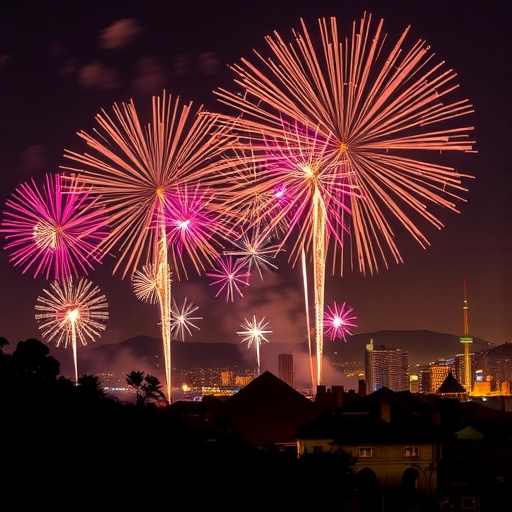
A surge of recent scientific investigations has illuminated the complex environmental repercussions stemming from the use of fireworks, an age-old tradition synonymous with celebration and spectacle worldwide. These comprehensive studies, disseminated through leading journals of the American Chemical Society (ACS), delve deeply into the chemical residues, airborne particulate matter, and gaseous compounds emitted during and after pyrotechnic displays. The revelations from these studies not only expand the scientific community’s understanding of fireworks’ environmental footprint but also underscore the broader implications for human health and ecological systems.
The first pivotal study, conducted under controlled laboratory conditions and published in Environmental Science & Technology, systematically analyzed the chemical constituents present in firecracker residue and its subsequent interaction with aquatic ecosystems. Researchers found that once firecrackers cease their visual allure, they leave behind a residue rich in partially combusted pyrotechnic fuels, metal salts integral to vivid coloration, and fragmented packaging materials. When these residues enter freshwater bodies such as lakes and rivers, they release substantial loads of metal ions—specifically potassium and manganese—and a variety of dissolved organic matter, including simple phenolic compounds and organosulfur species. Simultaneously, the remaining solid particulate matter adsorbs high-molecular-weight dissolved substances from the water. This dynamic exchange alters the water chemistry, potentially disrupting microbial populations and aquatic biota, which rely on balanced chemical environments for survival and reproduction.
The perturbation of microbial activity caused by metal ions and organic contaminants can cascade through aquatic food webs, affecting nutrient cycling and ecosystem resilience. This finding holds particular significance in regions hosting large-scale festive events where firecracker litter accumulates recurrently, highlighting the urgent need for efficient waste management strategies. Proper collection and disposal of spent pyrotechnics can substantially mitigate contamination risks, preserving freshwater quality and safeguarding aquatic biodiversity.
Another study, featured in ACS ES&T Air, ventured beyond chemical residues to explore the multifaceted impact of fireworks on urban air quality. During a significant multi-day athletic event in the United Kingdom, researchers employed continuous monitoring of airborne particulate matter to discern sources of pollution during and around the celebratory episodes. They observed marked transient spikes in both coarse and fine particulate concentrations coinciding with the event’s festivities. Intriguingly, while firework displays contributed to increased fine particulate matter, other sources such as cooking aerosols from concession vendors and dust resuspension due to vehicular movement were also significant contributors. Notably, the opening and closing ceremonies produced two distinct spikes in fine particles: an initial surge linked to the influx and movement of attendees and a secondary emission peak directly attributable to the fireworks themselves.
This granular dissection of particulate sources underlines the composite nature of air pollution during public celebrations. Critically, the study’s exposure assessment indicates that individuals participating in all event activities were likely subjected to fine particulate levels surpassing World Health Organization air quality guidelines. Given that fine particulate matter (PM2.5) is implicated in adverse respiratory and cardiovascular health outcomes, these findings challenge communities and policymakers to consider pollutant mitigation steps for large-scale festivities, balancing cultural expression with public health.
Expanding the inquiry to gaseous emissions, another groundbreaking investigation reported in Environmental Science & Technology Letters concentrated on the role of amines, nitrogen-containing organic compounds used in select firework formulations. Due to their chemical properties, amines can undergo atmospheric reactions that encourage aerosol formation, thereby contributing to the development of haze and diminished air quality post-celebration. Targeting Lunar New Year festivities in a suburban Chinese locale known for intensive fireworks use, scientists conducted real-time measurements of amine concentrations in both gaseous and particulate phases.
The data disclosed significant elevations in ambient amine levels during and immediately following major firework bursts, with concurrent increases in fine particulate matter, sulfate ions, and potassium ion concentrations—all recognized markers linked to pyrotechnic emissions. These results suggest that fireworks inject amines into the atmosphere rather than depleting them during combustion, thereby enhancing aerosol formation and exacerbating the characteristic smoky haze that lingers after display events. This new comprehension of the chemical pathways involved broadens the scope of environmental consequences attributed to fireworks beyond visible smoke and ash.
Together, these studies paint a nuanced portrait of fireworks as complex pollutant sources with multi-dimensional impacts on air and water quality. Their findings call for a reevaluation of pyrotechnic practices and regulatory frameworks, especially in urban areas where population densities magnify exposure risks. Moreover, the research exemplifies the importance of interdisciplinary approaches, integrating environmental chemistry, atmospheric science, and ecology to holistically assess cultural practices’ effects on the environment.
Equally important is the mobilization of public awareness and responsible behavior among both event organizers and participants. Emphasizing proper post-event clean-up, reduction of firework frequency, and exploration of environmentally benign alternatives could drastically reduce pollutant loads. Scientific evidence now supports the imperative for innovation in pyrotechnic formulations, aiming to minimize the release of toxic metals, organic precursors to haze, and particulate contaminants.
Beyond environmental health, these investigations bring to light the broader implications of fireworks on global sustainability goals, particularly concerning clean air and water. As festivities grow in scale worldwide, the cumulative environmental burden of fireworks merits increased attention from policymakers, scientists, and the public. Integrative strategies that encompass improved waste management, air quality controls, and public engagement are vital to harmonizing cultural celebrations with ecological stewardship.
The American Chemical Society’s commitment to disseminating these findings through its prominent journals reinforces the role of rigorous, peer-reviewed science in shaping informed dialogues on environmental challenges. By providing free access to these pivotal studies for journalists and the general public, ACS fosters transparency and encourages the translation of complex research into actionable knowledge.
In conclusion, while fireworks undeniably enrich cultural festivity with visual and auditory spectacle, it is increasingly apparent that their legacy extends beyond ephemeral joy. The persistence of chemical residues in water bodies, the acute spikes in harmful atmospheric particles, and the subtle yet significant contributions to aerosol precursors collectively underscore the multifaceted environmental nexus of pyrotechnics. Bridging scientific inquiry with practical mitigation offers a pathway toward sustainable celebration practices aligned with the imperative to protect human health and natural ecosystems.
- https://pubs.acs.org/doi/10.1021/acs.est.6c01478
- https://pubs.acs.org/doi/10.1021/acsestair.5c00142
- https://pubs.acs.org/doi/10.1021/acs.estlett.5c00806
- https://youtube.com/shorts/b2RvcTr73Mo
- https://www.acs.org/acs-webinars/library/history-of-fireworks.html
References: See the three primary ACS journal articles linked above.
Image Credits: Not provided
Cite Scienmag News
Russell Cooper. (July 1, 2026). 3 New Discoveries Illuminate Fireworks’ Environmental Impact. Scienmag. https://scienmag.com/3-new-discoveries-illuminate-fireworks-environmental-impact/
Russell Cooper. "3 New Discoveries Illuminate Fireworks’ Environmental Impact." Scienmag, 1 July 2026, https://scienmag.com/3-new-discoveries-illuminate-fireworks-environmental-impact/. Accessed 3 September 2026.
Russell Cooper. "3 New Discoveries Illuminate Fireworks’ Environmental Impact." Scienmag. July 1, 2026. https://scienmag.com/3-new-discoveries-illuminate-fireworks-environmental-impact/


