


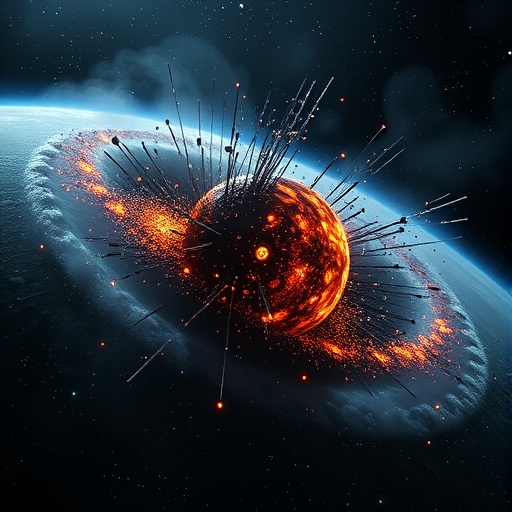
The Bullet Cluster has long stood as a cornerstone piece of evidence supporting the existence of dark matter, a mysterious form of matter that exerts gravitational influence yet eludes direct detection. However, an international team of astrophysicists has recently revisited this iconic cosmic collision with fresh eyes, analyzing new datasets and high-resolution images captured by the James Webb Space Telescope (JWST). Their findings, published in the journal Physical Review D, suggest that the phenomena observed in the Bullet Cluster might not necessitate the presence of dark matter in previously assumed quantities. Instead, alternative explanations grounded in modified theories of gravity and the presence of compact stellar remnants could reconcile observed gravitational effects without invoking dark matter as the sole explanation.
Approximately four billion years ago, two massive galaxy clusters—each containing thousands of galaxies and trillions of stars—collided at astonishing velocities exceeding 2,500 kilometers per second. The visible constituents of these clusters, primarily hot, diffuse interstellar gas, interacted through collisional processes, resulting in shock waves that heated the gas to extreme temperatures, observable today through X-ray emissions. Interestingly, while the gas components experienced significant friction and deceleration, the individual galaxies largely passed through one another unimpeded, owing to the vast distances separating stars within each galaxy. This separation between the distribution of gas and galaxies creates the unique structural signature known as the Bullet Cluster.
The Bullet Cluster’s significance in cosmology arises from the phenomenon of gravitational lensing—where the massive content of the cluster bends and distorts light from more distant background galaxies. These distortions appear strongest in regions coinciding with the galaxies rather than the X-ray emitting gas, suggesting a concentration of mass where little visible matter exists. Standard cosmological models interpret this discrepancy as direct evidence of non-baryonic dark matter, which interacts gravitationally yet remains invisible across the electromagnetic spectrum. The dark matter component, theorized to be collisionless, is predicted to remain spatially coincident with the galaxies rather than the gas, a scenario that aligns well with the lensing observations.
Despite the widespread acceptance of dark matter’s presence, direct empirical validation remains elusive. Profound skepticism about the dark matter paradigm has persisted in certain theoretical circles, with alternative frameworks such as Modified Newtonian Dynamics (MOND) posited decades ago. MOND proposes a modification to Newton’s laws in the regime of extremely weak gravitational acceleration, offering an explanation for observed galactic rotation curves without dark matter. Historically, MOND has struggled to account for the dynamics of systems like the Bullet Cluster, where colliding galaxy clusters present complex gravitational environments. Nevertheless, the new study challenges this narrative by demonstrating that the Bullet Cluster’s gravitational lensing can be reconciled within a MOND framework when baryonic mass budgets are recalculated with greater precision.
Central to this revised interpretation are observations made possible by the JWST, which provide unparalleled near-infrared data that allow astronomers to more accurately estimate the stellar mass content within the galaxy clusters. These improved measurements reveal a significantly higher count of massive stars and their evolved remnants, such as neutron stars and black holes. Such compact objects, while electromagnetically faint or invisible, contribute to the overall gravitational potential in a way that was previously underestimated. The accumulation of these baryonic remnants can mimic the gravitational effects ascribed to dark matter under conventional models.
The implications of including neutron stars and black holes as considerable mass contributors extend far beyond a mere recalibration of cluster mass distribution. They provide a natural explanation for the lensing signature in MOND without having to posit large quantities of exotic dark matter particles. This is groundbreaking because it situates the Bullet Cluster within a cohesive theoretical framework that challenges the orthodox cosmological paradigm and invites a reevaluation of gravitational physics on large scales. Co-author Dr. Indranil Banik highlights that even if the dark matter hypothesis holds, the required abundance of dark matter in the Bullet Cluster must be reduced by approximately half, drastically altering the inventory of cosmic matter.
The detailed computational analyses carried out by the research team employed sophisticated gravitational modeling and simulations tailored to MOND scenarios, taking into account the updated baryonic mass functions and the spatial distribution of stellar remnants. These simulations reveal a remarkable consistency between the predicted and observed gravitational lensing patterns. This match lends credence to the idea that baryonic matter alone, when properly accounted for, might suffice to explain the Bullet Cluster’s gravitational dynamics, particularly under the modified gravity perspective.
The study’s authors further emphasize that the role of massive stellar remnants has often been neglected or underestimated in cosmological mass budgets. Traditional dark matter models typically discount baryonic compact objects under the assumption that they form only a minor fraction of cluster mass. However, JWST observations have shed light on the prolific star formation and heavy-element enrichment (notably iron and oxygen) within the Bullet Cluster, signatures that imply a substantial population of massive stars reaching end-of-life phases and collapsing into neutron stars or black holes. This hidden reservoir of baryonic mass hence wields a gravitational influence previously attributed to dark matter.
This paradigm shift also underscores the critical importance of next-generation observatories like the JWST in refining astrophysical measurements. The enhanced precision in stellar population estimates and the detection of elemental abundances enable researchers to revisit and refine long-held astrophysical models. The unique combination of multi-wavelength data, including X-ray, optical, and infrared observations, forms a comprehensive picture of cluster dynamics and mass distribution that challenges simplistic interpretations strictly reliant on dark matter presence.
While the dark matter hypothesis remains dominant, the current investigation marks a significant step in the scientific discourse by opening pathways to alternative interpretations grounded in well-established physics of baryonic matter and modified gravity. Prof. Dr. Pavel Kroupa, leading the study from the University of Bonn, emphasizes that the MOND framework acquires newfound plausibility and empirical support through this work. The authors advocate for continued observational campaigns and theoretical refinements to fully unravel the complex interplay between visible matter, compact stellar objects, and gravitational phenomena in massive galaxy clusters.
The collaboration behind this research spans multiple leading academic institutions worldwide, including universities in Bonn, Portsmouth, Yonsei, Prague, Wuppertal, and Nanjing, with contributions from advanced research institutes in Iran. Their multidisciplinary approach marries observational astronomy, computational modeling, and theoretical physics, embodying the global effort to address one of the most pressing enigmas in cosmology.
As the cosmic narrative unfolds, the Bullet Cluster remains a cosmic laboratory where physics beyond the Standard Model may reveal itself. Whether through elusive dark matter particles or intricate gravitational modifications coupled with baryonic relics, these discoveries evoke broader questions about the fabric of the universe and the fundamental forces governing its evolution. The study invites the astrophysics community to reassess foundational assumptions and to remain open to alternative paradigms that reconcile observation with theory in the quest to comprehend the cosmos.
News Publication Date: 19-Jun-2026
Web References: DOI: 10.1103/6zrp-q7c4
Keywords
Bullet Cluster, dark matter, modified Newtonian dynamics, MOND, James Webb Space Telescope, gravitational lensing, neutron stars, black holes, baryonic matter, galaxy clusters, astrophysics, cosmology
Cite Scienmag News
Grant Pearson. (June 23, 2026). Collision in Space Fails to Confirm Dark Matter Presence After All. Scienmag. https://scienmag.com/collision-in-space-fails-to-confirm-dark-matter-presence-after-all/
Grant Pearson. "Collision in Space Fails to Confirm Dark Matter Presence After All." Scienmag, 23 June 2026, https://scienmag.com/collision-in-space-fails-to-confirm-dark-matter-presence-after-all/. Accessed 3 September 2026.
Grant Pearson. "Collision in Space Fails to Confirm Dark Matter Presence After All." Scienmag. June 23, 2026. https://scienmag.com/collision-in-space-fails-to-confirm-dark-matter-presence-after-all/


