


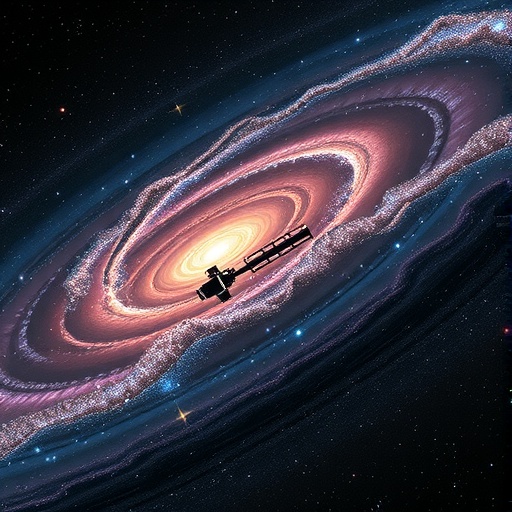
In a remarkable leap forward in our understanding of galactic evolution, an international consortium of astronomers led by the University of Nottingham has leveraged the unprecedented capabilities of the James Webb Space Telescope (JWST) to uncover the enigmatic processes behind the sudden cessation of star formation in distant galaxies. These galaxies, observed as they existed approximately nine billion years ago, provide a critical glimpse into a transformative era in cosmic history when the Universe was bustling at its zenith of star production and galactic assembly.
The investigation targeted a specific population known as “recently quenched” galaxies—massive systems that had abruptly halted stellar birth after an era of intense activity. Utilizing the JWST’s extraordinary infrared sensitivity and highresolution imaging, the team systematically identified these galaxies through their spectral fingerprints, which exhibit characteristic signatures marking the swift decline in star-forming activity. By analyzing deep, multiwavelength images obtained as part of the PRIMER-UDS survey, the researchers could delve into each galaxy’s structural morphology and subtle features that were previously inaccessible with other observatories.
Professor Omar Almaini, the principal investigator, highlighted the significance of this epoch, “This period represents a peak in cosmic star formation when many of today’s most massive galaxies were forming the bulk of their stars. Understanding why these colossal structures abruptly cease star production has long posed a profound challenge. Webb now reveals intricate details hidden until now, offering evidence to untangle these cosmic mysteries.” This breakthrough sidesteps the limitations of prior optical and ultraviolet studies, enabling a more comprehensive exploration into the mechanisms governing galactic quenching.
The hallmark discovery centers on the compactness of these quenched galaxies coupled with faint but unmistakable disturbances in their structure. Such disturbances point to tumultuous past interactions, most notably galaxy mergers, which have reshaped these massive entities. Dr. David Maltby, the study’s lead author, noted, “While these galaxies appear relatively serene at first glance, JWST reveals subtle scars—signatures of violent mergers that likely precipitated their rapid transformation by stripping them of the gas reservoirs necessary for star formation.”
This newfound compact morphology aligns closely with theoretical predictions from cosmological simulations: collisions between gas-rich galaxies funnel star-forming material inward, culminating in dense, compact remnants. By correlating the observed morphological traits with simulated outcomes, the research provides compelling observational confirmation of the merger hypothesis as a dominant quenching mechanism during this critical period.
The study synthesizes data from the PRIMER program, led by Professor James Dunlop at the University of Edinburgh, with the extensive Ultra-Deep Survey, managed by Professor Almaini’s team at Nottingham. This synergy of data sets offers unprecedented spatial resolution and spectral depth, facilitating the discernment of subtle phenomena that chart the evolutionary trajectory of these galaxies post-starburst. Such multiwavelength scrutiny reveals variations in stellar populations and dust content, furnishing a holistic view of their complex histories.
From a methodological perspective, the identification of recently quenched galaxies hinges on detecting specific spectral features indicative of recent star formation shutdowns, such as strong Balmer absorption lines coupled with diminished emission lines that trace ongoing star birth. The combination of spectral diagnostics and JWST’s exquisite imaging enables the isolation of candidate galaxies at redshifts between 0.5 and 3—key epochs spanning the Universe’s most active phases—to ascertain their morphological state and evolutionary context.
The implications of these findings extend far beyond mere classification. By pinpointing violent mergers as catalysts for quenching, this research reshapes our broader understanding of galaxy formation and evolution. It challenges previously favored scenarios involving gradual gas depletion or feedback from active galactic nuclei, instead emphasizing abrupt, collision-driven transformations that truncate star formation on remarkably short timescales.
Moreover, the ability to observe these phenomena in exquisite detail offers vital constraints for next-generation cosmological models. Incorporating empirical evidence from JWST into simulations refines our comprehension of baryonic physics, especially gas dynamics, star formation regulation, and black hole growth within evolving galaxies. These insights ultimately contribute to constructing a unified narrative of cosmic structure assembly.
In essence, the research delivers an unprecedented window into the final throes of galactic youth for some of the most massive galaxies residing at intermediate to high redshifts. It illuminates the violent, dynamic processes that abruptly stifle star birth and sculpt the compact remnants that will later evolve into the “red and dead” elliptical galaxies ubiquitous in the present-day Universe.
As the JWST mission continues, the refinement of these observations and expansion toward larger, more diverse galaxy samples promises to unravel further complexities in galaxy lifecycle processes. This research marks a crucial step toward demystifying the abrupt termination of star formation and enriches the narrative of how cosmic structures evolve from chaotic, vibrant star factories into quiescent behemoths.
The study, recently published in the Monthly Notices of the Royal Astronomical Society, exemplifies the transformative power of nextgeneration telescopes in probing the distant Universe, revealing phenomena critical to our cosmic origins and the lifecycle of galaxies.
News Publication Date: 1-Jul-2026
Web References:
PRIMER Programme – https://primer-jwst.github.io/
Ultra-Deep Survey – https://www.nottingham.ac.uk/astronomy/UDS/
References:
Published in Monthly Notices of the Royal Astronomical Society, DOI: 10.1093/mnras/stag987
Keywords
James Webb Space Telescope, galaxy quenching, recently quenched galaxies, galaxy mergers, star formation shutdown, compact galaxy morphology, cosmic star formation history, galaxy evolution, PRIMER survey, Ultra-Deep Survey, post-starburst galaxies, high-redshift galaxies
Cite Scienmag News
Grant Pearson. (July 1, 2026). James Webb Space Telescope Uncovers Violent Origins of Recently Quenched Galaxies. Scienmag. https://scienmag.com/james-webb-space-telescope-uncovers-violent-origins-of-recently-quenched-galaxies/
Grant Pearson. "James Webb Space Telescope Uncovers Violent Origins of Recently Quenched Galaxies." Scienmag, 1 July 2026, https://scienmag.com/james-webb-space-telescope-uncovers-violent-origins-of-recently-quenched-galaxies/. Accessed 3 September 2026.
Grant Pearson. "James Webb Space Telescope Uncovers Violent Origins of Recently Quenched Galaxies." Scienmag. July 1, 2026. https://scienmag.com/james-webb-space-telescope-uncovers-violent-origins-of-recently-quenched-galaxies/


