


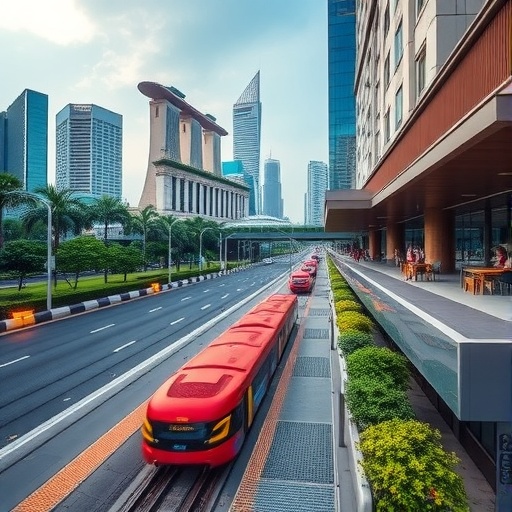
In the face of escalating global temperatures and intensifying urban heat phenomena, Singapore emerges as a pioneering example in the quest for effective heat resilience strategies within tropical city environments. The Global Heat Health Information Network (GHHIN) Southeast Asia Hub, operating through the Heat Resilience & Performance Centre at the National University of Singapore’s Yong Loo Lin School of Medicine, has collaboratively launched an extensive report entitled “A Multi-Stakeholder Approach for Urban Heat Resilience: Singapore’s Experience.” This publication encapsulates the city-state’s innovative, integrative responses to urban heat stress, unveiled during the prestigious World Cities Summit 2026 CLC-IPCC Senior Leaders Roundtable on the IPCC Special Report on Climate Change and Cities.
Urban centers throughout Southeast Asia face an alarming increase in ambient temperatures due to the compounded effects of climate change and intensified urban heat island dynamics. These rising heat metrics threaten public health, degrade worker productivity, and undermine overall community well-being. Critically, these adversities disproportionately affect vulnerable populations, including elderly individuals, outdoor laborers, and disadvantaged groups lacking access to cooling infrastructure—highlighting an urgent need for focused, adaptable urban policies and systemic interventions.
Singapore’s experience underscores that urban heat resilience cannot be addressed by piecemeal solutions or isolated initiatives. Instead, it requires a persistent, multi-faceted strategy that engages diverse stakeholders across governmental agencies, academia, private sectors, and community organizations. The report delineates six foundational pillars integral to sustained urban heat management: unwavering political resolve, multi-sectoral engagement, comprehensive inter-ministerial coordination, robust scientific partnerships, strategic employer collaborations, and empowered community participation.
Political leadership forms the bedrock of Singapore’s heat resilience framework, anchoring continuous investment in infrastructure capable of withstanding thermal extremes, facilitating translational research, and elevating public consciousness about heat risks. This high-level commitment ensures that resilience measures are institutionalized and prioritized amid competing urban development agendas. The city’s establishment of an Inter-Ministerial Committee on Climate Change exemplifies whole-of-government governance, steering cohesive strategies that encompass built environment planning, public health directives, socioeconomic considerations, and environmental stewardship.
Scientific collaboration plays a pivotal role in this ecosystem, where cutting-edge climatological and biomedical research informs evidence-based policy. Through synergies with academic institutions and specialized research centers, Singapore leverages granular heat exposure data, predictive modeling, and epidemiological insights to tailor interventions that mitigate physiological stress and prevent heat-related morbidity. These research partnerships translate technical findings into pragmatic applications, such as optimized urban design and occupational health guidelines.
Recognizing that vulnerable worker groups bear significant exposure risks, the government actively engages industries to formulate comprehensive occupational safety frameworks. These include guidelines on heat exposure monitoring, scheduled rest cycles, hydration protocols, and adaptive workplace technologies that collectively safeguard worker health while sustaining economic productivity. Through tripartite collaboration among employers, labor representatives, and regulatory bodies, Singapore illustrates a model where worker protection synergizes with business continuity imperatives.
Another cornerstone of Singapore’s model is community empowerment, which entails the dissemination of timely, accessible, and culturally resonant information, enabling individuals to make informed decisions during periods of excessive heat stress. Through public awareness campaigns, localized heat alerts, and heat adaptation education, vulnerable populations are equipped to adopt protective behaviors, thereby reducing heat-related health incidents. This approach fosters a participatory resilience ethos, integrating bottom-up feedback mechanisms and community-led initiatives.
The report’s authors, including leading experts from NUS Medicine, National Environment Agency, Ministry of Manpower, and Ministry of Sustainability and the Environment, emphasize the uniqueness of Singapore’s socio-political and environmental context while advocating for its lessons as scalable and adaptable to other cities grappling with similar challenges. They envision the document not just as a case study but as a catalyst for region-wide dialogue, research exchange, and collaborative development of climate adaptation strategies across diverse urban landscapes.
An important dimension of Singapore’s adaptation roadmap is its designation of 2026 as the Year of Climate Adaptation, underscoring the urgency and institutional momentum behind forthcoming policy evolution. The anticipation of its inaugural National Adaptation Plan reflects a commitment to harmonize multi-sectoral efforts, integrate stakeholder inputs, and systematically embed heat resilience into comprehensive climate strategies. This proactive policy stance aims to align scientific innovation, infrastructural investment, and social resilience in a unified national framework.
At a technical level, Singapore’s investments encompass urban greening projects, reflective surface materials, and advanced heat monitoring systems that collectively attenuate urban heat islands and enhance microclimate regulation. These infrastructural innovations complement public health initiatives, such as heat stress surveillance programs and adaptive healthcare frameworks designed to anticipate and respond to heat-exacerbated conditions. The synergy of physical and social determinants is central to Singapore’s approach, reflecting a holistic conceptualization of urban heat resilience.
The interplay of interdisciplinary scientific expertise, forward-looking governance, and dynamic stakeholder collaboration situates Singapore as a global exemplar in urban heat resilience. As cities worldwide confront unprecedented climatic challenges, this multi-stakeholder, integrated approach demonstrates how localized context, scientific rigor, and inclusive governance can converge to protect urban populations from the deleterious impacts of extreme heat, while sustaining economic vitality and social cohesion.
In sum, Singapore’s urban heat resilience journey presents a compelling testament to the power of whole-of-society action in climate adaptation. This model, while tailored to Singapore’s unique requirements, charts a strategic path for other tropical and subtropical cities seeking to safeguard public health and ensure environmental sustainability amid intensifying climate pressures. The ongoing evolution of these integrated frameworks will be critical for building urban futures resilient not only to heat but to the broader spectrum of climate-induced risks.
News Publication Date: 2026
Web References: Not provided
References: Not provided
Cite Scienmag News
Sloane Callahan. (June 15, 2026). New Report Highlights Singapore’s Collaborative Strategy for Urban Heat Resilience. Scienmag. https://scienmag.com/new-report-highlights-singapores-collaborative-strategy-for-urban-heat-resilience/
Sloane Callahan. "New Report Highlights Singapore’s Collaborative Strategy for Urban Heat Resilience." Scienmag, 15 June 2026, https://scienmag.com/new-report-highlights-singapores-collaborative-strategy-for-urban-heat-resilience/. Accessed 4 September 2026.
Sloane Callahan. "New Report Highlights Singapore’s Collaborative Strategy for Urban Heat Resilience." Scienmag. June 15, 2026. https://scienmag.com/new-report-highlights-singapores-collaborative-strategy-for-urban-heat-resilience/


