


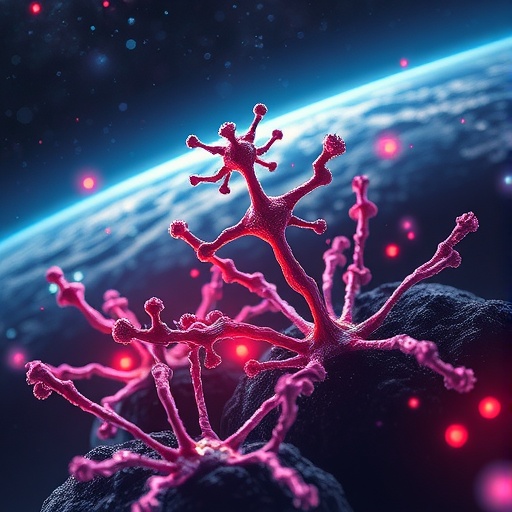
Recent research from Radboud University Medical Center has brought groundbreaking insights into how terrestrial microorganisms might survive on other celestial bodies within our solar system, particularly where water is present, such as Mars. This innovative study, carried out by PhD candidate Tommaso Zaccaria, explores the resilience and adaptability of microbes when subjected to simulated extraterrestrial environments. The findings signal significant implications not only for the burgeoning field of space medicine but also for our understanding of immune responses under extraterrestrial stressors, potentially reshaping strategies for long-duration human spaceflight.
Historically, space missions have prioritized avoiding contamination of Earth with extraterrestrial life forms. However, the scientific community’s attention has now shifted towards understanding the converse question: what terrestrial organisms are humans inadvertently carrying into space? Previous missions, including early lunar expeditions and the Viking mission to Mars in the 1970s, had less stringent sterilization protocols compared to today’s standards, highlighting a growing concern regarding forward contamination – the transfer of Earth microbes to other planets.
Zaccaria’s research specifically targeted moons and planets where water exists or existed, given that water is a quintessential ingredient for life. Drawing on geological and chemical evidence, the investigation considered environments such as Mars—including its historic hot springs —and the icy moons orbiting Jupiter and Saturn. On Mars, for example, certain regions have temperatures that can reach 20°C, a surprisingly habitable condition for some extremophiles living in analogous Earth environments.
In laboratory settings mimicking these extraterrestrial conditions, Zaccaria exposed microorganisms to intense radiation, extreme dehydration, and freezing temperatures at the German Aerospace Center (DLR) in Germany. Remarkably, certain extremophiles sourced from Earth’s volcanic areas and Antarctic regions exhibited profound survival capabilities. Yeasts, in particular, showed an exceptional ability to endure these hostile conditions. Cellular analyses revealed that yeasts ramped up their DNA repair systems and triggered protective biochemical pathways, which allowed them to withstand the extensive molecular damage caused by simulated space radiation and desiccation.
The study went further by replicating a journey to Mars for several known human pathogens, including Klebsiella pneumoniae, a notorious bacterium responsible for severe pneumonia infections. Post-exposure observations demonstrated that while these pathogens shrink in size after enduring the extraterrestrial conditions, they remain viable and infectious. Crucially, immune assays revealed that human blood immune cells exhibited attenuated responses to these shrunken pathogens, suggesting that space-conditioned microbes might evade the immune system more effectively. This presents a critical concern for astronaut health given the already compromised immune function during spaceflight.
Astronauts face numerous physiological challenges beyond microbial threats. The disruption of the circadian rhythm, limited nutrient intake, altered gut microbiota, DNA damage from chronic cosmic radiation, social isolation, and confinement all compound immune suppression in space. Understanding how microbes adapt and how immune defenses are altered in such an environment is essential for designing effective countermeasures to prevent infections during long missions.
The research also sheds light on the hazards posed by extraterrestrial dust, or regolith, when inhaled by astronauts. Simulated lunar and Martian dust samples revealed a damaging effect on the lung’s protective epithelial barriers, promoting infection susceptibility. Tests comparing this with Earth sand conclusively showed that Moon and Mars regolith have unique properties that exacerbate pulmonary inflammation and infections, marking them as a distinct health hazard during surface explorations.
Beyond space travel, the study’s senior supervisors, Professors Mihai Netea and Marien de Jonge emphasize that these insights carry profound implications for terrestrial medicine. De Jonge highlights that the accelerated immune aging and suppression observed in space parallels clinical phenomena on Earth, where individuals’ immunological age may differ markedly from their chronological age. Space-derived immunological research can influence strategies for managing infectious diseases and aging-related immune dysfunction in vulnerable Earth-bound populations.
The interdisciplinary nature of this research bridges astrobiology, immunology, and aerospace medicine, pioneering new paradigms for understanding host-pathogen interactions beyond our planet. Moreover, it raises urgent questions about planetary protection policies and the necessity for novel sterilization and containment frameworks for future manned missions.
Zaccaria will defend his thesis titled “Life beyond Earth: microbial survival and immune health in space” on June 19, 2026, contributing critical knowledge that may shape the era of interplanetary exploration. Co-supervised by experts from the German Aerospace Center, the work represents a collaborative effort blending terrestrial biology with space science in unprecedented ways. As humanity’s ambitions extend deeper into the cosmos, this research underscores the imperative to comprehend the dual biological threats posed by microbial persistence and immune vulnerability in extraterrestrial habitats.
The study not only opens pathways for safeguarding astronaut health but also enhances our comprehension of microbial resilience and immune functionality under extreme environmental stresses. The integration of these findings into mission planning could be its most potent legacy, enabling safer human presence beyond Earth while informing medicine in profound ways here at home.
Cite Scienmag News
Kristina Jarvis. (June 15, 2026). Pathogens Thrive in Extreme Conditions on Extraterrestrial Environments. Scienmag. https://scienmag.com/pathogens-thrive-in-extreme-conditions-on-extraterrestrial-environments/
Kristina Jarvis. "Pathogens Thrive in Extreme Conditions on Extraterrestrial Environments." Scienmag, 15 June 2026, https://scienmag.com/pathogens-thrive-in-extreme-conditions-on-extraterrestrial-environments/. Accessed 4 September 2026.
Kristina Jarvis. "Pathogens Thrive in Extreme Conditions on Extraterrestrial Environments." Scienmag. June 15, 2026. https://scienmag.com/pathogens-thrive-in-extreme-conditions-on-extraterrestrial-environments/


