


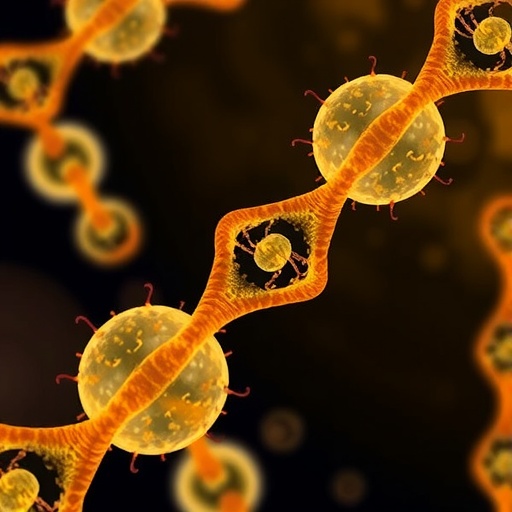
Aflatoxin, one of the most dangerous families of foodborne toxins, may soon face an unusual opponent: living cells transformed into microscopic sensing and treatment units. In a study published in Nature Communications, Zhen, Meng, Wen and colleagues describe “gelated cells” loaded with artificial DNA receptors that can detect aflatoxin inside biological environments while helping neutralize its harmful effects. The approach brings together molecular recognition, cell engineering and therapeutic delivery in a single platform—an idea that could change how scientists think about toxin exposure, diagnosis and intervention.
Aflatoxins are produced primarily by certain species of Aspergillus fungi that contaminate crops such as maize, peanuts, tree nuts, cottonseed and spices. Aflatoxin B1 is particularly notorious because the liver converts it into highly reactive metabolites capable of damaging DNA and proteins. Long-term exposure is associated with liver injury, impaired growth, immune disruption and hepatocellular carcinoma, the most common primary liver cancer. The danger is amplified in regions where food storage is difficult and routine toxin testing is limited. Conventional responses generally rely on preventing contamination, discarding polluted food or administering supportive treatments after exposure. None of these strategies directly combines real-time detection with targeted molecular intervention inside cells.
The new system is built around an artificial DNA receptor, a designed nucleic-acid structure that recognizes a specific chemical target through molecular interactions. Unlike DNA’s familiar role as a genetic information carrier, synthetic DNA receptors can be engineered to fold into three-dimensional shapes that bind selected molecules. Their recognition depends on features such as hydrogen bonding, electrostatic attraction and shape complementarity. In this case, the receptor is intended to interact with aflatoxin, creating a molecular switch that can translate the presence of the toxin into a detectable signal or trigger a downstream response. Because the receptor is synthetic rather than naturally encoded by the cell, its sequence and behavior can potentially be adjusted for sensitivity, selectivity and stability.
The researchers’ key innovation is placing these receptors inside gelated cells. Cell gelation involves surrounding or embedding cells within a hydrated polymeric network, creating a soft material that can protect the cells while allowing small molecules to move through it. The resulting structure can behave like a biological microreactor: nutrients and toxins diffuse across the gel, while the cellular interior provides a complex environment for sensing and processing. Loading the artificial receptors into the cells gives the platform an intracellular detection capability, potentially allowing it to recognize aflatoxin after the compound crosses the cell membrane rather than merely measuring it in the surrounding solution.
That intracellular location is important because toxins do not act only outside cells. Aflatoxin-related damage begins when the compound enters tissues and undergoes metabolic transformation, particularly in the liver. A sensor that operates inside a cellular environment may encounter the toxin closer to the point where biochemical injury develops. It could also benefit from the cell’s natural machinery, including enzymes, membranes and signaling pathways. The gel surrounding the cells may provide an additional layer of control by improving structural stability, limiting premature loss of the receptor and creating a more manageable material for laboratory or biomedical use. Together, the cell and gel form a hybrid system with properties that neither component could provide alone.
The “theranostic” label reflects the platform’s two linked functions. The first is diagnosis: when the artificial DNA receptor binds aflatoxin, the interaction can be converted into a measurable optical or biochemical output, allowing researchers to identify the toxin. The second is therapy: the same engineered cells may help capture, sequester or reduce the biological activity of the toxin, depending on how the receptor and cellular system are configured. In principle, a receptor could be designed to hold the target tightly enough to prevent it from interacting with vulnerable biomolecules, while the surrounding cell matrix could help retain the captured compound. A diagnostic signal would then reveal where exposure has occurred and whether the intervention is working.
This architecture also offers a response to one of the central problems in toxin treatment: specificity. Broad detoxification methods can affect beneficial molecules or interfere with normal physiology. An artificial DNA receptor, by contrast, is designed to favor one molecular target over closely related compounds. Such selectivity is not automatic; it must be evaluated against structurally similar toxins, metabolites and components of real biological samples. The study’s significance lies in demonstrating a route toward that precision through engineered recognition inside a cellular carrier. If the system can maintain receptor activity in complex environments, it could become a foundation for sensors that operate in food extracts, cell cultures or eventually living tissues.
The platform is also notable because it blurs the traditional boundary between a diagnostic device and a therapeutic material. Most toxin sensors are built to report contamination, while most detoxification strategies are designed to remove or chemically modify harmful compounds. Gelated receptor-loaded cells are conceived as both detector and responder. That combination could support earlier intervention, especially in situations where aflatoxin exposure is intermittent, difficult to quantify or mixed with other contaminants. A system that produces a signal while concentrating the toxin could help researchers map exposure more accurately and study how aflatoxin moves through biological barriers.
Important challenges remain before the technology can move beyond proof-of-concept research. Artificial DNA receptors must remain stable in the presence of nucleases, proteins and changing chemical conditions. Gelated cells must retain viability and function without becoming an unintended source of inflammation or immune activation. Any therapeutic application would also require careful control over where the engineered cells travel, how long they persist and how the captured toxin is ultimately removed. Safety testing would need to address the fate of the gel, the possibility of receptor degradation and the risk that the system could alter normal cellular processes. In addition, aflatoxin contamination occurs in complex food and environmental matrices, so performance in purified laboratory samples would need to be matched by reliable operation in real-world conditions.
Even with these hurdles, the study points toward a broader future for synthetic biology and molecular medicine. Cells can be engineered not merely to survive or produce a protein, but to detect a harmful molecule, generate a measurable response and participate in its containment. Artificial DNA receptors provide the recognition layer; gelation supplies physical organization and protection; living cells contribute biological processing. The result is a compact, adaptable platform for aflatoxin theranostics that could inspire similar systems for other environmental toxins, metabolites or disease-associated molecules. As food safety and global health researchers search for tools that are both sensitive and practical, these engineered cellular materials offer a striking new possibility: turning living matter into an active warning system against invisible chemical threats.
Cite Scienmag News
Ophelia Keating. (August 18, 2026). Engineered Gel Cells Carry Artificial DNA Receptors to Detect and Treat Aflatoxin. Scienmag. https://scienmag.com/engineered-gel-cells-carry-artificial-dna-receptors-to-detect-and-treat-aflatoxin/
Ophelia Keating. "Engineered Gel Cells Carry Artificial DNA Receptors to Detect and Treat Aflatoxin." Scienmag, 18 August 2026, https://scienmag.com/engineered-gel-cells-carry-artificial-dna-receptors-to-detect-and-treat-aflatoxin/. Accessed 4 September 2026.
Ophelia Keating. "Engineered Gel Cells Carry Artificial DNA Receptors to Detect and Treat Aflatoxin." Scienmag. August 18, 2026. https://scienmag.com/engineered-gel-cells-carry-artificial-dna-receptors-to-detect-and-treat-aflatoxin/


