


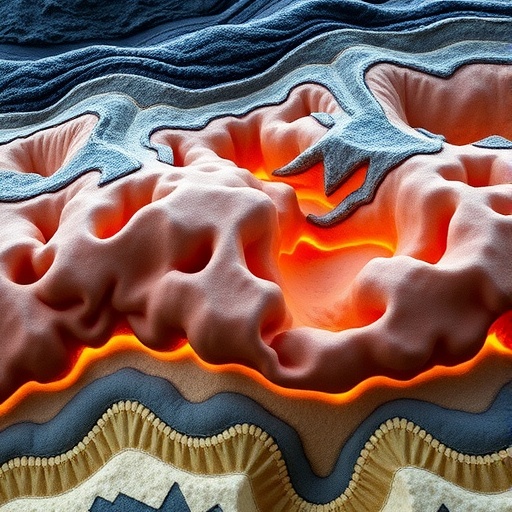
At first glance, an olivine crystal recovered from the seafloor may look like an inert green grain—a tiny mineral fragment forged from molten rock beneath the ocean. But new research argues that these crystals can preserve a remarkably detailed record of what happens inside the hidden magma plumbing systems beneath mid-ocean ridges. In a study led by C. Falc’hun, L. France, M. Laubier and colleagues, olivines from the FAMOUS region of the Mid-Atlantic Ridge are presented as “diaries” of the processes that shape oceanic crust. Their chemical architecture offers scientists a way to reconstruct how magma is stored, mixed, transported and transformed before it erupts onto the ocean floor.
The setting is one of Earth’s most active geological environments. Mid-ocean ridges form where tectonic plates pull apart, allowing hot mantle rock to rise and partially melt. That melt, known as mid-ocean-ridge basalt, or MORB, eventually feeds volcanic eruptions and creates new seafloor. Yet the path from mantle to eruption is not straightforward. Magma may pause in reservoirs, mingle with older crystals, react with surrounding minerals and move through networks of partially molten rock known as igneous mushes. These mush zones are neither fully liquid magma chambers nor completely solid rock. Instead, they are dynamic mixtures in which crystals and melt interact over time, potentially controlling when and how eruptions occur.
The FAMOUS area—an acronym for the French-American Mid-Ocean Underwater Study—is one of the best-known natural laboratories for investigating these processes. Located along the Mid-Atlantic Ridge, it has been explored for decades because its volcanic structures and exposed oceanic crust provide unusual access to the products of seafloor spreading. The new study focuses on olivines found in MORB, using the minerals as geological archives. Olivine is among the first crystals to form as basaltic magma cools. Because it grows while the melt is changing, it can trap chemical information in its interior and along its edges. Like tree rings, these variations may record successive stages in the crystal’s history, although the signals are written in elemental concentrations and mineral structures rather than in visible bands.
That record matters because conventional samples of erupted basalt often provide only the final snapshot of a much longer journey. Once magma reaches the surface and cools, much of the evidence for its underground evolution is homogenized or obscured. Olivine can preserve a more complex story. Its core may reflect an earlier melt from deep within the crust or mantle, while its rim may have formed after the crystal entered a different chemical environment. Differences between these zones can reveal whether crystals were carried upward rapidly, stored in a mush, exposed to new magma or partially dissolved before being overgrown. Such clues allow researchers to move beyond the question of what a basalt is and ask how it became that way.
The study’s central idea is that these crystals capture the behavior of magma reservoirs that are better imagined as active, porous systems than as large underground tanks filled with uniform liquid. In a mush, crystals can form a framework through which melt migrates. Some crystals may settle, others may be remobilized, and new batches of magma may percolate through the existing mineral network. Chemical exchange between olivine and melt can modify the crystal’s outer layers, while enclosed melt or microscopic compositional changes may preserve evidence of earlier conditions. Reading these signatures requires mineral chemistry, petrology and models of crystallization, but the payoff is a clearer view of the hidden processes that build oceanic crust.
The findings are especially significant because they challenge simple pictures of volcanic plumbing. A single eruption does not necessarily draw directly from one isolated magma chamber. Instead, it may reflect a chain of connected storage regions and mushy conduits operating at different depths and times. Olivines can help identify these connections by showing whether crystals formed in chemically distinct melts before being brought together in one eruption. If crystals with different histories occur in the same basalt, the rock may represent the mixing of previously separated components. That kind of evidence can reveal a plumbing system that is constantly reorganizing rather than remaining stable between eruptions.
This mineral-scale perspective also helps address a major question in volcanology: how does mantle melt become the chemically diverse oceanic crust observed around the planet? Partial melting beneath ridges produces primary magmas, but those magmas evolve as they cool, crystallize and interact with existing material. Olivine is particularly useful because its composition responds to the chemistry of the surrounding melt and to temperature-dependent conditions during growth. Although no single crystal can provide a complete geological history, populations of crystals can expose recurring patterns. Together, they may show how long magmas reside beneath a ridge, how often new melt enters the system and how efficiently volcanic plumbing transfers material from mantle to seafloor.
The work also demonstrates why samples from the deep ocean remain scientifically valuable even when they were collected years ago. Advances in microanalysis and geochemical modelling can extract new information from familiar rocks, turning ordinary-looking grains into high-resolution records of geological change. The FAMOUS MORB olivines offer an opportunity to connect field observations at the ridge with processes occurring far below the reach of direct observation. By treating crystals as time capsules rather than merely as components of basalt, the research brings the hidden life of magma mushes into focus—and gives scientists a more detailed framework for understanding how new oceanic crust is assembled, how eruptions are fed and how Earth continuously renews its seafloor.
Cite Scienmag News
Violet Maxwell. (August 18, 2026). FAMOUS MORB Olivines Record Magma-Mush Processes Beneath Ocean Ridges. Scienmag. https://scienmag.com/famous-morb-olivines-record-magma-mush-processes-beneath-ocean-ridges/
Violet Maxwell. "FAMOUS MORB Olivines Record Magma-Mush Processes Beneath Ocean Ridges." Scienmag, 18 August 2026, https://scienmag.com/famous-morb-olivines-record-magma-mush-processes-beneath-ocean-ridges/. Accessed 4 September 2026.
Violet Maxwell. "FAMOUS MORB Olivines Record Magma-Mush Processes Beneath Ocean Ridges." Scienmag. August 18, 2026. https://scienmag.com/famous-morb-olivines-record-magma-mush-processes-beneath-ocean-ridges/


