


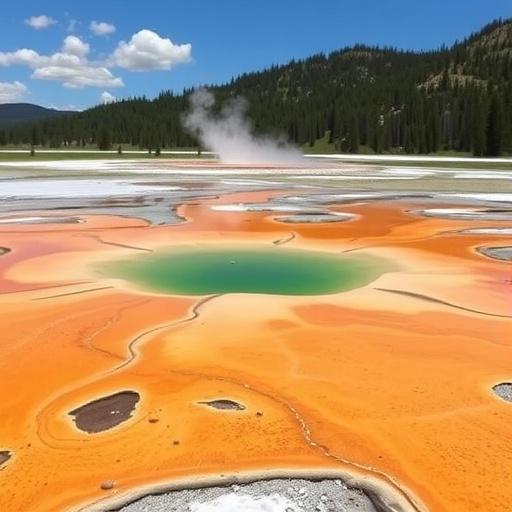
A 15,000-year-old environmental record preserved in the sediments of Yellowstone National Park’s Lower Geyser Basin is offering scientists a new explanation for how climate, wildfire and hydrothermal activity interact—and what a warmer future could mean for one of the world’s most famous geothermal landscapes. The study, led by Montana State University Regents Professor emerita Cathy Whitlock, finds that Yellowstone’s hydrothermal systems were generally more active during wet climatic periods, while drought increased wildfire activity and lowered lake levels. The results suggest that continued warming could bring more frequent fires and, over much longer timescales, reduced hydrothermal activity.
Published in the Proceedings of the National Academy of Sciences, the research reconstructs the development of vegetation, fire regimes, lake chemistry and geothermal activity across the Yellowstone Plateau after the retreat of the last glaciers. The work combines paleoclimatology, geology, ecology and geochemistry to examine how a landscape shaped by volcanic rock and boiling groundwater responded to dramatic changes in temperature and precipitation. Rather than relying on modern observations alone, the researchers used lake sediments as a natural archive of environmental change, revealing patterns that extend far beyond the length of instrumental records.
Whitlock’s interest in the Lower Geyser Basin began in 2020, when she and co-author Chris Schiller recovered sediment cores from the bottom of a small lake. The material looked markedly different from sediments collected elsewhere in Yellowstone, suggesting that the lake had developed under unusually strong geological and hydrothermal influences. Around the same time, Whitlock encountered a hypothesis that Old Faithful may have stopped erupting for roughly a century in the early 13th century because the geyser system experienced insufficient water. The possibility that drought could alter geothermal behavior prompted her to investigate whether ancient dry periods had left detectable traces in Yellowstone’s sediments.
The team collected cores from several small lakes in the Lower Geyser Basin, Yellowstone’s largest geyser system. These lakes are closed basins, meaning they lack streams flowing into or out of them. Their isolation allows material from the surrounding environment to accumulate with relatively little disturbance. The lakes probably formed in depressions created by hydrothermal explosions during wet climatic intervals, when abundant groundwater interacted with hot volcanic rock beneath the surface. Two of the basins appear to have formed soon after regional glaciers disappeared. As the heavy ice was removed, the pressure on the underlying ground declined, potentially triggering hydrothermal eruptions that excavated depressions later filled by water.
Every layer of lake sediment contains a chemical and biological record of the conditions that prevailed when it was deposited. The researchers established the ages of individual layers through radiocarbon dating and by identifying material associated with known natural events, including volcanic eruptions. Pollen grains revealed which plants occupied the surrounding landscape. Charcoal fragments recorded the occurrence and intensity of past wildfires. Arsenic and cesium concentrations provided clues about changes in hydrothermal input and sediment transport, while microscopic diatoms—algae whose species are sensitive to water chemistry, depth and nutrient conditions—helped reconstruct the history of the lakes themselves.
The sediment record shows that Yellowstone’s postglacial landscape began as a grassy steppe growing on rhyolite, a volcanic rock that produces nutrient-poor, rapidly draining soils. Between approximately 12,800 and 11,000 years ago, lodgepole pine forests became established. Since then, the forests have remained surprisingly consistent in composition despite major changes in climate. The researchers attribute this persistence to the severe limitations imposed by the rhyolitic plateau. Lodgepole pine is well adapted to the region’s infertile soils and recurring fires, while many competing tree species struggle to become established. The finding suggests that lodgepole pine may remain the dominant tree even as temperatures rise, although the fire environment is likely to change substantially.
Fire, unlike vegetation composition, responded sharply to climatic fluctuations. Paleoclimate simulations indicate that summers in the geyser basin were warmer and drier than today between about 12,000 and 6,000 years ago. The model results correspond closely with abundant charcoal in the lake sediments, indicating a period of heightened wildfire activity. Diatom communities and other sedimentary evidence point to lower lake levels at the same time, consistent with reduced moisture and stronger evaporation. The comparison demonstrates why climate models and geological records are most powerful when used together: simulations provide estimates of past temperature and precipitation, while sediments reveal how ecosystems and fire actually responded.
The study also identifies a link between water availability and hydrothermal behavior. Sediments deposited during wetter intervals contain chemical signatures indicating greater hydrothermal activity, whereas layers associated with drier conditions suggest a weaker geothermal influence. In Yellowstone, surface geothermal features depend on a complex underground plumbing system that moves heat and water through fractures in volcanic rock. Changes in precipitation and groundwater recharge can alter the amount of water available to that system, even though the heat source remains deep below the surface. A warmer climate could therefore produce a paradoxical combination of more intense ecological disturbance through wildfire and less hydrothermal activity over long periods.
The researchers emphasize that these changes should not be interpreted as a forecast that Yellowstone’s geysers will suddenly stop erupting. Michael Poland, research geophysicist and scientist-in-charge of the U.S. Geological Survey’s Yellowstone Volcano Observatory, said any climate-driven changes in geothermal behavior would probably unfold too slowly to be obvious over a human lifetime. Nevertheless, the sediment record raises the possibility that shifts in precipitation could influence the timing, force and frequency of eruptions in some hydrothermal areas. Because geysers are controlled by precise interactions among heat, water, pressure and underground plumbing, even modest changes in groundwater recharge could affect their behavior.
The project also depended on a decade of field research following the 1988 Yellowstone fires, when Whitlock and her colleagues measured how charcoal moved through the environment and became incorporated into lake sediments. Those studies established how far airborne charcoal could travel, how rapidly it settled and how long it took to become buried. The resulting methods have since been applied to fire-history research on every continent. By combining that framework with pollen, diatoms, geochemical indicators and climate modeling, the new study turns Yellowstone’s lakebeds into a detailed record of postglacial environmental change. Its central message is both local and global: the past shows that climate can reorganize fire and water systems even when vegetation appears stable, and that ancient environmental responses may provide one of the clearest guides to Yellowstone’s future.
News Publication Date: Not provided in the supplied content.
Web References: Proceedings of the National Academy of Sciences: https://www.pnas.org/doi/10.1073/pnas.2613422123
References: DOI: 10.1073/pnas.2613422123
Cite Scienmag News
Violet Maxwell. (August 17, 2026). Montana State Scientists Reconstruct Yellowstone Geyser Basins’ Environmental History. Scienmag. https://scienmag.com/montana-state-scientists-reconstruct-yellowstone-geyser-basins-environmental-history/
Violet Maxwell. "Montana State Scientists Reconstruct Yellowstone Geyser Basins’ Environmental History." Scienmag, 17 August 2026, https://scienmag.com/montana-state-scientists-reconstruct-yellowstone-geyser-basins-environmental-history/. Accessed 4 September 2026.
Violet Maxwell. "Montana State Scientists Reconstruct Yellowstone Geyser Basins’ Environmental History." Scienmag. August 17, 2026. https://scienmag.com/montana-state-scientists-reconstruct-yellowstone-geyser-basins-environmental-history/


