


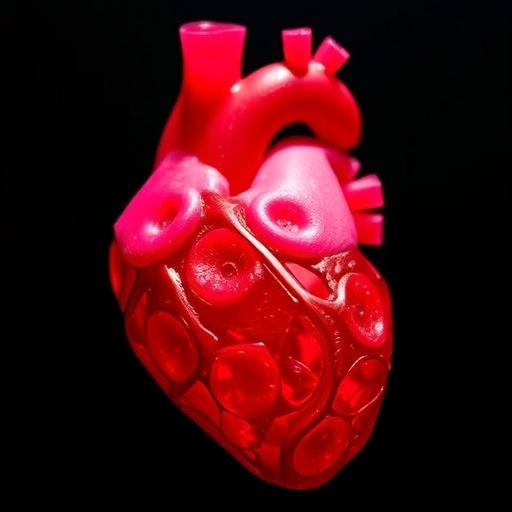
In a groundbreaking leap for cardiovascular research, scientists have engineered self-assembled chamber-like cardiac organoids that faithfully mimic the complex architecture and functionality of human heart chambers. This pioneering development not only provides a transformative model for studying cardiac chamber formation but also establishes a robust platform for assessing drug-induced cardiotoxicity, potentially revolutionizing how new therapeutics are evaluated before clinical trials. Published this year in Nature Communications, the work by Zou, Wang, Zheng, and colleagues spotlights the convergence of stem cell biology, tissue engineering, and regenerative medicine, presenting an unprecedented window into the earliest steps of heart development and disease modeling.
The human heart’s intricate structure—comprising multiple chambers each with specialized functions—is notoriously challenging to replicate in vitro. Traditional two-dimensional cardiomyocyte cultures lack the spatial organization and mechanical cues necessary for proper cardiac maturation. While previous three-dimensional cardiac organoids have demonstrated contractile activity and cell heterogeneity, recreating chamber-like structures that resemble true heart morphology has remained elusive. Zou et al. surmount this hurdle by harnessing self-assembly principles, enabling pluripotent stem cells to organize autonomously into defined, chambered organoids. This architectural mimicry is essential, as the heart’s ability to pump blood relies heavily on the precise formation and interplay of distinct chambers.
Central to their approach is the optimization of culture conditions that guide stem cells down specific differentiation trajectories while promoting cellular interactions and biomechanical feedback mechanisms. Through a carefully orchestrated protocol, the research team modulated signaling pathways such as Wnt, BMP, and Notch, which are pivotal during embryonic heart development. This biochemical guidance, combined with tailored extracellular matrix components, facilitated the aggregation of cardiomyocytes, cardiac fibroblasts, and endothelial cells into a cohesive, hollow structure reminiscent of heart chambers. Notably, the organoids exhibited spontaneous contractions with coordinated electrical conduction, underscoring their functional maturity.
This model opens unprecedented avenues for interrogating the molecular and biomechanical determinants of cardiac chamber morphogenesis. Researchers can now probe how gradients of morphogens and mechanical forces sculpt chamber identity, valve formation, and myocardial patterning in a controlled laboratory environment. By recapitulating key developmental milestones in vitro, these organoids provide insight into congenital heart defects and allow for the dissection of complex gene-environment interactions that underlie cardiac malformations. The study paves the way for elucidating pathway-specific perturbations linked to heart disease.
In addition to developmental insights, the chamber-like organoids serve as a sophisticated platform for pharmacological screening. Drug-induced cardiotoxicity remains a pervasive challenge in drug development, often causing late-stage failures or post-market withdrawals. Current preclinical models, including animal testing and 2D cultures, only partially recapitulate human cardiac physiology, limiting predictive accuracy. These self-assembled cardiac organoids, by contrast, provide a human-relevant context to assess the electrophysiological, structural, and contractile effects of novel compounds, capturing subtle toxicities that conventional assays might overlook.
The research team demonstrated the utility of their platform by testing well-known cardiotoxic agents, revealing dose-dependent disruptions in organoid rhythm and contractile force. Their findings correlated with clinical manifestations observed in patients, suggesting that this model can forecast adverse cardiac responses with enhanced fidelity. This capability could streamline drug safety assessments, reduce reliance on animal models, and ultimately expedite the delivery of safer cardiovascular therapeutics to patients.
Crucially, the organoids produced by Zou et al. display remarkable reproducibility and scalability, addressing long-standing challenges in organoid research. By standardizing the self-assembly process, the team ensured consistent formation of chambers exhibiting uniform size, morphology, and cell composition across batches. This consistency lays the groundwork for larger-scale applications such as high-throughput drug screening and precision medicine initiatives, where patient-derived organoids could be tested against personalized therapeutic regimens.
Furthermore, the researchers leveraged advanced imaging and electrophysiological techniques to characterize organoid dynamics in real time. Using high-resolution confocal microscopy and multi-electrode arrays, they mapped calcium transients, electrical propagation, and mechanical contraction patterns within the chamber-like structures. These comprehensive analyses confirmed that the organoids not only structurally resemble heart chambers but also functionally emulate their synchronous beating and electrical coupling, hallmarks of a physiologically relevant cardiac model.
Beyond drug testing, the potential of these cardiac organoids extends into regenerative medicine. The ability to self-organize into chambered constructs suggests their suitability for bioengineered tissue grafts aimed at repairing damaged myocardium. Although clinical translation remains distant, the mechanistic insights gained from these models can inform strategies for enhancing cardiac regeneration, integrating stem cell therapies, and engineering next-generation heart patches.
Zou and colleagues also touched upon the ethical and logistical advantages of their organoid system. By reducing dependence on animal experimentation, their model aligns with the principles of the 3Rs (replacement, reduction, refinement) in biomedical research. Additionally, the use of human induced pluripotent stem cells enables studies on genetically diverse populations, enhancing our understanding of how individual genetic backgrounds influence heart development and drug responses.
The combination of bioengineering, developmental biology, and pharmacology embodied in this research illustrates a paradigm shift in cardiovascular science. Where once the heart was an impenetrable black box, the creation of chamber-like cardiac organoids offers a tangible window into its formation, function, and pathologies. This synthetic heart tissue platform promises to accelerate the discovery of novel treatments for heart disease, a leading cause of mortality worldwide, with profound implications for public health.
Looking forward, the research sets the stage for integrating other cell types critical to heart function, such as immune cells and specialized conduction system components, to achieve even more physiologically comprehensive organoids. Advances in microfluidics and tissue perfusion could further enhance nutrient delivery and waste removal, mimicking in vivo conditions and prolonging organoid survival. Such innovations will push the boundaries of what organoids can reveal about cardiac biology and therapeutic potential.
In summary, the self-assembled chamber-like cardiac organoids developed by Zou et al. represent an extraordinary technological and conceptual advance. By recapitulating the form and function of human cardiac chambers in vitro, they provide a powerful tool for unraveling the complexities of heart development and disease, enabling safer drug discovery, and opening new horizons for regenerative therapies. This landmark study heralds a new era in cardiovascular research where the heart’s mysteries can be explored with unprecedented clarity, precision, and relevance.
Cite Scienmag News
Ophelia Keating. (June 2, 2026). Self-Assembled Cardiac Organoids Model Heart Chambers. Scienmag. https://scienmag.com/self-assembled-cardiac-organoids-model-heart-chambers/
Ophelia Keating. "Self-Assembled Cardiac Organoids Model Heart Chambers." Scienmag, 2 June 2026, https://scienmag.com/self-assembled-cardiac-organoids-model-heart-chambers/. Accessed 3 September 2026.
Ophelia Keating. "Self-Assembled Cardiac Organoids Model Heart Chambers." Scienmag. June 2, 2026. https://scienmag.com/self-assembled-cardiac-organoids-model-heart-chambers/


