


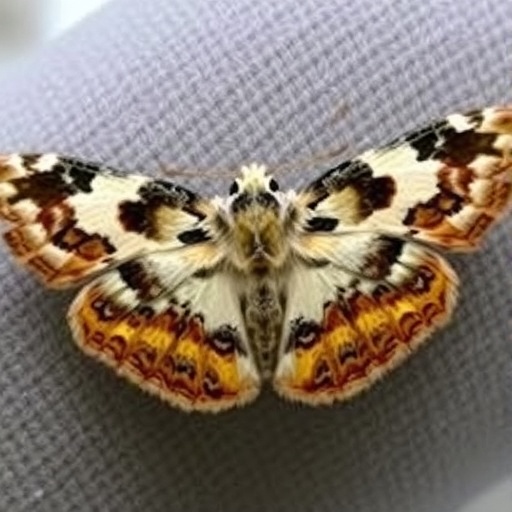
In the remote expanses of subarctic Lapland, climate change is not merely reshaping temperature gradients but is fundamentally altering intricate ecological relationships, particularly through its influence on moth populations. Recent longitudinal research conducted by the University of Turku unveils that, unlike the widespread global decline in insect biomass, total moth biomass in Lapland has moderately increased over the past 45 years. This revelation challenges prevailing narratives and highlights the nuanced, region-specific impacts of climate dynamics on terrestrial ecosystems.
Moths, complex indicators of environmental stability, play pivotal roles in subarctic food webs. Their larvae serve as a crucial nutritional resource for insectivorous birds, making fluctuations in moth populations significant for higher trophic levels. The study emphasizes the interconnectedness of marine and terrestrial ecosystems through the lens of regime shifts—a natural ecological phenomenon involving abrupt transitions between distinct stable states in marine environments. These shifts, occurring in the North Atlantic Ocean and Baltic Sea, appear to resonate terrestrially by influencing the ecology of moths in Lapland.
The study focused on the Kevo Research Station in Utsjoki, Finland, which offers a pristine monitoring environment free from urban and agricultural interference. Here, researchers exploited over four decades of comprehensive moth data collected via light traps, permitting an analysis of population trends in relation to climate variables. This extensive time series has proved invaluable in deciphering the subtle and long-term consequences of climate fluctuations on species and communities occupying northern latitudes.
Two significant marine regime shifts were documented over the timespan of the research. These shifts are characterized by substantial changes in salinity, temperature, and other oceanographic parameters, which cascade into the Baltic Sea’s marine ecosystem and, intriguingly, influence terrestrial species distant from the coast. The study’s findings illuminate how these marine transitions correlate strongly with variations in moth biomass, providing compelling evidence for cross-ecosystem climate linkages.
Further analysis revealed that specific moth groups responded distinctly to local climatic factors such as minimum and maximum seasonal temperatures and cumulative degree-days—a measure of heat accumulation critical for insect developmental rates. Such variables affect phenological events like plant budburst, which directly impact the availability and quality of larval host plants, thereby influencing moth survival and reproduction.
Winter survival mechanisms demonstrated additional complexity in responses. Species whose life cycles overwinter in the egg stage appeared more resilient under warming conditions, whereas those overwintering as larvae were vulnerable to repeated freeze-thaw cycles. These freeze-thaw events can damage diapausing larvae, reducing their viability and population recruitment, thus reshaping species composition within the moth community.
Interestingly, the observed increase in total moth biomass contrasts with alarming global trends showing widespread insect declines. This divergence suggests that climate change effects are highly context-dependent, influenced by local factors such as geographic isolation and habitat integrity. In Lapland, reduced anthropogenic disturbances, coupled with accelerated polar warming rates, may facilitate unique ecological trajectories not mirrored elsewhere.
However, the aggregate increase does not signify uniform species success. Specialist moth species, reliant on specific host plants, have declined, suggesting shifts in ecological niches and food web dynamics. Conversely, generalist moths with broad host ranges have proliferated, reflecting adaptive advantages in changing environments. This pattern underscores the importance of species-specific responses to environmental stressors within broader biodiversity assessments.
The implications extend beyond moths themselves. Insectivorous bird populations, which depend on predictable moth abundance for breeding success, are likely to experience altered reproductive outcomes in response to these biomass fluctuations. This dynamic exemplifies the cascading effects that climate-driven changes in lower trophic levels can exert on predators, with potential consequences for ecosystem stability.
The research complements previous studies linking marine regime shifts to aquatic invertebrate populations. For example, zooplankton biomass in the Baltic Sea has declined under similar climate influences, adversely affecting fish species like Baltic herring. Contrasting these trends with the moth population dynamics offers a rare cross-ecosystem perspective on climate impacts and highlights the complexity of trophic responses.
Overall, the research employing the unique longitudinal data from remote Lapland stands as a testament to the intricate and often unexpected ecological reverberations of climate change. By connecting marine regime shifts with terrestrial insect biomass, this study pioneers a holistic understanding of how climate drivers transcend ecosystem boundaries. Such insights are crucial for predicting future biodiversity patterns and informing conservation strategies in a rapidly warming world.
News Publication Date: 21-May-2026
Web References: http://dx.doi.org/10.1111/icad.70088
Cite Scienmag News
Gavin Prescott. (May 28, 2026). Oceanic Regime Shifts Reshape Subarctic Moth Communities: Species Split into Winners and Losers. Scienmag. https://scienmag.com/oceanic-regime-shifts-reshape-subarctic-moth-communities-species-split-into-winners-and-losers/
Gavin Prescott. "Oceanic Regime Shifts Reshape Subarctic Moth Communities: Species Split into Winners and Losers." Scienmag, 28 May 2026, https://scienmag.com/oceanic-regime-shifts-reshape-subarctic-moth-communities-species-split-into-winners-and-losers/. Accessed 4 September 2026.
Gavin Prescott. "Oceanic Regime Shifts Reshape Subarctic Moth Communities: Species Split into Winners and Losers." Scienmag. May 28, 2026. https://scienmag.com/oceanic-regime-shifts-reshape-subarctic-moth-communities-species-split-into-winners-and-losers/


