


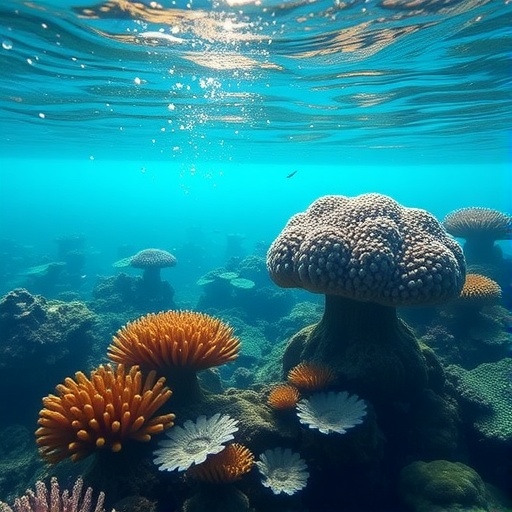
In the face of accelerating environmental threats to coral reef ecosystems, a groundbreaking study recently published in Nature Communications sheds new light on the microbial mechanisms that underpin coral resilience to eutrophication. Led by Xiang, N., Liao, T., Xie, M., and colleagues, the research reveals a crucial partnership between corals and hyper-efficient denitrifying microbes, a discovery that could revolutionize conservation strategies aimed at preserving these vital marine habitats.
Coral reefs, often described as the rainforests of the sea, are highly sensitive to nutrient imbalances caused by human activities such as agricultural runoff and wastewater discharge. Eutrophication — the excessive enrichment of water bodies with nutrients, primarily nitrogen and phosphorus — presents a formidable threat to coral health by disrupting their delicate biogeochemical balance. The study confronts a pressing question: how do some corals withstand these nutrient onslaughts while others succumb?
The researchers employed advanced metagenomic sequencing and isotope tracing techniques to characterize the microbial communities residing within coral tissues exposed to eutrophic conditions. What emerged was a vivid portrait of microbial consortia dominated by an array of denitrifying bacteria characterized by extraordinary efficiency in removing excess nitrogen through anaerobic respiration. These hyper-efficient denitrifiers appear to serve as critical microbial allies, actively mitigating the negative impacts of nutrient overload.
Denitrification is a vital process in the nitrogen cycle, whereby nitrate is converted to inert nitrogen gas, effectively lowering the bioavailable nitrogen in the environment. The team’s discovery that specific denitrifiers exhibit enhanced enzymatic machinery optimized for rapid and complete denitrification against crowded microbial ecosystems challenges previous assumptions about microbial limitations in corals. The hyper-efficient denitrifiers not only reduce nitrogen stress but also stabilize coral-microbial symbiotic networks under pressure.
By integrating correlative data from field experiments with laboratory-controlled nutrient enrichment assays, the study paints a holistic picture of coral-microbe dynamics under eutrophication. Corals hosting these elite denitrifying consortia maintained higher photosynthetic performance, lower bleaching rates, and sustained calcification compared to those lacking this microbial partnerships. This emphasizes the functional role of microbes as extensions of the coral holobiont in ecosystem resilience.
The results have profound implications for reef management, particularly in eutrophic coastal zones increasingly burdened by anthropogenic nutrient inputs. A microbial perspective offers a paradigm shift away from solely macro-faunal or physicochemical interventions toward harnessing natural microbial processes for reef restoration and conservation. Targeting and augmenting hyper-efficient denitrifiers in coral microbiomes may become an innovative biotechnological tool.
Moreover, the findings open avenues for the targeted manipulation of coral microbiomes, potentially enabling the selection or bioaugmentation of microbial communities to enhance coral resistance and recovery. Such strategies could be integrated with established coral reef restoration practices, including coral gardening and assisted evolution, to maximize ecosystem sustainability in the face of ongoing climate change and pollution pressures.
The study further highlights the complexity and specificity of coral-microbe associations, underscoring the need for detailed characterization of microbial functions rather than mere presence or abundance. It challenges the scientific community to refine frameworks describing the coral holobiont to incorporate functional microbial traits directly linked to ecosystem provisioning services.
Notably, the team’s multi-omics approach, combining genomic, transcriptomic, and metabolomic data, enables unprecedented resolution in decoding functional pathways critical to nitrogen cycling. These datasets reveal tightly regulated gene clusters responsible for nitrate reduction and nitrogen gas release, which are conspicuously upregulated in corals exposed to heightened nutrient availability. This suggests an adaptive microbial response finely tuned to environmental cues.
Ecologically, this research reminds us that microbial denitrifiers serve as unseen engineers buffering coral reefs from eutrophication-driven collapse. They exemplify nature’s intricate solutions wherein symbiosis extends beyond animal and algal partners to encompass diverse microbial communities acting as metabolic gatekeepers and biogeochemical mediators.
The discovery fits within a broader narrative recognizing the central role of microbiomes in ecosystem health and resilience. Whereas prior coral research mostly focused on symbiotic algae and pathogenic threats, Xiang et al.’s work prompts a reevaluation prioritizing beneficial functional microbes, their ecology, and evolutionary dynamics within the coral holobiont.
Furthermore, these insights could inform policy by underscoring the importance of maintaining water quality standards and mitigating nutrient pollution to protect microbial-mediated processes crucial for reef survival. Protecting and restoring corals demands integrated approaches addressing not only external environmental stressors but also internal biological mediators such as microbial denitrifiers.
The research exemplifies the power of interdisciplinary collaboration, merging marine ecology, molecular biology, and environmental microbiology, to unravel complex natural phenomena. It stands as a testament to the growing recognition that microbes, often overlooked, are fundamental architects of ecosystem resilience, holding keys to safeguarding biodiversity hotspots under anthropogenic threat.
In conclusion, the identification of hyper-efficient denitrifying bacteria as key microbial allies in coral resistance to eutrophication represents a significant leap forward in marine science. These microbial partners not only help maintain nutrient homeostasis within corals but also buffer reef ecosystems against the escalating impacts of nutrient pollution. This pioneering work opens promising pathways for innovative, microbiome-centered reef conservation in an era dominated by environmental change.
Cite Scienmag News
Morgan Morrow. (May 19, 2026). Coral Resistance to Eutrophication Linked to Denitrifiers. Scienmag. https://scienmag.com/coral-resistance-to-eutrophication-linked-to-denitrifiers/
Morgan Morrow. "Coral Resistance to Eutrophication Linked to Denitrifiers." Scienmag, 19 May 2026, https://scienmag.com/coral-resistance-to-eutrophication-linked-to-denitrifiers/. Accessed 4 September 2026.
Morgan Morrow. "Coral Resistance to Eutrophication Linked to Denitrifiers." Scienmag. May 19, 2026. https://scienmag.com/coral-resistance-to-eutrophication-linked-to-denitrifiers/


