


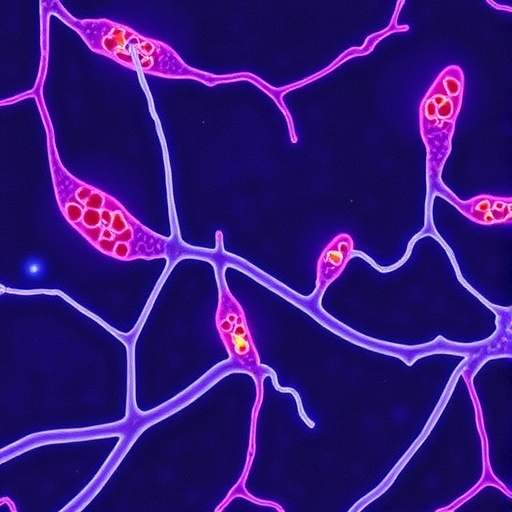
In the rapidly evolving field of neurodegenerative diseases, a groundbreaking study now unveils a promising biomarker that could revolutionize diagnosis and differentiation of synucleinopathies. Published in the forthcoming 2026 issue of npj Parkinson’s Disease, the study led by Di Fabrizio, M., van der Gaag, B.L., Terzi, M., and colleagues explores the intricate alterations of myelin in donor skin and highlights its potential to distinguish between different synucleinopathies with remarkable specificity.
Synucleinopathies—such as Parkinson’s disease, multiple system atrophy, and dementia with Lewy bodies—are characterized by the aberrant accumulation of alpha-synuclein protein aggregates in neurons and glial cells. However, clinical overlap and overlapping pathological features have long complicated accurate diagnosis during life, often necessitating postmortem confirmation. Identifying peripheral biomarkers that reflect central nervous system pathology presents an urgent challenge for the neurodegenerative disease community.
The researchers set their sights on myelin damage in donor skin as a hitherto underappreciated window into the neurodegenerative process. Myelin, the lipid-rich sheath enveloping axons, ensures rapid conduction velocity of electrical signals along neurons. Damage to myelin disrupts neuronal communication and is a hallmark in various neurodegenerative disorders. By examining skin biopsies from a cohort of confirmed synucleinopathy donors, the team employed immunohistochemical and ultrastructural analyses to characterize myelin integrity and molecular alterations.
Their findings were striking. Distinct patterns of myelin disruption emerged that correlated strongly with specific synucleinopathy subtypes. For example, Parkinson’s disease patients exhibited partial degradation of the compact myelin layers with preserved paranodal regions, whereas multiple system atrophy donors showed widespread myelin unwrapping and fragmentation. These differential patterns suggest divergent mechanisms of neurodegeneration linked to alpha-synuclein strains or strains’ cellular targets.
Crucially, the study demonstrated that myelin alterations detected in peripheral skin biopsies mirrored central nervous system pathology revealed postmortem by neuropathological examination. This concordance paves the way for skin biopsy-based diagnostic assays, a far less invasive and more accessible approach compared to cerebrospinal fluid or brain imaging techniques. The prospect of detecting disease-specific myelin damage signatures in a simple skin biopsy could transform clinical practice by enabling earlier diagnosis and stratification of synucleinopathies in living patients.
On a molecular level, the investigation illuminated potential mechanisms driving myelin disruption in synucleinopathies. The authors documented co-localization of pathological alpha-synuclein aggregates with myelin-associated glycoproteins and lipid domain alterations, suggesting that misfolded protein species may interact directly with myelin components to initiate degeneration. Oxidative stress markers and inflammatory mediators were also elevated in affected skin regions, implicating immune activation as a contributor to demyelination.
The research team leveraged advanced electron microscopy to visualize nanoscale myelin pathology, revealing subtle myelin sheath decompaction and lamellar disruption invisible to conventional microscopy. This ultrastructural approach allowed unprecedented resolution of pathological features that differentiate subtypes, capturing the spatial relationship between alpha-synuclein deposits and myelin membranes. Such insights underscore the importance of combining multidisciplinary techniques in neurodegenerative disease research.
In addition to diagnostic implications, the study’s findings may shed light on therapeutic targets. If myelin damage is not merely a downstream consequence but also a driver of neurodegeneration in synucleinopathies, interventions aimed at stabilizing or repairing myelin could hold promise. Remyelination therapies, already being explored in multiple sclerosis, might be repurposed or adapted for synucleinopathies, potentially modifying disease progression and improving patient outcomes.
Furthermore, peripheral tissue biomarkers such as skin myelin integrity offer advantages in clinical trial design and monitoring. They could serve as accessible endpoints to track disease progression or response to therapies, reducing reliance on expensive imaging or invasive procedures. Early-phase therapeutic trials might benefit from including skin biopsy myelin analysis as a surrogate biomarker, expediting drug development pipelines.
The multidisciplinary team behind the study combined expertise in neurology, pathology, dermatology, and molecular biology to achieve this comprehensive characterization. Their robust methodology included blinded analysis and validation cohorts to ensure reproducibility and generalizability of results. The rigorous design highlights the study’s potential to set a new standard for biomarker discovery in neurodegenerative research.
While these findings are compelling, the authors acknowledge challenges ahead. Larger multicenter studies are necessary to validate the specificity and sensitivity of skin myelin damage as a diagnostic biomarker across diverse populations and disease stages. Longitudinal studies will clarify whether these alterations precede clinical symptoms, enabling potential preclinical diagnosis and intervention.
Moreover, understanding how different alpha-synuclein strains or posttranslational modifications influence myelin damage will require detailed biochemical and genetic investigations. Integrating skin biopsy results with fluid biomarkers, neuroimaging, and clinical phenotyping will provide a holistic approach to unravel synucleinopathy heterogeneity.
This landmark study also opens intriguing questions regarding the pathophysiological role of peripheral nervous system involvement in synucleinopathies. The presence of myelin pathology in skin supports theories of peripheral propagation of alpha-synuclein pathology, with implications for disease initiation, spread, and symptomatology. Targeting peripheral pathology could constitute a novel therapeutic angle.
In conclusion, the discovery that myelin damage in donor skin can differentiate between synucleinopathies represents a major advance in the quest for reliable, minimally invasive biomarkers. By bridging peripheral tissue pathology and central neurodegeneration, this approach holds promise to revolutionize diagnosis, patient stratification, and therapy development in a group of devastating disorders that currently lack definitive biomarkers.
As research progresses, this study lays the groundwork for clinical translation of a skin biopsy–based diagnostic tool, potentially transforming how clinicians approach synucleinopathies in the near future. The intersection of neuropathology, dermatology, and advanced imaging captured in this work exemplifies the power of cross-disciplinary innovation to unravel complex diseases and improve patient care on a global scale.
Cite Scienmag News
Diana Fleming. (May 19, 2026). Myelin Damage in Donor Skin Distinguishes Synucleinopathies. Scienmag. https://scienmag.com/myelin-damage-in-donor-skin-distinguishes-synucleinopathies/
Diana Fleming. "Myelin Damage in Donor Skin Distinguishes Synucleinopathies." Scienmag, 19 May 2026, https://scienmag.com/myelin-damage-in-donor-skin-distinguishes-synucleinopathies/. Accessed 6 September 2026.
Diana Fleming. "Myelin Damage in Donor Skin Distinguishes Synucleinopathies." Scienmag. May 19, 2026. https://scienmag.com/myelin-damage-in-donor-skin-distinguishes-synucleinopathies/


