


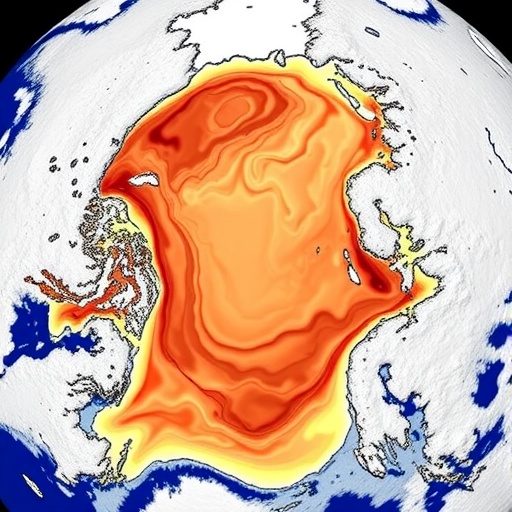
In a groundbreaking new study published in Communications Earth & Environment, researchers Gluckman, Evans, and Golden delve into a subtle yet powerful feedback mechanism that could reshape our understanding of the Arctic’s rapidly changing ice landscape. Their work, titled “Topography-albedo feedback reinforces the transition to a younger Arctic ice pack,” unveils how the physical features of Arctic ice influence its own melting dynamics, accelerating a transition that has profound implications for regional and global climate systems. This research adds a crucial layer to the complex puzzle of Arctic ice change, providing insights that may help refine predictions for future ice conditions.
The Arctic region has long been known as a bellwether for global climate change due to its rapid warming rate, often outpacing that of the global average. Central to this dynamic is the Arctic sea ice cover, which acts both as an indicator and influencer of climate variations by regulating surface temperatures through the albedo effect — the reflection of solar radiation. The new study by Gluckman and colleagues expands on this concept by focusing on how topographic features of the ice itself, such as ridges and hummocks, influence albedo and subsequent melt patterns, thus reinforcing a feedback loop that promotes a “younger” ice pack dominated by thinner and more dynamic floes.
At the heart of this research lies the topography-albedo feedback, a phenomenon where the three-dimensional structure of ice alters the surface’s reflectivity. Unlike uniformly smooth ice, a topographically varied ice surface creates shadows, differential sun exposure, and changes in snow accumulation patterns. These factors collectively reduce the surface albedo, meaning less sunlight is reflected back into space and more is absorbed as heat. This localized warming leads to uneven and accelerated melting, gradually reshaping the ice pack’s morphology and overall thickness distribution.
The authors highlight that as Arctic sea ice thins and becomes more fragmented due to warming temperatures and changing wind patterns, its topography shifts significantly. Older, thicker ice generally features more complex ridges and variable surface heights created by pressure and deformation over many years. Conversely, younger ice is typically thinner and flatter but can experience rapid surface roughening due to fracturing and melt ponding. The interplay between these physical characteristics and solar radiation absorption fundamentally alters the trajectory of ice age distribution, pushing the Arctic cycle towards a state dominated by younger ice types.
This feedback process does not operate in isolation. Gluckman et al. argue that it is intertwined with established climate drivers such as air and ocean temperatures, cloud cover variations, and atmospheric circulation changes. However, previous models have largely underestimated the influence of ice topography on albedo, focusing instead on areal extent and ice concentration metrics. By integrating high-resolution lidar and satellite altimetry data with sophisticated radiative transfer models, the research team provides compelling evidence of the overlooked but critical role topography plays in modulating ice melt patterns.
A particularly striking implication of the topography-albedo feedback mechanism is its potential to accelerate the shift from multi-year ice—ice that survives multiple melt seasons and is generally thicker and more resilient—to predominantly first-year ice. This younger ice is more vulnerable to rapid melting during the summer months, hastening the overall seasonal variability and leading to a more unstable ice regime. Such a transition drastically alters the Arctic ecosystem, with consequences spanning from habitat loss for ice-dependent species to modifications in local weather patterns and global climate teleconnections.
Moreover, the researchers’ findings challenge some optimistic projections about Arctic sea ice recovery in the coming decades. While certain climate models predicted possible rebounds in ice extent due to natural variability or mitigation efforts, the topography-albedo feedback introduces a self-reinforcing cycle that makes such recovery less likely without substantial reductions in greenhouse gas emissions. The complex interplay between physical structures on the ice and solar radiation absorption essentially acts as an amplifier, deepening the irreversible pathway the ice cover is currently on.
Technically, the team employed a combination of field measurements and remote sensing technologies to quantify how variations in surface the topography influence albedo. Using airborne laser scanning data combined with spectral reflectance measurements, they characterized microtopographic features across various ice types and assessed their impact on sunlight reflection across visible and near-infrared wavelengths. This empirical approach allowed them to build and validate numerical simulations that incorporate real-world ice surface complexities, producing more accurate estimates of melt rates driven by radiative forcing changes.
Another innovative aspect of the study is its focus on the spatial scale at which topography-albedo feedback operates. Unlike large-scale climatic influences that are often diffuse, topographic features create melt hotspots at meter- to kilometer-scale lengths, which can then coalesce into broader melt patterns at the ice pack scale. Understanding this scale-dependent behavior helps resolve discrepancies between satellite-derived melt estimates and in-situ observations, allowing for improvement in predictive models that can be deployed for operational forecasting and climate scenario planning.
In addition to the physical processes detailed, the paper explores the broader implications for Arctic communities and global climate policy. The increasing prevalence of younger, less stable ice exacerbates risks for indigenous populations reliant on predictable sea ice conditions for hunting and transportation. It also complicates shipping and resource extraction efforts that depend on stable ice as a navigational platform. From a policy perspective, highlighting the role of topography in amplifying ice loss underscores the urgency for enhanced climate mitigation and adaptive strategies tailored to the accelerating Arctic transformation.
The authors also discuss potential feedbacks to the global climate system, including altered heat exchange between ocean and atmosphere due to changing surface roughness and ice cover dynamics. As Arctic ice diminishes, dark ocean waters absorb more solar energy, further warming the region and disrupting atmospheric circulation patterns, potentially affecting weather extremes in mid-latitudes. The topography-albedo feedback therefore sits within a web of interconnected climatic effects that resonate far beyond the Arctic Circle.
One of the critical challenges emphasized is the need for sustained and enhanced observational programs to monitor Arctic ice topography and albedo variations. Continuous data collection through satellites equipped with advanced lidar systems, along with coordinated field campaigns, will be vital to capture seasonal and interannual variability in ice surface features. This ongoing monitoring will feed into evolving climate models, helping to reduce uncertainties and improve response strategies to a swiftly changing Arctic environment.
Looking ahead, the researchers suggest avenues for future study, especially regarding how changing ice topography interacts with other feedback mechanisms such as melt pond development and snow cover variability. Melt ponds, which form on the ice surface during warm seasons, have been known to drastically lower albedo, but their formation and evolution are partly influenced by underlying surface roughness. A deeper understanding of these interconnected processes will be crucial to unraveling the complexity of Arctic ice dynamics in a warming world.
In conclusion, the study by Gluckman, Evans, and Golden illuminates a vital yet underappreciated aspect of Arctic sea ice retreat — the role of topography-driven albedo changes in reinforcing the transition to a younger, more vulnerable ice pack. This research not only elevates the scientific discourse on Arctic cryosphere dynamics but also serves as a clarion call to expand observational and modeling efforts that encompass the intricate physical features of sea ice. As the Arctic continues its unprecedented transformation, insights such as these will prove indispensable in forecasting future conditions and guiding policy decisions to mitigate and adapt to rapid environmental changes.
Gluckman, D.E., Evans, T.P. & Golden, K.M. Topography-albedo feedback reinforces the transition to a younger Arctic ice pack.
Commun Earth Environ (2026). https://doi.org/10.1038/s43247-026-03636-3
Cite Scienmag News
Violet Maxwell. (May 18, 2026). Topography-Albedo Feedback Drives Younger Arctic Ice. Scienmag. https://scienmag.com/topography-albedo-feedback-drives-younger-arctic-ice/
Violet Maxwell. "Topography-Albedo Feedback Drives Younger Arctic Ice." Scienmag, 18 May 2026, https://scienmag.com/topography-albedo-feedback-drives-younger-arctic-ice/. Accessed 5 September 2026.
Violet Maxwell. "Topography-Albedo Feedback Drives Younger Arctic Ice." Scienmag. May 18, 2026. https://scienmag.com/topography-albedo-feedback-drives-younger-arctic-ice/


