


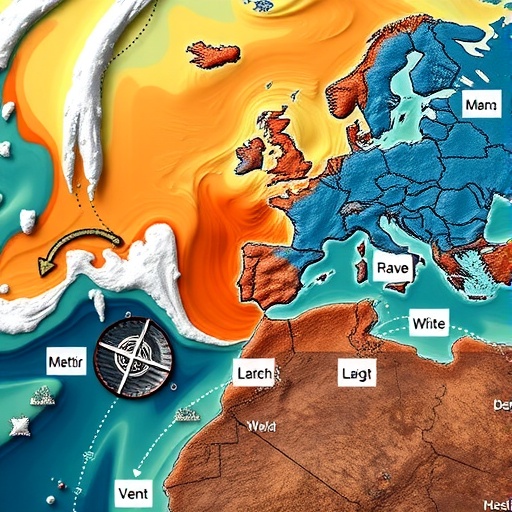
Breaking news from oceanography: a new study reports that waters flowing out of the Mediterranean may help “power” the deep convection that fuels critical mixing in the North Atlantic. The work, published in Nature Communications by Calvo, Malanotte-Rizzoli, Menna and colleagues (2026), reframes how scientists think about where convection sites receive their heat and salt that drive dense-water sinking.
Researchers focused on the Mediterranean outflow—salty, relatively dense water that exits through straits and spreads downstream across the Atlantic. Using a combination of oceanographic observations and targeted modeling, the team traced how this outflow can be transformed by mixing and then delivered to locations where buoyancy conditions favor vertical overturning.
Technically, the study connects changes in salinity and temperature to density anomalies that determine whether water parcels sink or remain buoyant. The authors emphasize that even modest adjustments in these properties can tip local stratification toward unstable configurations, enabling deep convection to form and sustain itself.
A central result is that Mediterranean-sourced water does not merely passively drift through the basin; it can act as a supply line of key tracers linked to dense-water characteristics. By comparing modeled pathways with measured signatures, the researchers argue that the timing and distribution of the outflow align with observed or inferred convection activity.
The findings also speak to the multi-stage nature of ocean mixing. As the outflow travels, it undergoes transformation through entrainment, double-diffusive processes, and turbulence-driven exchange with surrounding waters. These steps help set the density and chemical “fingerprints” of the arriving parcels.
For climate-relevant dynamics, the implication is straightforward: convection sites influence how the ocean transports heat and carbon between layers. If Mediterranean outflow steers where convection intensifies, it may indirectly modulate large-scale variability in the North Atlantic.
Importantly, the study’s framework offers a pathway for improving future predictive models. Rather than treating deep convection as locally generated, it points to upstream forcing embedded in basin-to-basin circulation.
Bottom line: Mediterranean outflow waters appear to be an overlooked, yet significant contributor to North Atlantic convection regions, strengthening the link between regional Mediterranean processes and broader ocean circulation and climate impacts.
Cite Scienmag News
Violet Maxwell. (July 17, 2026). Mediterranean Outflow Waters Power North Atlantic Deep Convection Sites. Scienmag. https://scienmag.com/mediterranean-outflow-waters-power-north-atlantic-deep-convection-sites/
Violet Maxwell. "Mediterranean Outflow Waters Power North Atlantic Deep Convection Sites." Scienmag, 17 July 2026, https://scienmag.com/mediterranean-outflow-waters-power-north-atlantic-deep-convection-sites/. Accessed 4 September 2026.
Violet Maxwell. "Mediterranean Outflow Waters Power North Atlantic Deep Convection Sites." Scienmag. July 17, 2026. https://scienmag.com/mediterranean-outflow-waters-power-north-atlantic-deep-convection-sites/


