

Friday, July 17, 2026
Science
No Result
View All Result
  • Login
  • HOME
  • SCIENCE NEWS
  • CONTACT US
  • HOME
  • SCIENCE NEWS
  • CONTACT US
No Result
View All Result
Scienmag
No Result
View All Result
Home Science News Earth Science

Ice-to-ocean method tracks mercury mobilization and export from Greenland ice sheet

July 17, 2026
in Earth Science
Reading Time: 2 mins read
0
Ice-to-ocean method tracks mercury mobilization and export from Greenland ice sheet

Ice-to-ocean method tracks mercury mobilization and export from Greenland ice sheet

65
SHARES
587
VIEWS
Share on FacebookShare on Twitter
ADVERTISEMENT

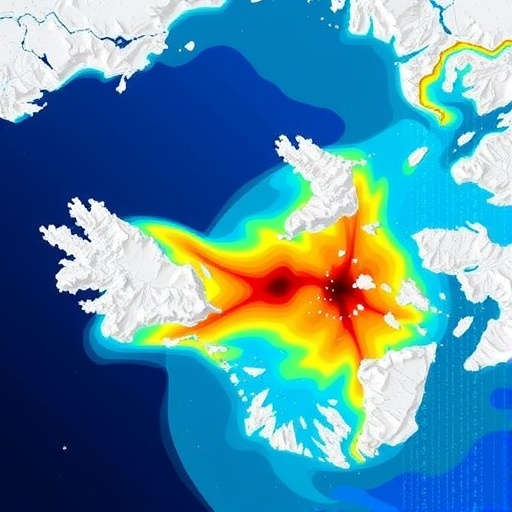
A new study paints a high-resolution picture of how mercury moves from Greenland’s icy interior to the surrounding ocean—an environmental pathway that can influence ecosystems far beyond the ice sheet itself. Writing in Communications Earth & Environment, researchers report an “ice-to-ocean” framework designed to track mercury mobilization, transport, and eventual export, bridging a gap between glaciology and geochemistry.

Mercury is a potent neurotoxicant, and even small shifts in its cycling can alter atmospheric deposition patterns, ocean chemistry, and food-web contamination. Yet mercury export from ice sheets has been notoriously difficult to quantify because the relevant processes occur across harsh terrain, variable temperatures, and strongly coupled hydrological pathways.

The team combined field- and model-informed logic to simulate how mercury embedded or deposited on ice can become chemically available during melting and runoff events. When surface snow and ice warm, meltwater can reorganize the chemical environment, changing how mercury partitions between solid phases and dissolved forms. In particular, the study emphasizes mobilization mechanisms driven by meltwater flushing and reaction pathways that occur as water flows toward marine margins.

A central result is that episodic melt conditions can act as short, efficient “delivery windows,” during which mobilized mercury is transported rapidly from land-ice surfaces into coastal waters. This timing matters: the ocean does not simply receive a steady trickle, but likely receives pulses that can enhance downstream bioavailability.

The researchers also address export efficiency—the fraction of mobilized mercury that survives transport without being strongly re-sorbed or transformed before reaching the sea. By coupling hydrological transport assumptions with mercury chemistry, the framework estimates how much mercury could reach ocean settings where it may be transformed further.

Although the work focuses on Greenland, the implications extend to other cryospheric regions where warming increases meltwater production and alters drainage networks. As Arctic temperatures rise, the balance between storage in ice and release to oceans may shift, potentially affecting mercury exposure risk in marine food chains.

Finally, the study provides a roadmap for linking ice-sheet dynamics to contaminant fate, offering a tool for future projections under different melt scenarios. If mercury export accelerates, the Arctic could become a more active source of contamination to the global ocean—an outcome with measurable consequences.

Subject of Research: Mercury mobilization and export from the Greenland Ice Sheet to the ocean
Article Title: Mercury mobilization and export from the Greenland Ice Sheet using an ice-to-ocean approach.
Article References: Youssef, A.N., Janssen, S.E., Lamborg, C. et al. Mercury mobilization and export from the Greenland Ice Sheet using an ice-to-ocean approach. Commun Earth Environ (2026). https://doi.org/10.1038/s43247-026-03818-z
Image Credits: AI Generated
DOI: 10.1038/s43247-026-03818-z
Keywords: Mercury; Greenland Ice Sheet; ice-to-ocean transport; meltwater mobilization; contaminant export; Arctic geochemistry

Tags: coastal mercury export from Greenland iceenvironmental pathways of mercury from iceglaciology and geochemistry integrationGreenland ice sheet mercury exporthigh-resolution modeling of mercury fluxice sheet contribution to global mercury cycleice-to-ocean mercury transportimpact of meltwater on mercury cyclingmeltwater-driven chemical reactionsmercury contamination in marine ecosystemsmercury mobilization during ice meltmercury redistribution in polar regions
Share26Tweet16
Previous Post

Platelet Reactivity in Older Polymorbid Patients and Effects of 4-Methylcatechol

Next Post

Smartphone Social-Experience Tests Predict Relapse Risk in First-Episode Psychosis

Related Posts

Scientists identify rare oddball meteorite linked to dinosaur extinction
Earth Science

Scientists identify rare oddball meteorite linked to dinosaur extinction

July 17, 2026
Mediterranean Outflow Waters Power North Atlantic Deep Convection Sites
Earth Science

Mediterranean Outflow Waters Power North Atlantic Deep Convection Sites

July 17, 2026
Elevation-Driven Warming at High Altitudes Across the Westerly Tibetan Plateau
Earth Science

Elevation-Driven Warming at High Altitudes Across the Westerly Tibetan Plateau

July 17, 2026
Long-Term Evaluation of Restoration Outcomes Under China’s Shan-Shui Initiative
Earth Science

Long-Term Evaluation of Restoration Outcomes Under China’s Shan-Shui Initiative

July 17, 2026
El Niño Impacts Global Water Storage Through Asymmetric Hydrological Patterns
Earth Science

El Niño Impacts Global Water Storage Through Asymmetric Hydrological Patterns

July 17, 2026
Effects of Deforestation and Reforestation on Soil Biodiversity and Ecosystem Function
Earth Science

Effects of Deforestation and Reforestation on Soil Biodiversity and Ecosystem Function

July 17, 2026
Next Post
Smartphone Social-Experience Tests Predict Relapse Risk in First-Episode Psychosis

Smartphone Social-Experience Tests Predict Relapse Risk in First-Episode Psychosis

  • Mothers who receive childcare support from maternal grandparents show more

    Mothers who receive childcare support from maternal grandparents show more parental warmth, finds NTU Singapore study

    27656 shares
    Share 11059 Tweet 6912
  • University of Seville Breaks 120-Year-Old Mystery, Revises a Key Einstein Concept

    1061 shares
    Share 424 Tweet 265
  • Bee body mass, pathogens and local climate influence heat tolerance

    682 shares
    Share 273 Tweet 171
  • Researchers record first-ever images and data of a shark experiencing a boat strike

    546 shares
    Share 218 Tweet 137
  • Groundbreaking Clinical Trial Reveals Lubiprostone Enhances Kidney Function

    531 shares
    Share 212 Tweet 133
Science

Embark on a thrilling journey of discovery with Scienmag.com—your ultimate source for cutting-edge breakthroughs. Immerse yourself in a world where curiosity knows no limits and tomorrow’s possibilities become today’s reality!

RECENT NEWS

  • UMN researcher wins $3.7 million NIH grant to advance AI glaucoma care
  • Y-Added FeCoNiSiB Amorphous Multi-Principal Alloys Demonstrate Enhanced Performance
  • Study Links Heavy TV Watching to Smaller Brain Structures
  • University of Toronto Professor Elected Fellow of the British Academy

Categories

  • Agriculture
  • Anthropology
  • Archaeology
  • Athmospheric
  • Biology
  • Biotechnology
  • Blog
  • Bussines
  • Cancer
  • Chemistry
  • Climate
  • Earth Science
  • Editorial Policy
  • Marine
  • Mathematics
  • Medicine
  • Pediatry
  • Policy
  • Psychology & Psychiatry
  • Science Education
  • Social Science
  • Space
  • Technology and Engineering

Subscribe to Blog via Email

Enter your email address to subscribe to this blog and receive notifications of new posts by email.

Join 5,146 other subscribers

© 2025 Scienmag - Science Magazine

Welcome Back!

Login to your account below

Forgotten Password?

Retrieve your password

Please enter your username or email address to reset your password.

Log In
No Result
View All Result
  • HOME
  • SCIENCE NEWS
  • CONTACT US

© 2025 Scienmag - Science Magazine

Discover more from Science

Subscribe now to keep reading and get access to the full archive.

Continue reading
