


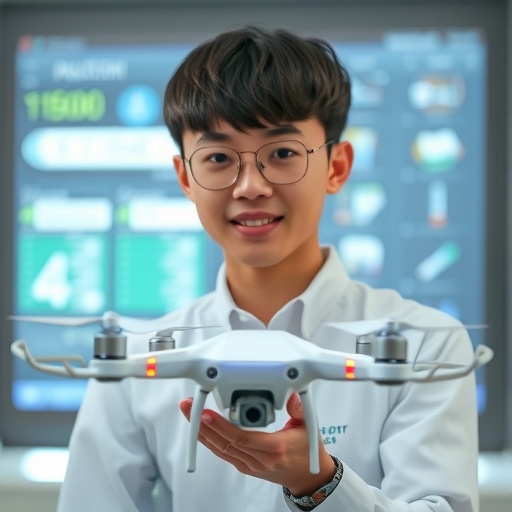
Unauthorized drones could soon be identified by compact surveillance systems that consume a fraction of the power required by conventional artificial intelligence hardware. Researchers at Sungkyunkwan University in South Korea have developed UAV-NAS, an artificial intelligence system designed to recognize drones and determine aspects of their flight activity using radio-frequency signals. The system combines neural architecture search with a low-power field-programmable gate array, or FPGA, creating a pathway toward continuous drone monitoring in military, industrial and other security-sensitive environments.
The work, led by undergraduate researcher Doyeon Kim in the Department of Electronic and Electrical Engineering under Professor Wansu Lim, addresses a central problem in deploying AI at the edge. Drone detection systems often rely on computationally demanding neural networks that run on conventional central processing units. Although these systems can analyze signals effectively, their energy requirements make them difficult to install on small, battery-powered platforms, especially devices expected to operate outdoors for long periods without access to a reliable power supply.
UAV-NAS approaches the problem by allowing software to search automatically for an efficient neural network structure rather than relying entirely on engineers to design the architecture manually. Neural architecture search, commonly known as NAS, evaluates possible combinations of layers, connections and processing operations to identify a model that meets a specific balance of accuracy, speed and energy consumption. In this case, the search was guided by the demands of radio-signal analysis and the hardware constraints of an FPGA, producing a model intended to be both compact and practical for real-time deployment.
Instead of depending primarily on camera images, the system processes radio signals associated with drones. These signals can be represented as in-phase and quadrature, or I/Q, data, a format widely used to describe the amplitude and phase of complex radio waves. By examining patterns in the signals, an AI model can learn to distinguish one drone or transmission profile from another. This approach could be valuable in environments where visual detection is hindered by darkness, weather, distance, obstacles or the limited field of view of a camera.
The researchers deployed the automatically designed model on an FPGA, a programmable semiconductor device whose hardware resources can be configured for specialized computation. Unlike a general-purpose CPU, an FPGA can execute carefully structured operations in parallel, reducing unnecessary data movement and improving energy efficiency for selected workloads. This makes the technology particularly attractive for edge AI, where data must be analyzed close to the sensor rather than transmitted continuously to a remote server or large data center.
In experiments, the team reported that the FPGA implementation identified drone types and flight conditions with high accuracy while reducing power consumption by 88.7 percent compared with running the AI system on a conventional CPU. The result suggests that intelligent monitoring could be integrated into smaller surveillance units, portable equipment or distributed sensor networks. A lower energy requirement could also allow systems to remain active for longer periods, strengthening the possibility of uninterrupted monitoring around industrial facilities, restricted airspace and military installations.
The significance of the result extends beyond a single drone-recognition application. Unauthorized unmanned aerial vehicles are increasingly viewed as a security challenge because they can approach sensitive infrastructure quickly, operate at low altitude and be difficult to track using traditional methods. A network of low-power radio-signal sensors could potentially provide an additional layer of protection by detecting and classifying drones before they enter a restricted area. Such systems could complement radar, optical cameras and other sensing technologies while reducing the burden on centralized computing hardware.
The study also highlights the growing role of hardware-aware AI design. Many neural networks are developed first for powerful processors and only later adapted to embedded devices, a process that can lead to compromises in speed, memory use and power consumption. UAV-NAS reverses that workflow by incorporating the target FPGA into the model-design process from the beginning. The result is an architecture shaped not only by recognition accuracy but also by the realities of semiconductor resources, computation time and energy availability.
Kim’s research path reflects the increasingly close connection between university laboratories and the semiconductor industry. He has worked in FPGA research since his junior year and also completed an internship at Rebellions, a South Korean AI semiconductor company. Sungkyunkwan University described the project as an example of undergraduate research reaching an international publication while remaining closely connected to practical engineering. Kim is scheduled to graduate with a bachelor’s degree in August and will begin a fully funded Ph.D. program at Purdue University in September, where he plans to continue studying semiconductors and artificial intelligence.
The research was published in IEEE Transactions on Industrial Informatics under the title “UAV-NAS: UAV Identification on FPGAs via Neural Architecture Search.” By combining radio-frequency signal intelligence, automated neural-network design and specialized low-power hardware, the work points toward a future in which drone monitoring is not limited to large, energy-intensive installations. Instead, compact AI devices could remain active at the edge, analyzing the airspace around critical locations in real time and making advanced detection capabilities more accessible.
Web References: https://doi.org/10.1109/TII.2026.3685163
References: D. Y. Kim, J. Kang, C.-H. Lee and W. Lim, “UAV-NAS: UAV Identification on FPGAs via Neural Architecture Search,” IEEE Transactions on Industrial Informatics, vol. 22, no. 8, pp. 7347–7358, August 2026. DOI: 10.1109/TII.2026.3685163.
Keywords
UAV identification, drone detection, radio-frequency signals, I/Q signals, neural architecture search, NAS, FPGA, edge AI, low-power semiconductors, embedded artificial intelligence, real-time monitoring, energy efficiency, AI accelerators, unauthorized drones, semiconductor engineering
Cite Scienmag News
Denise Maddox. (August 7, 2026). Sungkyunkwan University Student Develops Semiconductor Technology for AI Drone Identification. Scienmag. https://scienmag.com/sungkyunkwan-university-student-develops-semiconductor-technology-for-ai-drone-identification/
Denise Maddox. "Sungkyunkwan University Student Develops Semiconductor Technology for AI Drone Identification." Scienmag, 7 August 2026, https://scienmag.com/sungkyunkwan-university-student-develops-semiconductor-technology-for-ai-drone-identification/. Accessed 4 September 2026.
Denise Maddox. "Sungkyunkwan University Student Develops Semiconductor Technology for AI Drone Identification." Scienmag. August 7, 2026. https://scienmag.com/sungkyunkwan-university-student-develops-semiconductor-technology-for-ai-drone-identification/


