


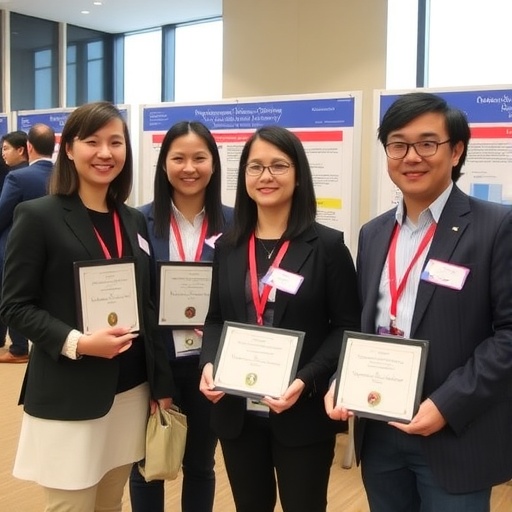
In an inspiring showcase of emerging medical talent, ten students from Boston University’s Chobanian & Avedisian School of Medicine recently garnered significant recognition at the Massachusetts Medical Society’s 17th Annual Research Poster Symposium. This notable event, integrated with the Future Health: Best Practices for Advancing Care educational conference, stands as a premier platform encouraging groundbreaking scientific inquiry and fostering innovative approaches to complex healthcare challenges. The symposium, renowned for its rigorous selection process, offered a competitive arena where students meticulously presented their research within four specialized categories: clinical research, basic research, clinical vignettes, and health policy/medical education.
The symposium attracted over 120 abstract submissions this year, underscoring the expansive interest and commitment from young medical researchers eager to contribute to the field. After a detailed evaluation by expert panels, only eight posters were selected for full presentation, displaying the highest caliber of academic and scientific rigor. Among these, three winners were distinguished in each category, alongside several notable honorable mentions, illustrating the depth and diversity of cutting-edge medical research cultivated within the academic environment.
Chief among the Boston University winners was the innovative work of third-year medical students Kiyah Adams and Catherine Sutton, who jointly secured first place in the health policy and medical education category. Their poster, entitled “Improving Patient Connection Rates with AI-Driven Social Needs Referrals in the Emergency Department,” highlights an increasingly critical intersection of artificial intelligence and social determinants of health. This research elucidates how AI algorithms can enhance referral systems by rapidly identifying and connecting patients with essential social support services, strategically addressing barriers to care in emergency settings. The utilization of AI in this context not only improves efficiency but also aligns with broader public health goals by addressing systemic inequities.
In the clinical research domain, first-year student Rama S. Varanasi was awarded first place for the compelling poster “Anti-VEGF Injections Associated with Renal Function Decline: Prospective Cohort Study.” This investigation probes the nephrotoxic potential of anti-vascular endothelial growth factor (VEGF) therapies, widely used in ocular treatments for conditions such as age-related macular degeneration. The study’s prospective design allowed for a systematic evaluation of renal biomarkers, identifying correlations that may inform clinical risk assessments and guide more personalized patient management strategies, thereby enhancing therapeutic safety profiles.
Second place in clinical research was achieved by third-year student Aryan Wadhwas for the poster “Cerebral Cavernous Malformation–Related Epilepsy Maps to a Conserved Brain Network.” This study delves into the neuroanatomical substrates implicated in epilepsy arising from cerebral cavernous malformations, leveraging advanced neuroimaging techniques and network analysis to elucidate conserved epileptogenic pathways. The insights gleaned hold potential implications for improved diagnostic precision and the development of targeted interventions aimed at mitigating seizure activity within this patient population.
An additional highlight from Boston University, first-year student Erika Teresa Minetti, MS, earned third place in the basic research category. Her poster, “Cardiometabolic Proteomics and Vascular Insulin Resistance in Type 2 Diabetes,” presents a sophisticated proteomics analysis that uncovers novel protein signatures intertwined with insulin resistance within vascular tissues. This work contributes to the foundational understanding of the molecular mechanisms underpinning diabetes-induced vascular dysfunction, offering promising avenues for biomarkers and therapeutic targets in combating cardiovascular complications associated with metabolic disorders.
Third-year student Shreya Tripathy, securing third place in clinical research with a poster titled “Cases of Acquired Synesthesia Map to a Common Brain Network,” explored the neurological phenomena underlying acquired synesthetic experiences through functional neuroimaging. By mapping the brain networks involved, this research advances our comprehension of sensory integration and neural plasticity, which has broad implications for cognitive neuroscience and potential rehabilitation frameworks for sensory processing abnormalities.
Honorable mentions further underscored the depth of Boston University’s research spectrum. Third-year student Aaron Moy investigated “Transplanted Airway Stem Cells Survive Viral Infection and Restore the Airway Epithelium,” providing critical insights into regenerative medicine strategies vital for respiratory health, especially amidst viral pandemics. Similarly, third-year student Isabelle Joy’s work on “ZUF: A Novel DNA Repair Factor with Implications in PARP Inhibitor Response” advances the understanding of DNA repair pathways and their therapeutic exploitation in oncology.
First-year student Urvika Gupta examined the “Role of BCL11B in Cardiovascular and Neuronal Embryonic Development in Model System Xenopus Laevis,” elaborating on gene regulatory mechanisms essential for organogenesis, while third-year student Nnaemeka Chukwudalu Nnwoke’s research on “Food Insecurity, Bone Health, and Frailty In U.S. Adults: Implications For Spine Neurosurgery” bridged nutritional epidemiology with neurosurgical outcomes, underscoring socioeconomic factors affecting patient vulnerability and surgical prognosis.
The Assistant Dean of Research at Boston University School of Medicine, Dr. Matthew Layne, PhD, emphasized the symposium’s vital role in fostering early career scientific development. He highlighted the significance of peer exchange and mentorship in cultivating a research community committed to translational impact. This event not only spotlights student achievements but also affirms the institution’s dedication to supporting groundbreaking research endeavors poised to shape future medical paradigms.
Overall, the Massachusetts Medical Society’s Research Poster Symposium stands as a testament to the dynamic integration of clinical innovation, fundamental biology, and health policy within medical education. The notable accomplishments by Boston University’s students illuminate the trajectory of medical research from hypothesis to potential practice-changing discoveries. These young investigators, through their rigorous work and collaborative spirit, exemplify the forward momentum essential to advancing health sciences and improving patient care in an increasingly complex healthcare landscape.
Boston University’s success at this prestigious event reflects the strategic emphasis placed on fostering an environment where medical students are immersed in diverse research opportunities. Their projects, spanning AI applications, molecular medicine, neuroscience, regenerative biology, and public health, collectively contribute to the expanding frontiers of medicine. Such recognition not only motivates the student body but also signals to the broader scientific community the emergence of a new generation of physician-scientists equipped to tackle modern health challenges with intellect and innovation.
News Publication Date: Not specified
Web References: Not specified
References: Not specified
Cite Scienmag News
Courtney Benton. (May 13, 2026). BU Medical Students Honored at Massachusetts Medical Society Research Poster Symposium. Scienmag. https://scienmag.com/bu-medical-students-honored-at-massachusetts-medical-society-research-poster-symposium/
Courtney Benton. "BU Medical Students Honored at Massachusetts Medical Society Research Poster Symposium." Scienmag, 13 May 2026, https://scienmag.com/bu-medical-students-honored-at-massachusetts-medical-society-research-poster-symposium/. Accessed 4 September 2026.
Courtney Benton. "BU Medical Students Honored at Massachusetts Medical Society Research Poster Symposium." Scienmag. May 13, 2026. https://scienmag.com/bu-medical-students-honored-at-massachusetts-medical-society-research-poster-symposium/


