


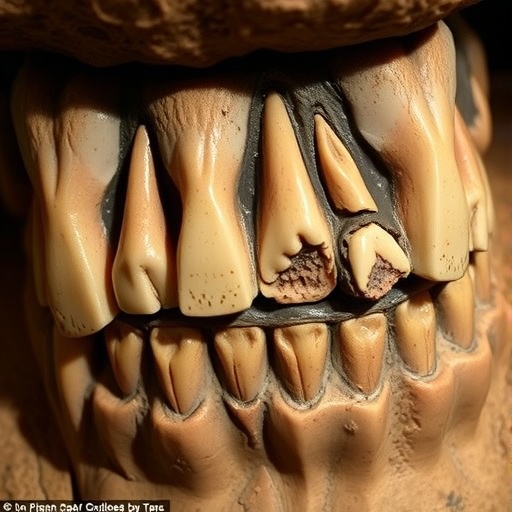
In a groundbreaking discovery that reshapes our understanding of Neanderthal cognitive and medical capabilities, recent research reveals that these ancient hominins were capable of performing invasive dental procedures to alleviate tooth infections. Published in the open-access journal PLOS One on May 13, 2026, the study by Alisa Zubova and colleagues from the Peter the Great Museum of Anthropology and Ethnography provides the earliest confirmed evidence of dental intervention by Neanderthals—dating back nearly 59,000 years. This finding not only pushes back the timeline for complex medical behavior in archaic humans but also offers profound insights into the sophistication of Neanderthal health management strategies.
The focal point of this remarkable study is a single Neanderthal molar recovered from Chagyrskaya Cave in Russia. This tooth displays a deep, intentionally crafted hole penetrating the pulp cavity—an anatomical site where nerves and blood vessels reside and where untreated infections can become excruciatingly painful. By employing advanced imaging techniques such as computed microtomography, the researchers were able to visualize structural changes in the dentin mineralization indicative of severe carious lesions. Intriguingly, the morphology of the cavity diverged from natural decay patterns, suggesting it was the result of deliberate human modification rather than accidental damage.
To validate their hypothesis, the research team undertook experimental replication studies using modern human teeth. They used stone points analogous to the tools recovered from the same archaeological site to drill into the enamel and dentin layers. The microscopic grooves and striations found on these experimentally treated teeth matched those observed on the Neanderthal molar with exceptional precision. This congruence strongly supports the interpretation that the prehistoric cavity was shaped using a sharp stone implement, effectively constituting one of the earliest examples of invasive dental treatment in the evolutionary record.
The behavior inferred here is both medically and cognitively sophisticated. Not only does drilling into the tooth require fine motor skills and an understanding of cause and effect, but it also necessitates recognizing the source of pain and choosing an intervention that, while painful in the short term, would provide long-term relief. This challenges prior conceptions that only anatomically modern humans engaged in such nuanced medical procedures and suggests that Neanderthals possessed a comparable depth of knowledge about their own biology.
Further supporting the therapeutic nature of the procedure is evidence that the individual continued using the affected tooth well after treatment, as indicated by antemortem wear patterns. This implies success in mitigating pain sufficiently to allow normal masticatory function. The presence of toothpick grooves further highlights complex oral hygiene behaviors, indicating a layered approach to dental care that included both preventive and invasive strategies.
The discovery also reframes the role of Neanderthals as not mere brutish predecessors but as intelligent agents capable of solving complicated health problems. The use of stone tools for dental work aligns with broader archaeological evidence of Neanderthal technological innovation, from tool production to symbolic behavior. Moreover, this dental intervention predates previously known instances of human dental manipulation by over 40,000 years, a testament to its remarkable antiquity.
Contextualizing this find within Neanderthal ecology, the Chagyrskaya Cave population lived in the Altai region, which provided abundant resources, stable climate conditions, and rich biodiversity. These favorable environmental circumstances may have supported the development and transmission of medical knowledge. Genetic studies link these Neanderthals to the Micoquian culture, widespread across Eurasia, suggesting that such medical practices could have been part of a larger cultural repertoire.
The success of this dental intervention also speaks to the social frameworks within Neanderthal groups. Performing such a painful procedure would likely require social cooperation and care, highlighting complex social bonds and empathetic behaviors. The willingness to endure pain to alleviate suffering may reflect a sophisticated understanding of health that goes beyond mere survival instincts.
From a methodological standpoint, this study underscores the power of an interdisciplinary approach. The integration of high-resolution imaging, experimental archaeology, and paleopathology allows scientists to reconstruct behaviors that left no direct textual or artistic records. These technologies enable the detection of subtle microscopic patterns on ancient teeth that would otherwise be indistinguishable from natural damage.
The implications for the field of paleoanthropology are profound. This discovery necessitates a revision of narratives surrounding Neanderthal cognition, pushing back the emergence of medical intervention and complex problem-solving in the hominin lineage. It also raises new questions. How widespread was this behavior among Neanderthals? Did it vary regionally or temporally? What were the specific cultural practices that supported such medical knowledge transmission?
Furthermore, this evidence invites a reevaluation of the evolutionary pathways for healthcare practices. If Neanderthals independently developed invasive dental treatment, it suggests convergent evolution in medical behaviors or perhaps a shared ancestral knowledge predating the divergence between Neanderthals and Homo sapiens.
Alisa Zubova, reflecting on the uniqueness of this finding, emphasized the distinctive morphology of the dental concavity, unlike typical carious lesions seen in modern humans, and the clear signs of intentional modification. Lydia Zotkina highlighted their experimental drilling work, which conclusively demonstrated that a sharp, thin stone tool could effectively remove infected dental tissue, while Ksenia Kolobova contextualized the find within the migration patterns and cultural affiliations of Neanderthal populations in Eurasia.
Collectively, these insights present a paradigm shift in our understanding of Neanderthals—not as archaic beings lacking sophisticated knowledge—but as complex, innovative hominins capable of advanced medical interventions long before Homo sapiens. This discovery enriches the intricate tapestry of human evolution, illuminating unexpected facets of our ancient cousins and reminding us of their enduring legacy.
News Publication Date: 13-May-2026
Web References: http://dx.doi.org/10.1371/journal.pone.0347662
References: Zubova AV, Zotkina LV, Olsen JW, Kulkov AM, Moiseyev VG, Malyutina AA, et al. (2026) Earliest evidence for invasive mitigation of dental caries by Neanderthals. PLoS One 21(5): e0347662.
Cite Scienmag News
Courtney Benton. (May 13, 2026). Neanderthal Dentists Employed Stone Drills to Treat Cavities Nearly 60,000 Years Ago. Scienmag. https://scienmag.com/neanderthal-dentists-employed-stone-drills-to-treat-cavities-nearly-60000-years-ago/
Courtney Benton. "Neanderthal Dentists Employed Stone Drills to Treat Cavities Nearly 60,000 Years Ago." Scienmag, 13 May 2026, https://scienmag.com/neanderthal-dentists-employed-stone-drills-to-treat-cavities-nearly-60000-years-ago/. Accessed 4 September 2026.
Courtney Benton. "Neanderthal Dentists Employed Stone Drills to Treat Cavities Nearly 60,000 Years Ago." Scienmag. May 13, 2026. https://scienmag.com/neanderthal-dentists-employed-stone-drills-to-treat-cavities-nearly-60000-years-ago/


