


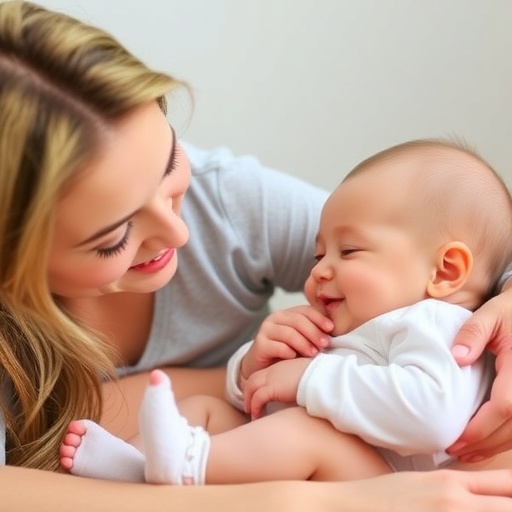
As any caregiver can attest, infants often surprise us with their emerging capacity to assist in daily routines. From slipping their tiny arms through sleeves to picking up misplaced clothing during laundry time, these early manifestations of helping hint at complex developmental processes unfolding quietly in the first year of life. Beyond mere mimicry, such behaviors indicate the beginnings of prosocial tendencies—actions intended to benefit others—rooted deeply in the infant’s growing motor and social-cognitive capabilities.
A groundbreaking longitudinal study led by researchers at Ludwig-Maximilians-Universität München in Germany has lately shed light on the nuanced pathways through which helping behavior develops in infancy. Spanning multiple observations at six, ten, and fourteen months, the study tracked 118 caregiver-infant dyads, predominantly involving mothers and their full-term, typically developing infants, to investigate how helping emerges in interactional contexts and how it correlates with underlying developmental markers.
The researchers approached the intricate phenomenon of infant helping by focusing on two distinct but intertwined contexts: shared chores with the primary caregiver and helping behaviors directed at unfamiliar adults. The inquiry centered around whether and how infants’ helping actions are shaped by their motor development, social understanding assessed via eye-tracking methodologies, and the quality of caregiver interactions, including modeling of helpful behaviors and sensitivity to the infant’s needs.
Crucially, the study revealed that infants’ willingness and ability to assist were tightly linked to the caregiver’s active demonstration and scaffolding of helping activities. When mothers engaged infants in shared routines—folding laundry or tidying books—and provided clear behavioral cues, infants were more likely to step in and assist. This finding underscores the role of concrete situational learning: the more caregivers actively model helping, the stronger infants’ helping behavior toward the caregiver. Interestingly, this direct modeling link did not extend to helping strangers, suggesting divergent developmental routes for prosocial behavior depending on the recipient’s familiarity.
Moreover, the study highlights that helping unfamiliar adults hinges less on immediate behavioral cues and more on infants’ broader social-cognitive maturity—specifically, their ability to infer others’ goals—and the sensitive attunement they have experienced in meeting their own needs. These infants, whose caregivers responded consistently and reliably to their signals, showed greater propensity to help unknown individuals. This distinction points to the layered complexity of prosocial development and implies that the motivations and mechanisms driving helping vary with social context.
Methodologically, assessing infants’ social understanding through eye-tracking offered a sensitive window into how infants process and interpret social information, while caregiver reports on motor development provided essential data on the infant’s physical ability to act. It is increasingly clear that motor capabilities do not merely enable actions but interlace with social and cognitive processes, prompting infants to engage actively in their social world.
The research advances prevailing theoretical perspectives that regard early helping as embodied within interactive routines. Infants learn to help by being embedded in everyday interactions that scaffold their emerging skills, where motor development and social understanding evolve hand in hand. These findings lend empirical weight to classic developmental theories emphasizing the foundational role of caregiver-child dynamics in fostering prosociality.
Potential applications of this research extend beyond academic interest. For families and early childhood educators, the findings encourage deliberate involvement of infants in shared tasks and everyday helping scenarios to foster these capacities. The insights suggest that caregivers’ demonstration of helpfulness and sensitivity to infants’ cues forge pathways for nurturing prosocial dispositions from the earliest months.
Yet, the researchers cautiously acknowledge limitations inherent in their work. By evaluating helping toward caregivers and strangers at the same developmental time points, the nuanced developmental trajectory across differing recipients remains incompletely understood. Additionally, laboratory assessments, while controlled for standardization, cannot capture the full richness and variability of helping opportunities infants encounter naturally at home.
As a next frontier, the researchers propose investigating helping behavior within naturalistic settings to complement laboratory findings. Further inquiries may unravel how diverse forms of prosociality—such as emotional support and sharing—emerge and what roles caregiver interaction quality, scaffolding, and social cognition play across different social acts.
The synthesis of caregiver modeling, infant motor skills, and social understanding revealed by this study represents a significant advance in unraveling the origins of human helpfulness. It reflects a developmental tapestry in which biology and social experience weave together, guiding infants as they first pick up not merely objects but the social gestures that build community.
Published in the journal Child Development, this in-depth exploration by Christner, Kammermeier, Kaßecker, and Paulus represents a milestone in early developmental science, inviting both families and practitioners to recognize and nurture the humble beginnings of empathy and helpfulness evidenced in every reaching infant hand.
News Publication Date: 13-May-2026
Web References: DOI link 10.1093/chidev/aacag022 provided for journal article access.
References: Christner, N., Kammermeier, M., Kaßecker, A., and Paulus, M. (2026). Developmental pathways of infant helping toward caregivers and unfamiliar adults: A longitudinal study. Child Development.
Cite Scienmag News
Courtney Benton. (May 13, 2026). New Study Reveals How Babies Support Their Caregivers. Scienmag. https://scienmag.com/new-study-reveals-how-babies-support-their-caregivers/
Courtney Benton. "New Study Reveals How Babies Support Their Caregivers." Scienmag, 13 May 2026, https://scienmag.com/new-study-reveals-how-babies-support-their-caregivers/. Accessed 4 September 2026.
Courtney Benton. "New Study Reveals How Babies Support Their Caregivers." Scienmag. May 13, 2026. https://scienmag.com/new-study-reveals-how-babies-support-their-caregivers/


