


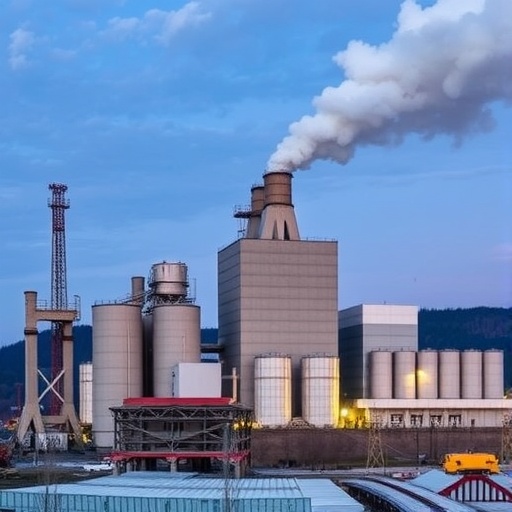
As the global community intensifies efforts to combat climate change, much of the spotlight has been on curbing fossil fuel consumption and cutting greenhouse gas emissions. However, a significant yet often overlooked contributor to carbon dioxide emissions is cement production, responsible for approximately 8% of worldwide CO₂ emissions. Addressing this, a groundbreaking study published in ACS Energy Letters reveals an innovative method for manufacturing cement using electricity that slashes energy consumption by 70% and reduces carbon emissions by an astonishing 98% compared to conventional processes.
Curtis Berlinguette, the lead researcher from the University of British Columbia and corresponding author of the study, emphasizes the transformative potential of this research. The study pioneers an electrified pathway for cement manufacture by utilizing electricity in place of traditional fossil fuel combustion for chemical conversion processes, thereby drastically minimizing the industry’s carbon footprint. This breakthrough involves using recycled waste cement as a feedstock to produce critical cement precursors at exceptionally low temperatures, transforming the industry’s environmental impact.
Traditional cement production relies heavily on heating limestone—a calcium carbonate compound—along with silica-containing minerals to temperatures exceeding 1,450 degrees Celsius (over 2,600 degrees Fahrenheit). This intense heating occurs in two stages and results not only in substantial thermal energy consumption but also releases significant quantities of carbon dioxide as limestone decomposes into lime (calcium oxide) and CO₂. The thermal decomposition reaction is an intrinsic source of emissions, making traditional cement plants among the largest industrial CO₂ emitters globally.
In contrast, Berlinguette’s team utilizes an electrochemical process that leverages electricity to initiate the conversion of limestone and silica into cement precursors at a mild 60 degrees Celsius (140 degrees Fahrenheit). This dramatic reduction in processing temperature marks a significant departure from established kilning techniques. The cement precursor produced through this electrolytic method is subsequently calcined into belite—a form of calcium silicate essential for the structural integrity of massive constructions such as dams—at only 650 degrees Celsius. This lower temperature kiln operation consumes markedly less thermal energy.
This innovative approach not only drastically curtails the thermal energy requirement by 70% but also reduces CO₂ emissions significantly, thanks to both the lower processing temperatures and the substitution of feedstocks. Notably, the research team employed recycled waste cement as the primary raw material instead of virgin limestone. The use of post-consumer cement waste addresses concerns related to raw material extraction impacts while dramatically slashing the carbon footprint. This feedstock replacement reduced CO₂ emissions to merely 20 kilograms per ton of cement produced—an approximately 98% decrease compared to the conventional emissions of 800 kilograms per ton.
An intriguing aspect of the electrochemical method is its generation of hydrogen as a by-product during the conversion reactions. This green hydrogen can be harnessed as a clean fuel source in the kiln’s secondary heating step, further eliminating dependence on fossil fuels. By integrating hydrogen combustion for thermal energy, the entire cement production cycle could transition toward zero-carbon operations, revolutionizing industrial practices entrenched in carbon-intensive technologies.
Belite-rich cement, which results from this process, is vital for large-scale infrastructure due to its enhanced durability and long-term strength characteristics. Conventional belite cement production typically requires sustained high temperatures akin to those in traditional Portland cement manufacture. The novel electrochemical precursor synthesis reduces the required calcination temperature significantly, which in turn diminishes the associated energy demands and emissions even at this secondary stage.
The team’s approach aligns with circular economy principles by incorporating recycled cement into fresh manufacturing, thereby reducing waste and promoting resource efficiency. By circumventing limestone mining and lowering thermal requirements, this method tackles two major environmental challenges simultaneously: resource depletion and industrial greenhouse gas release. The scalability potential of this technology could reshape the cement industry and contribute meaningfully to national and international climate goals.
Berlinguette’s research group acknowledges financial support from several Canadian institutions dedicated to fostering innovative science and engineering solutions. They have also filed an international patent for the technology and are actively working toward commercializing this low-carbon cement production pathway through a startup, signaling a promising transition from laboratory research to industry-wide adoption.
The publication of this study in ACS Energy Letters highlights the critical importance of interdisciplinary approaches in tackling global environmental issues. By combining principles of electrochemistry, materials science, and industrial engineering, the researchers strategically targeted the energy-intensive bottleneck of cement manufacture. This advancement reflects a broader trend wherein electrification and green technologies increasingly underpin sustainable industrial transformations.
While cement underpins global infrastructure development—from residential buildings to monumental dams—its environmental footprint has long been a barrier to sustainable growth. Innovations like this electrochemical production method are essential for decoupling cement output from carbon emissions without compromising material performance. As countries ramp up infrastructure investments to support urbanization and climate resilience, low-carbon cement alternatives will be indispensable.
Besides environmental benefits, the proposed process promises economic advantages due to reduced energy costs and potential integration with renewable electricity sources. By leveraging clean electricity grids and utilizing waste materials, this method could facilitate green manufacturing workflows within circular economy frameworks, fostering sustainable industrial ecosystems.
In conclusion, the University of British Columbia team has unveiled a pioneering electrical process for cement production with the potential to slash its massive carbon footprint by nearly 98%. This breakthrough not only addresses one of the largest industrial contributors to climate change but also opens pathways for a cleaner, sustainable construction industry. As electrification and resource recycling gain momentum globally, such innovations will be vital for achieving carbon-neutral infrastructure and combating global warming.
News Publication Date: 13-May-2026
Web References:
http://pubs.acs.org/doi/abs/10.1021/acsenergylett.5c04150
References:
DOI: 10.1021/acsenergylett.5c04150
Cite Scienmag News
Sloane Callahan. (May 13, 2026). Electricity Could Enable Nearly Carbon-Free Cement Production. Scienmag. https://scienmag.com/electricity-could-enable-nearly-carbon-free-cement-production/
Sloane Callahan. "Electricity Could Enable Nearly Carbon-Free Cement Production." Scienmag, 13 May 2026, https://scienmag.com/electricity-could-enable-nearly-carbon-free-cement-production/. Accessed 3 September 2026.
Sloane Callahan. "Electricity Could Enable Nearly Carbon-Free Cement Production." Scienmag. May 13, 2026. https://scienmag.com/electricity-could-enable-nearly-carbon-free-cement-production/


