


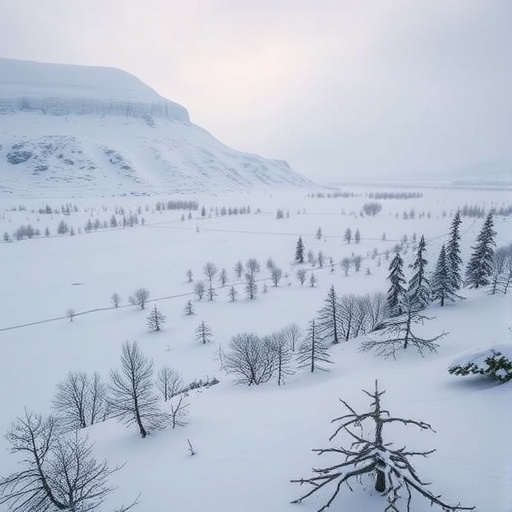
In recent years, the Arctic has witnessed a troubling climatic phenomenon that is reshaping its fragile ecosystem: rain-on-snow events. These episodes, where rainfall occurs over existing snowpacks, lead to the formation of perilous ice layers both atop and within the snow. The consequences of these ice formations ripple far beyond meteorological curiosities—they directly impact the mobility and foraging behavior of key Arctic herbivores such as caribou and muskoxen. Given the dependence of Indigenous and local communities on these animals for food, cultural practices, and livelihoods, the repercussions of these climatic shifts are profound and multifaceted.
At the forefront of investigating these dynamics is a dedicated team of researchers from Colorado State University, spearheaded by Stine Højlund Pedersen. Their work delves into the intricate physical processes underpinning rain-on-snow events and seeks to create advanced models for predicting the formation and persistence of resultant ice layers. This endeavor is critical, as the Arctic continues to warm at an unprecedented rate, exacerbating the frequency and severity of these rain-on-snow episodes. Understanding the physicochemical changes within the snowpack under such conditions is essential for anticipating broader ecological and socio-economic impacts.
The complex interplay between temperature fluctuations, precipitation patterns, and snowpack thermodynamics is at the core of these investigations. Rain, upon contact with snow, can freeze, creating impermeable and often continuous ice strata that subdivide the snowpack. This stratified structure alters the snow’s thermal properties, mechanical strength, and permeability. These ice layers can be sufficiently thick and resilient to bear significant weight, thereby influencing the ease with which animals traverse their habitats. However, they can simultaneously obstruct access to vegetation embedded beneath, imposing severe foraging challenges.
During an intensive field expedition to northwest Alaska—a region frequently assaulted by rain-on-snow events—researchers meticulously documented parameters including snow depth profiles, grain size distributions, snow grain typology, and the precise vertical positioning of ice layers. Beyond geophysical measurements, the team also quantified the biomechanical implications for fauna by analyzing hoofprint morphology and the depth of impressions animals leave on varying snow and ice conditions. These data illuminate the energetic costs animals incur when negotiating altered substrates, a factor with significant implications for survival and reproductive success.
The scientific challenge lies in integrating these heterogeneous data streams into a cohesive modeling framework. Traditional snow models, while robust in simulating accumulation and distribution processes, have historically lacked a nuanced representation of ice layer formation within snowpacks. Pedersen’s team aims to bridge this gap by developing a specialized ice-layer submodel that can be incorporated into existing three-dimensional, physics-based snow simulators. Such a tool will enable precise simulations of how ice layers modify snowpack stability and heterogeneity across varied topographies and microclimates.
One compelling application of this model is its capacity to capture differential melting rates influenced by solar radiation exposure. For instance, ice layers on the sun-exposed slopes of mountainous terrain may exhibit accelerated degradation compared to those shrouded in shade, profoundly affecting habitat accessibility for wildlife. Moreover, quantifying the temporal persistence of these ice strata can offer insights into periods of heightened animal stress and altered migratory behaviors caused by constrained movement or scarce forage availability.
Complementing the modeling efforts, Adele Reinking, a wildlife research biologist and doctoral candidate at CSU, emphasizes the critical importance of “ground-truthing” via empirical data collection. Remote sensing technologies and stationary weather stations provide valuable macro-scale environmental snapshots but fall short of detailing subsurface snowpack characteristics. The hybrid approach pursued by this research seamlessly combines large-scale observational data with granular field measurements, producing a richly detailed understanding of environmental dynamics.
Indeed, this multidimensional perspective is necessary to address the complex feedback loops at play. For example, the formation of ice layers may reduce the insulating capacity of snowpacks, potentially accelerating permafrost thaw beneath. This, in turn, can modify vegetation communities, affecting food availability for herbivores. Consequently, disruptions at the snow and ice interface can cascade through trophic levels, impacting predator-prey relations, nutrient cycling, and broader ecological resilience.
This research is supported by a $2 million NSF-funded project designed to span five years, during which data will be systematically collected in multiple Arctic locales beyond Alaska, including Greenland and Svalbard. These sites share the increasing prevalence of rain-on-snow events, offering a comparative lens to examine divergent environmental and ecological responses across the circumpolar north. Results obtained will not only inform scientific understanding but also serve Indigenous communities and policymakers striving to mitigate climate-induced risks.
Ultimately, the goal is transformative: to translate rigorous scientific inquiry into practical, widely applicable tools that inform conservation efforts, wildlife management, and climate adaptation strategies. The model under development promises to be a versatile asset for researchers across disciplines, enabling accurate simulations of snowpack-ice dynamics under varied climate scenarios. This capacity is vital as the Arctic faces an uncertain future shaped by anthropogenic warming and its cascading ecological effects.
The stakes extend beyond academic curiosity. Altered animal movement and foraging behaviors precipitated by rain-on-snow-induced ice layers challenge subsistence hunters and pose threats to cultural heritage, food security, and economic well-being of local populations. As such, this work embodies a holistic paradigm, intertwining physical science, ecology, and human dimensions in pursuit of actionable knowledge and sustainable stewardship of one of Earth’s most vulnerable environments.
The pioneering efforts by the Colorado State University team represent a beacon of interdisciplinary research innovation, illustrating the critical interplay between environmental monitoring, mechanistic modeling, and impact assessment. By unpacking the physics of ice layer formation and linking these findings to biological and societal outcomes, their endeavor embodies the urgent and impactful science necessary for navigating the Arctic’s evolving landscape amid global climate change.
News Publication Date: Not provided
Web References:
- Colorado State University: https://www.colostate.edu/
- Cooperative Institute for Research in the Atmosphere (CIRA): https://www.cira.colostate.edu/
- CSU Department of Atmospheric Science: https://www.atmos.colostate.edu/
- NSF Award 2402348: https://www.nsf.gov/awardsearch/show-award/?AWD_ID=2402348&HistoricalAwards=false
- CSU Graduate Degree Program in Ecology: https://ecology.colostate.edu/
Cite Scienmag News
Russell Cooper. (May 13, 2026). Researchers Explore Impact of Rainfall on Arctic Snowpack. Scienmag. https://scienmag.com/researchers-explore-impact-of-rainfall-on-arctic-snowpack/
Russell Cooper. "Researchers Explore Impact of Rainfall on Arctic Snowpack." Scienmag, 13 May 2026, https://scienmag.com/researchers-explore-impact-of-rainfall-on-arctic-snowpack/. Accessed 3 September 2026.
Russell Cooper. "Researchers Explore Impact of Rainfall on Arctic Snowpack." Scienmag. May 13, 2026. https://scienmag.com/researchers-explore-impact-of-rainfall-on-arctic-snowpack/


