


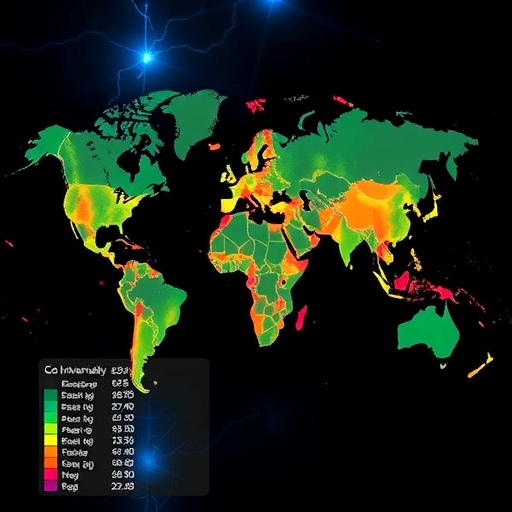
In an era where sustainable development hinges critically on efficient energy use, the global patterns of electric consumption have never been more significant. A groundbreaking study by Liu, Guo, Zhao, and colleagues, published in npj Urban Sustainability (2026), presents an unprecedented spatial analysis of how electricity is consumed worldwide. This research pierces through conventional narratives by integrating multi-scale perspectives, revealing stark inequalities that challenge existing assumptions about energy distribution and access.
Electricity, the lifeblood of modern civilization, underpins virtually every facet of urban life—from residential comfort to industrial production. However, understanding the intricate patterns of electricity consumption across the globe requires more than raw data. It demands a spatially nuanced approach that considers geographic, socio-economic, and infrastructural factors collectively. The researchers achieved this by leveraging advanced geospatial analytics alongside rich datasets, enabling a detailed mapping of energy usage patterns across cities, regions, and entire countries.
The study begins by delineating the methodological framework deployed to capture these patterns. Traditional approaches often rely on aggregate national statistics, which obscure local heterogeneity. By contrast, this work harnesses high-resolution satellite data combined with ground-based sensors and utility records. This fusion enables a robust visualization of consumption at different scales—from micro-level urban neighborhoods to macro-level continental divisions.
One critical technical advancement is the implementation of spatial clustering algorithms that identify characteristic zones of energy use. These zones reflect distinct socio-economic profiles, infrastructure maturity, and climatic variabilities influencing demand. The spatial segmentation approach reveals not only hotspots of intense consumption but also zones experiencing energy deprivation. Moreover, this multi-scalar perspective is crucial to detect how disparities manifest differently at local, regional, and global scales.
Delving deeper, the researchers employ inequality metrics adapted from economics and social science to measure disparities in electricity consumption. Unlike conventional income-related inequality, energy consumption inequality can elucidate environmental justice issues and access inequities. Surprisingly, their results indicate that while some regions display relatively uniform consumption patterns, others show extreme polarization, underscoring entrenched infrastructural and policy divides.
The spatial dimension of these inequalities yields further insights into urban development trajectories. Mega-cities often emerge as voracious electricity consumers, driven by industrial activity and high residential demand. However, within these sprawling urban agglomerations, notable intra-city disparities arise. Affluent districts consume disproportionately more electricity, benefiting from reliable infrastructure and advanced technologies, while marginalized neighborhoods face intermittent supply and lower consumption levels.
One of the profound implications of this study concerns climate mitigation strategies. Understanding where and how electricity is consumed allows policymakers to tailor interventions with precision. For instance, regions identified as consumption hotspots can be targeted for efficiency upgrades and demand-response programs. Conversely, areas exhibiting low consumption due to lack of access highlight opportunities for expansion of electricity infrastructure, promoting equity and economic development.
From a technical standpoint, the research illustrates the power of integrating heterogeneous data sources. Machine learning models trained on satellite imagery and socio-economic indicators predict consumption trends with remarkable accuracy. These predictive insights are critical for urban planners and energy providers seeking to optimize grid management and anticipate future demand spikes.
The study also confronts challenges inherent in handling vast and varied data. Managing spatiotemporal data streams requires robust computational frameworks and sophisticated algorithms. The authors detail how cloud computing resources and parallel processing pipelines were instrumental, enabling scalable analysis across global datasets without compromising resolution.
Further, the spatial inequality analysis draws on theoretical constructs like spatial autocorrelation and fractal geometry. These concepts help to quantify how consumption patterns cluster or disperse geographically. The findings reveal that energy inequality is not purely a function of economic wealth but also deeply intertwined with spatial factors such as urban form, proximity to energy generation sites, and policy interventions.
In their discussion, the researchers emphasize the importance of a holistic perspective that bridges technical data science, urban planning, and social equity. They advocate for sustainable urban energy systems that balance efficiency with fairness, a vision that requires continuous monitoring and adaptive governance informed by spatial analytics.
The significance of this research extends beyond academia. By making data-driven inequality visible, it equips governments, civil society, and industry stakeholders with evidence needed to confront systemic disparities. It also inspires innovation in smart grid technologies, renewable integration, and demand-side management, all essential components of a sustainable energy future.
Finally, this work underscores the dynamism of urban energy landscapes, which are rapidly evolving due to digitalization, climate change, and demographic shifts. Continuous spatial monitoring of electric consumption is poised to become an indispensable tool in navigating this complexity, helping humanity chart a sustainable path forward.
In essence, Liu and colleagues’ spatially grounded inquiry into global electric consumption patterns opens a vital window onto the intertwined challenges of sustainability and equity. Their innovative application of spatial perspective technologies reveals a multifaceted portrait of inequality that demands urgent attention from researchers, policymakers, and citizens alike. As urban centers continue to grow and electrification accelerates worldwide, this research provides both the diagnostic clarity and strategic direction necessary for shaping our energy future.
Cite Scienmag News
Courtney Benton. (May 13, 2026). Mapping Global Electric Use and Inequality Across Scales. Scienmag. https://scienmag.com/mapping-global-electric-use-and-inequality-across-scales/
Courtney Benton. "Mapping Global Electric Use and Inequality Across Scales." Scienmag, 13 May 2026, https://scienmag.com/mapping-global-electric-use-and-inequality-across-scales/. Accessed 3 September 2026.
Courtney Benton. "Mapping Global Electric Use and Inequality Across Scales." Scienmag. May 13, 2026. https://scienmag.com/mapping-global-electric-use-and-inequality-across-scales/


