


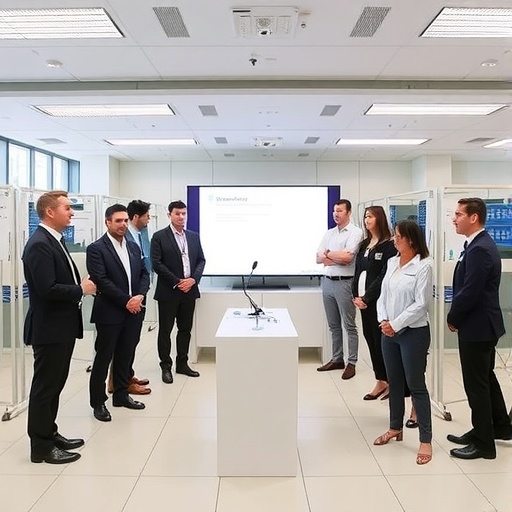
In a landmark moment for infectious disease research, Korea University Medicine officially inaugurated its state-of-the-art Biosafety Level 3 (BL3) and Animal Biosafety Level 3 (ABL3) special laboratories on April 16, marking a pivotal expansion in the nation’s capacity to tackle high-risk pathogens. Located on the sixth floor of the Mediscience Park Chung Mong-Koo Future Medicine Building, these newly expanded and modernized facilities embody the cutting edge of biosafety and biomedical research infrastructure. This announcement was complemented by a grand symposium hosted in the Donghwa Bio Building, underscoring Korea University Medicine’s commitment to advancing collaborative research initiatives that bridge public, private, academic, and industrial sectors.
Korea University Medicine stands as the only domestic tertiary general hospital with a pronounced research focus, including its three affiliated hospitals at Anam, Guro, and Ansan. This unique infrastructure fosters an integrated approach combining clinical treatment excellence with rigorous research methodologies. The institution has a well-established record in the clinical and basic science domains of infectious disease, contributing significantly to national health security through its research output. The inauguration of the BL3 and ABL3 labs marks an upscale of these efforts, enabling enhanced pathogen analysis, vaccine innovation, and therapeutic development under the highest biosafety standards.
Characterized by a spatial footprint approximately double that of the institution’s previous biosafety facilities—totaling around 200 pyeong—the new laboratories provide an advanced integrated environment. This expansion facilitates comprehensive study ranges from high-risk pathogen handling to mechanistic investigations of infectious diseases, as well as the seamless transition from laboratory research to clinical application. The platform is designed to catalyze Korea University Medicine’s ambition to launch the country’s first fully privatized “full-cycle vaccine development platform,” consolidating efforts from fundamental research through to commercialization.
The upgraded biosafety facilities include advanced containment systems, rigorous air filtration, and decontamination protocols consistent with global biosafety management standards. These enable safe manipulation and experimentation with infectious agents classified under biosafety level 3, including airborne bacteria and viruses that pose serious health threats but generally have available treatments or vaccines. The ABL3 component similarly supports animal studies essential for preclinical validation of vaccines and therapeutics, thereby facilitating the translation of discoveries from in vitro and in vivo models into clinical settings.
Leadership from Korea University Medicine underscored the strategic importance of these investments. President Yoon Eul-sik emphasized that the enhanced BL3 and ABL3 laboratories represent a significant upgrade to the nation’s infectious disease preparedness infrastructure. By integrating foundational expertise with top-tier research facilities, Korea University Medicine pledges to spearhead the development of novel vaccines and treatments in close cooperation with governmental bodies, academic institutions, and industry partners, thereby reinforcing national and global health security.
Dean Pyeon Seong-beom echoed this sentiment, highlighting the facilities as a transformative milestone for infectious disease research capacity. These laboratories not only conform to strict global biosafety norms but will also serve as a crucible for pioneering next-generation infectious disease research. This encompasses the study of pathogens with high health risks and the subsequent design and testing of innovative vaccines and therapeutics, ultimately securing Korea’s competitive edge in biomedical research on the international stage.
The inauguration event attracted more than a hundred leading experts in infectious diseases and vaccine research from Korea and abroad. Noteworthy attendees included Mika Salminen, Director General of the Finnish Institute for Health and Welfare, who delivered a keynote speech on pandemic preparedness. Salminen stressed that pandemics are multifaceted crises extending beyond healthcare, demanding coordinated societal responses, robust surveillance systems, and international cooperation. He underscored that fostering public trust in authorities is vital to effective collective action and preparedness.
Collaborations between Korea University Medicine and key national and international organizations were prominently featured during the symposium. Directors and presidents from bodies such as Korea’s Disease Control and Prevention Agency, International Vaccine Institute, Korean Vaccine Society, Korea Biological Safety Association, and CESCO acknowledged their ongoing partnerships. Director Nam Jae-hwan highlighted prior cooperative achievements in infectious disease surveillance and vaccine research and voiced optimism that the new biosafety labs would catalyze enhanced collaborative efforts, particularly in addressing emerging and mutated pathogens.
The discussion also focused on leveraging technological advancements to future-proof infectious disease countermeasures. Director Park Man-seong envisions the BL3 and ABL3 laboratories evolving into autonomous experimental hubs driven by artificial intelligence and automation, dramatically shortening timelines for vaccine and therapeutic development in emergent pandemic scenarios. This vision aligns with government strategies aiming to produce vaccines or medicines within unprecedented timelines of 100 to 200 days post-outbreak detection, a crucial factor for mitigating pandemic impacts.
Director Jung Hee-jin emphasized the strategic advantage imparted by the labs’ expansion. She noted that researchers can now conduct integrated workflows encompassing the full cycle of vaccine candidate discovery, efficacy validation, and downstream clinical trials within a single venue. This streamlines the translational research pipeline substantially, accelerating the pace of innovation especially in the development of universal vaccines and new technologies to counter future infectious disease threats.
The symposium further detailed ongoing research activities and policy frameworks. Presentations covered Korea University’s Biosafety Center and Vaccine Innovation Center research outputs, government R&D directives, and universal vaccine development efforts at the International Vaccine Institute. Participants collectively explored strategic frameworks for multinational cooperation in pandemic preparedness and infectious disease management, emphasizing the critical need for sustained interdisciplinary collaborations.
Korea University Medicine’s initiative exemplifies a forward-looking approach to infectious disease research. The integration of high-containment laboratory infrastructure with clinical acumen and global partnerships embodies a holistic model capable of rapid response to infectious disease challenges. As global health landscapes continue to evolve with the emergence of novel pathogens, such integrated platforms will be instrumental in safeguarding populations through innovative science, robust surveillance, and swift therapeutic interventions.
This expansion not only strengthens Korea’s domestic biomedical research capacity but also positions Korea University Medicine as a global leader in infectious disease mitigation. By harnessing advanced biosafety technologies and fostering synergistic collaborations, the institution offers a blueprint for modern infectious disease response, ranging from pathogen characterization to vaccine licensure. As the world anticipates future pandemics, initiatives like this are vital building blocks for resilient and adaptive health systems.
In conclusion, Korea University Medicine’s unveiling of its BL3 and ABL3 laboratories signifies a remarkable leap forward in national and global infectious disease research infrastructure. The culmination of strategic vision, cutting-edge technology, and collaborative spirit demonstrated at the symposium portends significant advancements in the rapid development of vaccines and therapeutics. This initiative reflects an urgent and necessary evolution in how nations prepare for and respond to the ever-present threat of infectious diseases, emphasizing the power of integrated research platforms to safeguard humanity’s health in an interconnected world.
News Publication Date: Not provided
Web References: Not provided
References: Not provided
Cite Scienmag News
Kristina Jarvis. (May 13, 2026). Successful Launch of the Largest BL3 and ABL3 Special Laboratories for Domestic Universities Accompanied by a Symposium. Scienmag. https://scienmag.com/successful-launch-of-the-largest-bl3-and-abl3-special-laboratories-for-domestic-universities-accompanied-by-a-symposium/
Kristina Jarvis. "Successful Launch of the Largest BL3 and ABL3 Special Laboratories for Domestic Universities Accompanied by a Symposium." Scienmag, 13 May 2026, https://scienmag.com/successful-launch-of-the-largest-bl3-and-abl3-special-laboratories-for-domestic-universities-accompanied-by-a-symposium/. Accessed 4 September 2026.
Kristina Jarvis. "Successful Launch of the Largest BL3 and ABL3 Special Laboratories for Domestic Universities Accompanied by a Symposium." Scienmag. May 13, 2026. https://scienmag.com/successful-launch-of-the-largest-bl3-and-abl3-special-laboratories-for-domestic-universities-accompanied-by-a-symposium/


