


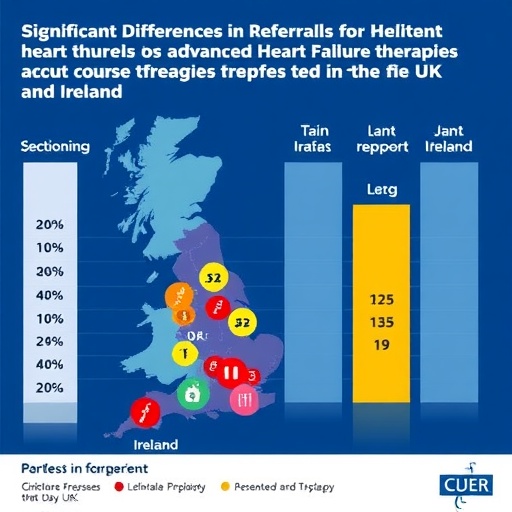
A landmark national audit conducted across the United Kingdom and Ireland has unveiled striking disparities in referral rates for advanced heart failure therapies, revealing a significant gap between patient needs and the provision of life-saving treatments. Published in the open access journal Open Heart, the 2024 National Advanced Heart Failure Audit Report represents the first comprehensive analysis of how patients with advanced heart failure access critical interventions such as heart transplants and left ventricular assist devices (LVADs). Despite the uniform burden of heart failure across regions, referral patterns exhibit marked regional variation, with no clear correlation to geographical location or indices of social deprivation.
Heart failure affects approximately one million individuals in the UK, with an estimated 200,000 new cases diagnosed annually. Of these, around 50,000 patients are classified as having advanced heart failure and are under 65 years old, thereby potentially qualifying for interventions aimed at prolonging survival and improving quality of life. Yet the audit’s findings reveal a stark underutilization of these therapies, with only slightly over 300 surgical interventions reported annually throughout the UK. This shortfall is alarming given the substantial morbidity and mortality associated with advanced heart failure, and underscores the urgent need for refined national strategies to bridge this service delivery gap.
The audit specifically scrutinized referral trends to the seven adult heart transplant centers spanning the UK and Ireland, focusing on patients referred for heart transplant or LVAD assessment within the first four months of 2024. The study employed a granular approach by stratifying referral regions based on rates per million population within the key eligibility age group of 16 to 69 years. This detailed regional analysis exposed dramatic disparities, with referral rates varying from below three per million to over thirty per million, after appropriate adjustment for the population’s age profile. Such heterogeneity suggests that local clinical practices and institutional referral cultures may play a more decisive role than demographic or socioeconomic factors.
One of the most concerning revelations of the audit is the persistent under-referral of women for advanced heart failure therapies. Women accounted for only approximately one-third of referrals, even though epidemiological data suggest a comparable disease burden between sexes. The underrepresentation of women hints at systemic biases or gaps in clinician awareness that disadvantage female patients, thus compounding health inequities. Addressing this gender disparity will require concerted efforts to standardize referral criteria, enhance clinician education, and raise public awareness about the eligibility and benefits of life-prolonging treatments for heart failure.
Further complicating the landscape is the finding that nearly one-third of patients referred for assessment were deemed unsuitable for advanced therapies at the point of evaluation. The primary reasons included modifiable contraindications such as poorly controlled diabetes, ongoing tobacco or alcohol use, and frailty. These factors highlight missed opportunities for earlier intervention and optimization of patient health prior to referral. They also underscore the critical importance of integrated care pathways that emphasize comprehensive management of comorbidities and lifestyle modification in patients with heart failure, optimizing their candidacy for advanced therapeutic modalities.
Importantly, the audit found no significant relationship between proximity to transplant centers and the likelihood of referral, nor did it observe an association with the level of deprivation as derived from patient postcode analyses. This finding challenges preconceived notions about access barriers rooted in geography or socioeconomic status and instead implicates elements intrinsic to healthcare delivery systems—such as clinician referral behavior, regional health service organization, and resource allocation—as key drivers of the observed disparities. Given that postcode-level socioeconomic data may imperfectly capture individual patient circumstances, the report acknowledges the need for deeper data granularity to fully elucidate underlying causes.
The report’s authors emphasize that the current findings reflect broader systemic issues, including a pronounced lack of standardization in specialist heart failure services across the UK and Ireland. While some regions demonstrate robust, well-resourced programs with streamlined referral pathways, others are characterized by fragmented or absent services, contributing to inconsistent patient experiences and outcomes. This uneven landscape poses challenges for national healthcare planning, necessitating coordinated policy frameworks that promote equitable access, workforce development, and resource distribution tailored to population needs.
Despite certain limitations—such as reliance on regional postcode data and incomplete capture of the full continuum of care—the audit sets a powerful precedent for ongoing surveillance and quality improvement in advanced heart failure management. The authors call for development and widespread adoption of standardized, co-produced referral criteria, enhanced educational initiatives targeting clinicians, and the fostering of collaborative networks that transcend national and devolved healthcare boundaries. Such strategies aim to ensure timely identification and optimal management of eligible patients, thereby maximizing therapeutic benefit and survival.
The clinical implications extend beyond mere referral counts. Given epidemiological estimates suggesting around 134,000 individuals in the UK may be living with advanced heart failure, many requiring specialist palliative care in addition to life-prolonging interventions, the audit highlights a vast unmet need within this patient population. Ensuring access to comprehensive, multidisciplinary care must be a central priority, integrating cardiology, palliative services, and community support to holistically address symptom burden, quality of life, and end-of-life planning.
Dr. Rajiv Sankaranarayanan of the British Cardiovascular Society encapsulates the urgency of these findings, emphasizing the ethical imperative to rectify inequities in access to advanced therapies. He advocates for national standardization of referral pathways and infrastructure enhancement to guarantee that potentially life-saving treatments are accessible regardless of geographical locale or patient sex. The report’s resounding message is a call to action: to align clinical practice with evidence-based standards and equity principles, thus transforming the landscape of advanced heart failure care in the UK and Ireland.
In sum, this first-of-its-kind national audit reveals profound inter-regional and demographic disparities in the referral and utilization of advanced heart failure therapies, illuminating critical areas for intervention. By addressing modifiable contraindications earlier in the disease course, standardizing referral practices, and expanding specialist service provision across regions, healthcare systems can improve prognosis and equity for this vulnerable patient group. The audit provides a foundational evidence base for future research, policy formulation, and clinical innovation aimed at optimizing outcomes for patients with advanced heart failure.
Cite Scienmag News
Courtney Benton. (June 2, 2026). Significant Differences in Referrals for Advanced Heart Failure Therapies Across the UK and Ireland. Scienmag. https://scienmag.com/significant-differences-in-referrals-for-advanced-heart-failure-therapies-across-the-uk-and-ireland/
Courtney Benton. "Significant Differences in Referrals for Advanced Heart Failure Therapies Across the UK and Ireland." Scienmag, 2 June 2026, https://scienmag.com/significant-differences-in-referrals-for-advanced-heart-failure-therapies-across-the-uk-and-ireland/. Accessed 3 September 2026.
Courtney Benton. "Significant Differences in Referrals for Advanced Heart Failure Therapies Across the UK and Ireland." Scienmag. June 2, 2026. https://scienmag.com/significant-differences-in-referrals-for-advanced-heart-failure-therapies-across-the-uk-and-ireland/


