


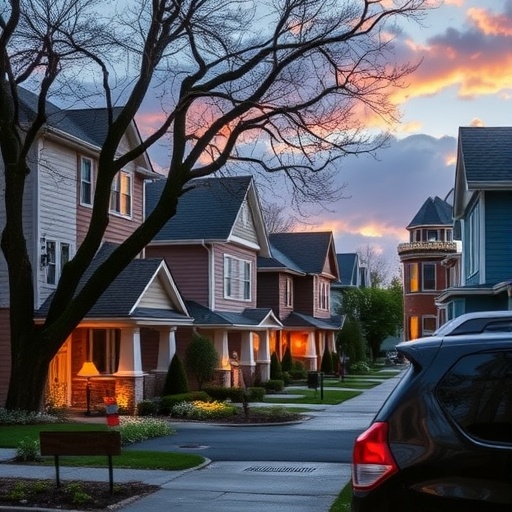
An ordinary walk down a city street may be doing more than guiding people from one destination to another. The arrangement of trees, buildings, sidewalks, traffic signs and open spaces could influence how safe residents feel—and, indirectly, how long and how well they sleep. That possibility has emerged from a new study in Tokyo in which researchers used artificial intelligence to examine more than 200,000 Google Street View images and connect the visual character of neighborhoods with the sleep health of more than 1,000 working adults.
The study, led by Professor Daisuke Matsushita of Osaka Metropolitan University’s Graduate School of Human Life and Ecology, focused on the largely overlooked relationship between the eye-level urban environment and human well-being. Rather than relying only on conventional measures such as population density, traffic volume or proximity to parks, the researchers examined what residents actually encounter when they look out onto their streets. Their findings suggest that the visual composition of a neighborhood may shape a person’s sense of safety, which was in turn associated with sleep duration and insomnia symptoms.
To analyze the urban landscape at a scale that would be impossible to manage manually, the team applied machine-learning techniques to Google Street View imagery. The AI performed semantic segmentation, a process that classifies individual pixels in an image according to the object they represent. Buildings, trees, roads, sidewalks, vehicles, pedestrians and traffic signs could therefore be identified and measured across a vast collection of images. This transformed ordinary street photographs into detailed, data-rich maps of the visual features surrounding residential areas.
The researchers then compared these objective streetscape measurements with survey responses from 1,089 working adults living in Tokyo. The participants lived on lower floors of apartment buildings, where views and conditions at street level were more likely to be directly relevant to their daily experience. They reported their sleep duration, insomnia symptoms and perceptions of neighborhood safety. Because the study was observational and cross-sectional, it cannot prove that a particular street feature causes better or worse sleep. However, it revealed consistent associations between the visual environment, perceived safety and sleep-related outcomes.
One of the clearest patterns involved greenery. Participants living in areas with more leafy trees tended to report longer sleep. Vegetation may contribute to a more restorative environment by making streets appear calmer and more attractive, while also potentially reducing visual harshness, heat and perceived noise. Greenery can affect psychological responses even when residents do not consciously focus on it. A tree-lined street may signal comfort and stability, helping the mind shift away from the vigilance and stimulation associated with a heavily built urban setting.
The study also identified an unexpected association with enclosure. Streets surrounded by relatively tall buildings and containing fewer broad, open spaces were linked to longer sleep and fewer insomnia symptoms. In urban design, enclosure describes the degree to which buildings and other vertical elements define the boundaries of a street. Although open views are often assumed to be inherently desirable, a moderate sense of enclosure may make a neighborhood feel more structured, sheltered and predictable. In the Tokyo settings examined, that visual organization appeared to be associated with a stronger sense of safety.
Walkability produced the most surprising result. Streets with more sidewalks and traffic signs—features commonly promoted as indicators of pedestrian-friendly design—were associated with lower perceived safety and shorter sleep duration. The finding does not mean that sidewalks or walkable neighborhoods are harmful. Instead, the researchers suggest that extensive pedestrian infrastructure may also mark areas that are busier, more crowded and used by larger numbers of strangers. For some residents, the constant movement and social exposure of such streets may feel less relaxing than a quieter residential environment.
This apparent contradiction highlights why urban health research cannot treat walkability as a single, universally beneficial characteristic. A street can be easy to navigate while still feeling noisy, exposed or unpredictable. The same infrastructure that encourages walking may coincide with heavier traffic, commercial activity or greater pedestrian density. By separating individual visual elements and examining how they relate to perceived safety, artificial-intelligence-assisted analysis could help planners understand why neighborhoods with similar amenities produce very different emotional responses.
The researchers believe the method could eventually be used to evaluate cities for more than sleep health. Large-scale analysis of street-level imagery might allow urban authorities to estimate patterns of perceived safety, beauty, liveliness and enclosure, as well as identify environmental conditions related to pollution and noise. Such information could support more targeted neighborhood design, particularly in dense cities where small changes to trees, building edges, pedestrian routes and street organization may influence everyday well-being. For now, the Tokyo study offers a provocative message: the streets people see every day may be quietly shaping the nights they spend asleep.
Web References: https://www.omu.ac.jp/en/ ; https://doi.org/10.1016/j.buildenv.2026.114711
References: Building and Environment, DOI: 10.1016/j.buildenv.2026.114711
Cite Scienmag News
Russell Cooper. (August 3, 2026). Neighborhood appearance and atmosphere may influence how well you sleep. Scienmag. https://scienmag.com/neighborhood-appearance-and-atmosphere-may-influence-how-well-you-sleep/
Russell Cooper. "Neighborhood appearance and atmosphere may influence how well you sleep." Scienmag, 3 August 2026, https://scienmag.com/neighborhood-appearance-and-atmosphere-may-influence-how-well-you-sleep/. Accessed 5 September 2026.
Russell Cooper. "Neighborhood appearance and atmosphere may influence how well you sleep." Scienmag. August 3, 2026. https://scienmag.com/neighborhood-appearance-and-atmosphere-may-influence-how-well-you-sleep/


