


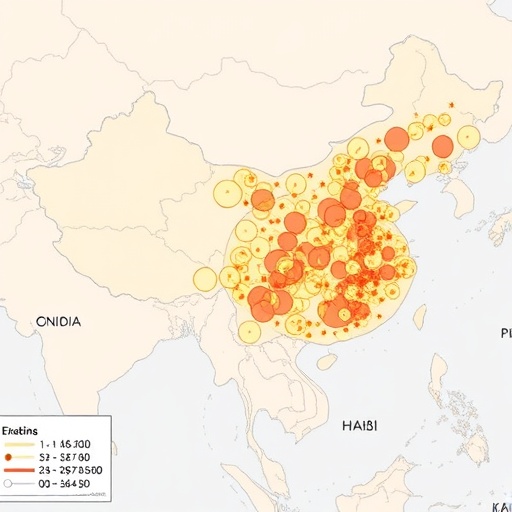
For decades, one of the most familiar ideas in migration science has been that distance acts like a brake. People are generally more likely to move between nearby cities than between cities separated by hundreds or thousands of kilometers, a pattern known as distance decay. Yet a new study of China’s intercity migration network suggests that this rule is far from uniform. Instead of following one simple national pattern, the strength and shape of distance decay can change dramatically from one part of the country to another, revealing a migration system shaped by geography, economics, infrastructure and regional history.
The research, published in npj Urban Sustainability by Y. Li, S. Chen, Y. Wang and colleagues, investigates what the authors describe as spatial heterogeneity in distance-decay patterns. In practical terms, the study asks a deceptively simple question: does distance influence migration in the same way everywhere? The answer appears to be no. A short journey may strongly favor nearby destinations in one region, while migrants in another region may routinely travel much farther because of employment opportunities, transportation links, administrative relationships or unequal access to urban services.
Distance decay is commonly represented through mathematical functions that describe how interaction declines as separation increases. In migration studies, researchers often use gravity-style models, in which the expected flow between two cities rises with the size or attractiveness of the cities and falls as distance increases. A basic formulation might express migration flow as proportional to the populations of two cities divided by a function of their distance. The exponent or decay parameter then indicates how sensitive movement is to geographical separation. A high decay rate means migration is concentrated among nearby cities; a low rate indicates that long-distance movement remains comparatively strong.
The Chinese case provides an unusually powerful setting for examining this process. China contains densely connected coastal megaregions, rapidly urbanizing inland corridors, mountainous borderlands and vast areas with very different levels of economic development. Its cities are tied together by high-speed rail, highways, air routes and digital platforms, but these connections are not distributed evenly. The result is a national migration network in which two city pairs separated by the same physical distance may face entirely different effective barriers to movement.
That distinction between physical and effective distance is central to understanding the study’s significance. A map may show two cities hundreds of kilometers apart, but travel time, ticket prices, transport frequency and direct connectivity determine how distant they feel to potential migrants. A well-served high-speed rail corridor can compress travel time and make a distant city more accessible than a closer destination separated by mountains or weak transport links. Economic distance also matters: a city with strong demand for workers, better wages or more attractive public services may draw migrants across long distances, overriding the tendency to remain close to home.
The study’s focus on spatial heterogeneity moves beyond the practice of applying a single distance-decay coefficient to an entire country. Such a national average can conceal important differences. In a highly connected urban cluster, migration may be dominated by short-range exchanges, including commuting, family relocation and movement between neighboring cities. In contrast, cities with specialized industries, major universities or national administrative importance may attract people from far away. Regional labor markets can therefore produce distinct migration signatures, even when they exist within the same national policy environment.
This matters because migration networks are not merely records of where people go. They are pathways through which labor, skills, money, information and social connections circulate. When a region attracts migrants from a wide geographic area, it may function as a national or regional hub. When flows remain strongly localized, the region may be more dependent on nearby cities and surrounding rural areas. Mapping these contrasting patterns can help researchers identify how urban systems are integrated, where economic opportunities are concentrated and which areas remain relatively isolated from broader networks.
The findings also challenge the idea that distance decay is a fixed law of human mobility. It is better understood as an emergent property of multiple systems operating at once. Demographic structure can influence who is willing or able to move. Housing costs can redirect migrants away from major centers toward nearby satellite cities. Hukou-related institutional arrangements, employment conditions and access to education or healthcare can alter the perceived benefits of relocation. Historical migration chains can further reduce the psychological and practical costs of long-distance movement by giving newcomers contacts and support in destination cities.
For urban planners and policymakers, recognizing this variability could improve forecasts of population change. Models that assume one uniform distance effect may underestimate long-distance migration toward strategic economic centers or overestimate movement between neighboring cities where barriers remain high. More localized models could support better planning for housing, transport, schools, hospitals and employment services. They could also reveal where infrastructure investment is likely to reshape migration most strongly by reducing travel time and connecting previously separated labor markets.
The broader message is both technical and human: migration does not simply decline with distance; it declines according to the geography of opportunity. China’s intercity network shows how roads and railways, regional economies, institutions and social ties can stretch or compress the map. By exposing the uneven geography hidden inside a familiar statistical pattern, the study offers a more realistic way to understand how cities exchange people. In an era of rapid urban transformation, that insight could help explain not only where migrants move today, but also how future networks of opportunity may form.
Cite Scienmag News
Courtney Benton. (August 1, 2026). Chinese Intercity Migration Network Reveals Why Migration Distance-Decay Varies Spatially. Scienmag. https://scienmag.com/chinese-intercity-migration-network-reveals-why-migration-distance-decay-varies-spatially/
Courtney Benton. "Chinese Intercity Migration Network Reveals Why Migration Distance-Decay Varies Spatially." Scienmag, 1 August 2026, https://scienmag.com/chinese-intercity-migration-network-reveals-why-migration-distance-decay-varies-spatially/. Accessed 3 September 2026.
Courtney Benton. "Chinese Intercity Migration Network Reveals Why Migration Distance-Decay Varies Spatially." Scienmag. August 1, 2026. https://scienmag.com/chinese-intercity-migration-network-reveals-why-migration-distance-decay-varies-spatially/


