


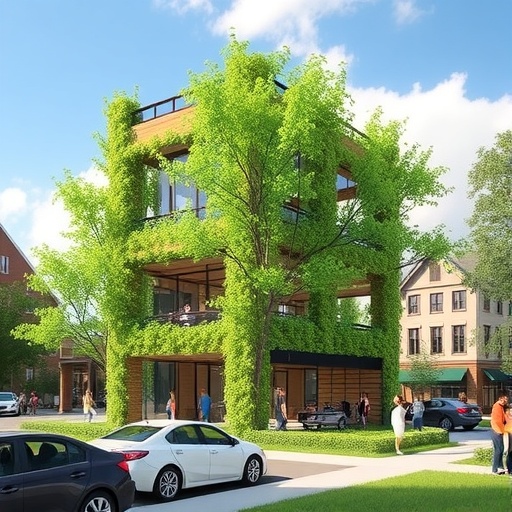
In the evolving struggle to harmonize urban development with environmental sustainability, a groundbreaking tool has emerged that promises to redefine how city planners and environmentalists approach urban landscaping. Researchers including Visintin, Kirk, Garrard, and colleagues have developed a novel vegetation assessment system designed to quantitatively compare the biodiversity potential of diverse urban landscaping designs. Published in npj Urban Sustainability in 2026, this innovative tool leverages ecological science and advanced modeling to offer unprecedented insights into how urban greenery can be optimized to support biodiversity, which in turn sustains ecosystem services critical to urban life.
Urban landscapes frequently suffer from a loss of biodiversity due to the dominance of non-native plant species and flashy but ecologically sterile designs that prioritize aesthetics over function. This newly developed tool confronts these challenges head on by enabling a detailed evaluation of different landscaping configurations, assessing not only the diversity of plant species but their potential to support local wildlife, promote ecological resilience, and deliver environmental benefits such as air purification and temperature regulation. It thus provides city planners with data-driven guidance that transcends traditional landscaping metrics which often neglect the biological richness of vegetation.
The heart of the tool lies in its sophisticated assessment framework, which integrates species-specific ecological traits with landscape-scale spatial analyses. By incorporating factors such as native plant prevalence, structural diversity (including canopy layering and ground cover complexity), and the presence of nectar and seed resources, the model simulates how various planting schemes can support diverse faunal groups. This approach addresses a critical gap in urban ecological planning by moving beyond simplistic species counts to a nuanced understanding of habitat quality and connectivity.
Key to the tool’s robustness is its adaptability across urban settings worldwide. It accounts for climatic variations, soil types, and urban matrix configurations, making it applicable to cities with widely differing ecosystems and urban structures. The tool employs a modular design that practitioners can tailor to local conditions, ensuring that recommendations are contextually relevant and that biodiversity potential is maximized according to specific regional ecological constraints and opportunities.
In developing this tool, the research team utilized extensive field data collected from multiple metropolitan areas, combining on-the-ground vegetation surveys with remote sensing and citizen science inputs. This comprehensive dataset enabled the creation of a predictive model that not only evaluates current biodiversity potential but also simulates the impacts of future landscaping interventions. Such predictive capabilities empower urban planners to prioritize designs that deliver tangible biodiversity improvements before green infrastructure is even implemented.
Moreover, the tool emphasizes the importance of native plant species in urban biodiversity conservation. By highlighting how native plants provide essential ecosystem services and support indigenous fauna, the tool advocates for landscaping designs that resist the homogenizing trend of ornamental exotics. This focus aligns with growing global awareness of the need to foster urban environments that preserve native biodiversity refuges amidst expanding urban sprawl.
Beyond its technical prowess, the tool is designed to be highly user-friendly, bridging the gap between ecological theory and practical application. A clear, graphical user interface allows stakeholders without specialized ecological training to input their landscaping parameters and receive immediate assessments of biodiversity potential, accompanied by actionable recommendations. This democratization of ecological expertise is poised to significantly accelerate the adoption of biodiversity-sensitive urban design principles.
The implications of this tool extend far beyond aesthetic improvements. Urban biodiversity underpins numerous ecosystem services vital for human well-being, including carbon sequestration, stormwater management, and the mitigation of heat island effects. By prioritizing vegetation designs that maximize these services, the tool contributes to broader sustainability goals, helping cities meet climate adaptation targets and improve residents’ quality of life.
Recent global surveys indicate that urban green spaces can act as biodiversity hotspots, but their conservation potential depends heavily on how they are designed and managed. This tool provides essential clarity on why certain landscaping strategies succeed or fail in supporting wildlife, supplying empirical evidence that policymakers and landscape architects can use to make informed decisions. Ultimately, it empowers cities to transition from green spaces that are merely decorative to dynamic, living ecosystems.
An exciting aspect of the tool’s development is its incorporation of machine learning algorithms that refine biodiversity predictions over time. As more cities adopt the tool and contribute data, it continuously learns from new environmental inputs, thereby improving accuracy and utility. This adaptive learning feature ensures the assessment remains state-of-the-art, responsive to emerging urban environmental challenges and innovations in landscaping practices.
Furthermore, the tool facilitates interdisciplinary collaboration by harmonizing inputs from ecologists, urban planners, landscape architects, and community stakeholders. Through its integrative framework, it enables diverse perspectives to converge on common goals, fostering collaborative strategies that balance ecological integrity with human needs. Such synergy is critical in creating livable, resilient urban spaces that thrive socially and environmentally.
Critically, the research underscores the need to reconsider conventional landscaping paradigms that have prioritized maintenance ease and immediate aesthetics at the expense of ecological functionality. The authors argue convincingly that urban sustainability hinges on embracing complexity—structural diversity and species richness—that this tool explicitly measures and promotes. It reframes urban vegetation as a multifunctional asset rather than a cosmetic afterthought.
As cities globally grapple with biodiversity loss amidst rapid urbanization, this assessment tool offers a timely and transformative resource. It equips decision-makers with the science-based means to design greener cities that not only look good but function as viable ecosystems supporting diverse organisms. Consequently, it marks a landmark advancement in the quest to integrate urban development with nature conservation.
Looking forward, the researchers envision expanding the tool’s applications to evaluate not only terrestrial vegetation but also aquatic and hybrid green infrastructures such as green roofs and bioswales. By extending its scope, the tool could help create a comprehensive urban ecological network, further enhancing connectivity and resilience. Such strategic deployment has the potential to transform urban centers into biological sanctuaries.
Ultimately, this new vegetation assessment tool exemplifies how technological innovation coupled with ecological understanding can solve some of today’s most pressing environmental challenges. It signals a paradigm shift in urban design—one where biodiversity gains prominence in planning processes, leading to healthier, more vibrant cities worldwide. The research thus stands as a beacon for future urban sustainability initiatives.
Cite Scienmag News
Margaret Porter. (May 13, 2026). New Tool Assesses Urban Landscaping Biodiversity Potential. Scienmag. https://scienmag.com/new-tool-assesses-urban-landscaping-biodiversity-potential/
Margaret Porter. "New Tool Assesses Urban Landscaping Biodiversity Potential." Scienmag, 13 May 2026, https://scienmag.com/new-tool-assesses-urban-landscaping-biodiversity-potential/. Accessed 3 September 2026.
Margaret Porter. "New Tool Assesses Urban Landscaping Biodiversity Potential." Scienmag. May 13, 2026. https://scienmag.com/new-tool-assesses-urban-landscaping-biodiversity-potential/


